PET-CT: What It Shows, Preparation and Report Terms
Reviewed by the LabReadAI medical team
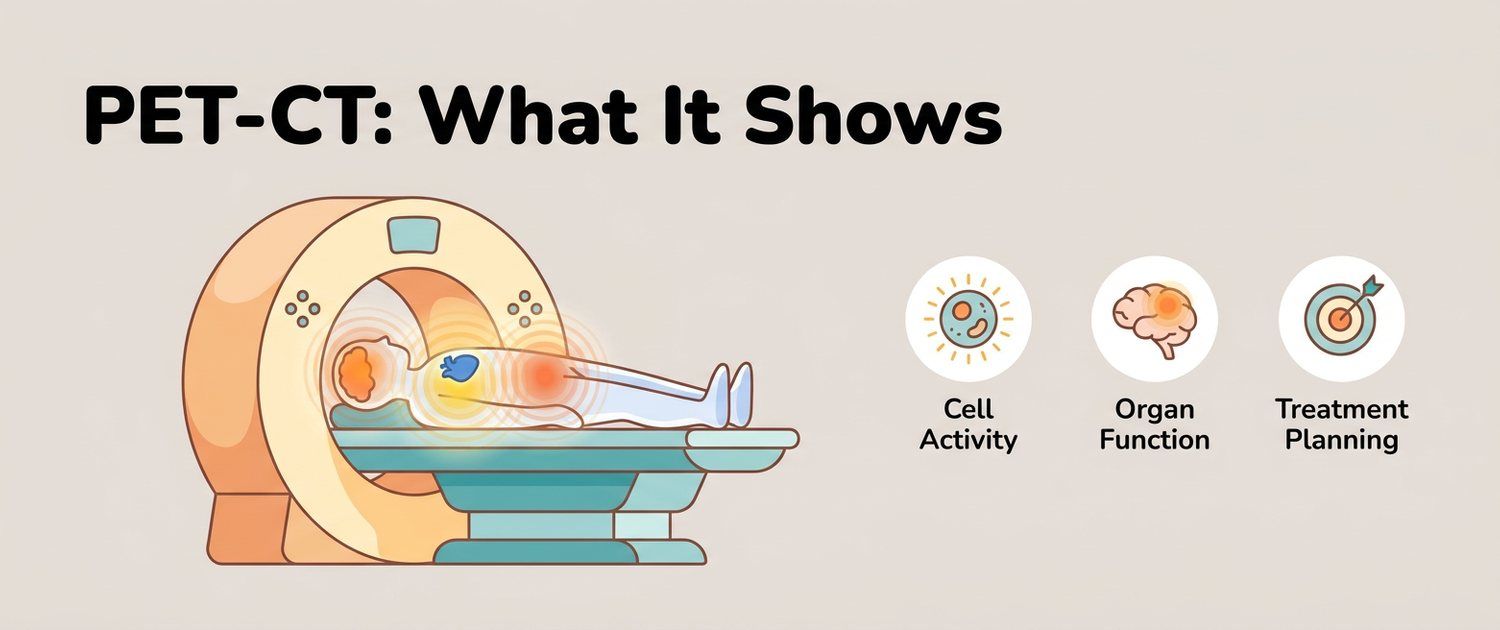
PET-CT sounds complicated, and a referral for it often frightens: if such a serious scan was ordered, does it mean things are bad? Not so. PET-CT is a powerful and accurate method that doctors use for various reasons, most often to understand the situation better, not to deliver bad news. Let's calmly sort out what PET-CT shows, why it is used in oncology, how to prepare and what the report terms mean.
What PET-CT Is and What It Shows
PET-CT is two scans in one. PET (positron emission tomography) shows not shape but the work of tissues: how actively they consume "fuel" — glucose. CT (computed tomography) gives precise anatomy — exactly where a focus is. Overlaying the images lets you see not only "where" but also "how active". So PET-CT is often more accurate than either method alone.
FDG and How Glucose Uptake Works
Most often the tracer FDG is used — this is labeled glucose. Tissues with high metabolism (and many tumors actively "eat" glucose) take up FDG more strongly and "light up" on the scan. It is important to understand: not only tumors take up glucose actively, but also inflammation, infection, healing tissue. So "uptake" is a signal to look into, not an automatic cancer diagnosis.
Why PET-CT in Oncology: Staging and Treatment Response
The main tasks of PET-CT in oncology are staging (how far the process has spread, whether there are foci elsewhere) and assessing treatment response (whether therapy is working). Less often the method helps find a source with an unclear picture or plan radiotherapy. The scan itself does not replace biopsy: a cancer diagnosis is ultimately confirmed by tissue examination, and how a tumor is detected overall is in the article on whether a blood test shows cancer.
How to Prepare for PET-CT
Preparation affects the quality of the scan. Usually you must come fasting (a few hours without food), with controlled blood glucose — a high sugar distorts the result. Before the scan and after the tracer is given, it is important to lie calmly at rest, without exertion or talking, so muscles do not "pull" the FDG onto themselves. Sometimes PET-CT is done with contrast. The clinic gives exact instructions — they must be followed.
How the Scan Goes and What "Whole Body" Means
After the tracer is given, you wait for it to distribute (usually about an hour), then the scanning itself is performed. PET-CT is often done "whole body" — from the base of the skull to the upper third of the thighs, so as not to miss distant foci. The scanning itself is painless; there is a radiation dose, but the scan is ordered when its benefit is justified. A broad view of imaging methods is in the articles on reading an MRI and chest X-ray.
What SUV and "Uptake" Mean in the Report
The report often has an SUV value — a numeric estimate of how actively tissue took up the tracer. A higher SUV means more active metabolism, but it is not a "malignancy scale": high values also occur with inflammation. The term "uptake" (or "hypermetabolic focus") describes an area of increased uptake. A doctor reads these numbers and words in the context of the whole picture. If a PET-CT report is confusing, you can upload the scan for decoding — the service explains the terms in plain language. The study usually comes on a disc: if its files won't open, see how to open an MRI or CT disc — though you don't need to open them for the interpretation.
What to Do with a PET-CT Result
Do not draw conclusions yourself from a single word "uptake". A PET-CT report is part of a picture that a doctor matches with other scans, tests and, if needed, a biopsy. Increased uptake may turn out to be inflammation rather than a tumor, and vice versa. Calmly discuss the result with your treating doctor — it is they who draw conclusions and decide the next steps, including with tumor markers if ordered.
This article is for informational purposes only and does not replace a doctor's consultation. A PET-CT report is interpreted by a specialist in the context of the whole clinical picture and other studies.
For informational purposes only
This article is for informational purposes only and does not constitute medical advice, diagnosis, or treatment. Please consult a healthcare professional for medical guidance.