Signs of Autism (ASD) in Children and Adults: How to Recognise
Reviewed by the LabReadAI medical team
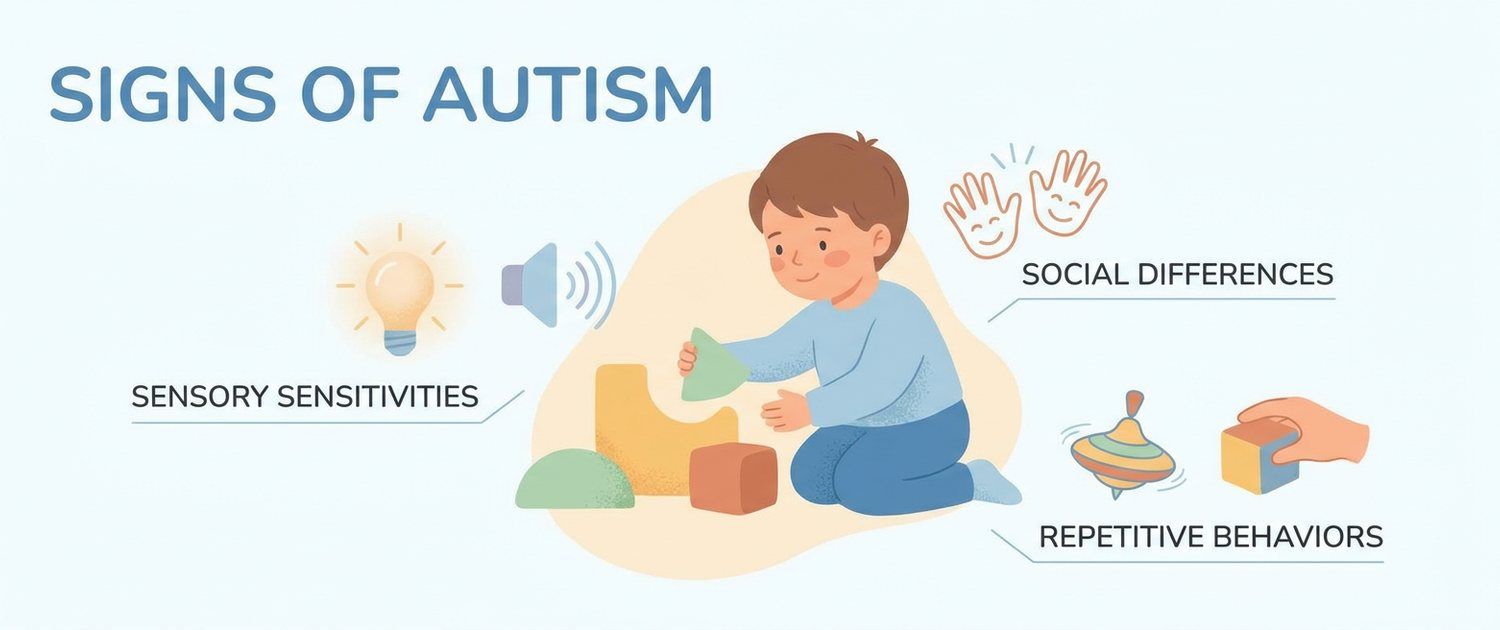
Autism (autism spectrum disorder, ASD) is a difference in how the nervous system develops, in which a person perceives the world, communicates and processes sensory signals differently. The word "spectrum" is key: presentations vary enormously — from clear difficulties with speech and self-care to subtle features in a person with high intelligence and a career. It isn't a disease to be "cured," and it isn't the result of parenting or vaccines; it's an inborn neurological difference you can live a full life with — all the more so the earlier it's recognised and supported.
What ASD is, in plain words
ASD is a stable set of features in two broad areas, present from early childhood and affecting daily life:
- Social communication and interaction — how a person makes contact, reads emotions and grasps the unspoken rules of communication.
- Repetitive behaviour and narrow interests — a need for predictability, rituals, deep absorption in topics, and heightened sensitivity to sounds, light, textures.
"Spectrum" means the mix and intensity of features are unique to each person. Outdated labels like "Asperger's syndrome" are today part of the single concept of ASD.
Signs of autism in children by age
Early signals are most often noticed by parents. No single sign means autism on its own — what matters is the combination and its persistence.
By 12 months:
- rarely responds to their name;
- little responsive smiling, limited eye contact;
- doesn't point or follow a pointing gesture.
By 18–24 months:
- no or very few words; regression — loss of words already acquired;
- no pretend play (feeding a doll, "phone" play);
- doesn't bring things to show and share enjoyment.
At 2–4 years and older:
- difficulty playing with other children, prefers playing alone;
- repetitive movements (hand-flapping, rocking), lining objects up;
- a rigid need for routine, strong distress at change;
- unusual responses to sounds, light, touch, tastes;
- echolalia — repeating phrases instead of answering.
If any of this is persistent, don't wait for them to "grow out of it" — see a paediatrician and a developmental specialist. Validated screening questionnaires exist for toddlers (for example, M-CHAT-R), administered by a professional.
Signs of autism in adults
Many adults only learn about ASD now — in childhood their features were put down to "personality." This is the group most often described with the word neurodivergence, and the most common co-occurring condition here is ADHD: how they differ is unpacked in ADHD or burnout, anxiety, depression. From the same place comes deep immersion in a narrow interest with a lost sense of time; the same mechanism seen from the attention side is covered in the piece on hyperfocus. Autism in adults can look like:
- difficulty with small talk, reading hints, sarcasm, unspoken expectations;
- socialising is draining; long recovery needed after social contact;
- strong attachment to routine, discomfort with unexpected change;
- deep, narrow interests that hold attention for a long time;
- sensory overload in noisy, bright places;
- "masking" — deliberately copying others' behaviour to seem "like everyone else" (a common reason for late recognition, especially in women).
In adults, ASD often comes with anxiety, depression or ADHD traits — worth assessing together.
Myths about autism
- "Autism is caused by vaccines." No. This has been disproven repeatedly and robustly.
- "Autistic people don't feel emotions." They do — often intensely; the difficulty is reading and expressing emotions in the socially expected way.
- "It's bad parenting." No; ASD is an inborn neurological difference.
- "Autism can be outgrown or cured with a pill." No; but building skills and support radically change quality of life.
When to see a specialist
It's worth seeing a paediatrician, neurologist, psychiatrist or clinical psychologist if:
- a child persistently shows the signs above or there's been a regression in speech/skills;
- an adult recognises themselves in the description and it interferes with work, relationships or wellbeing;
- there is accompanying anxiety, depression, or burnout from constant "masking."
An ASD diagnosis is made not by a single test but through observation, interview and standardised assessment. Online materials and screens are a reason to see a specialist, not a conclusion. Early support (building communication, an environment without overload, addressing accompanying conditions) genuinely improves life at any age.
This article is for information only and does not replace a specialist's consultation. It does not diagnose and does not replace an in-person assessment.
For informational purposes only
This article is for informational purposes only and does not constitute medical advice, diagnosis, or treatment. Please consult a healthcare professional for medical guidance.