Signs of Schizophrenia: Early Symptoms and What It Is
Reviewed by the LabReadAI medical team
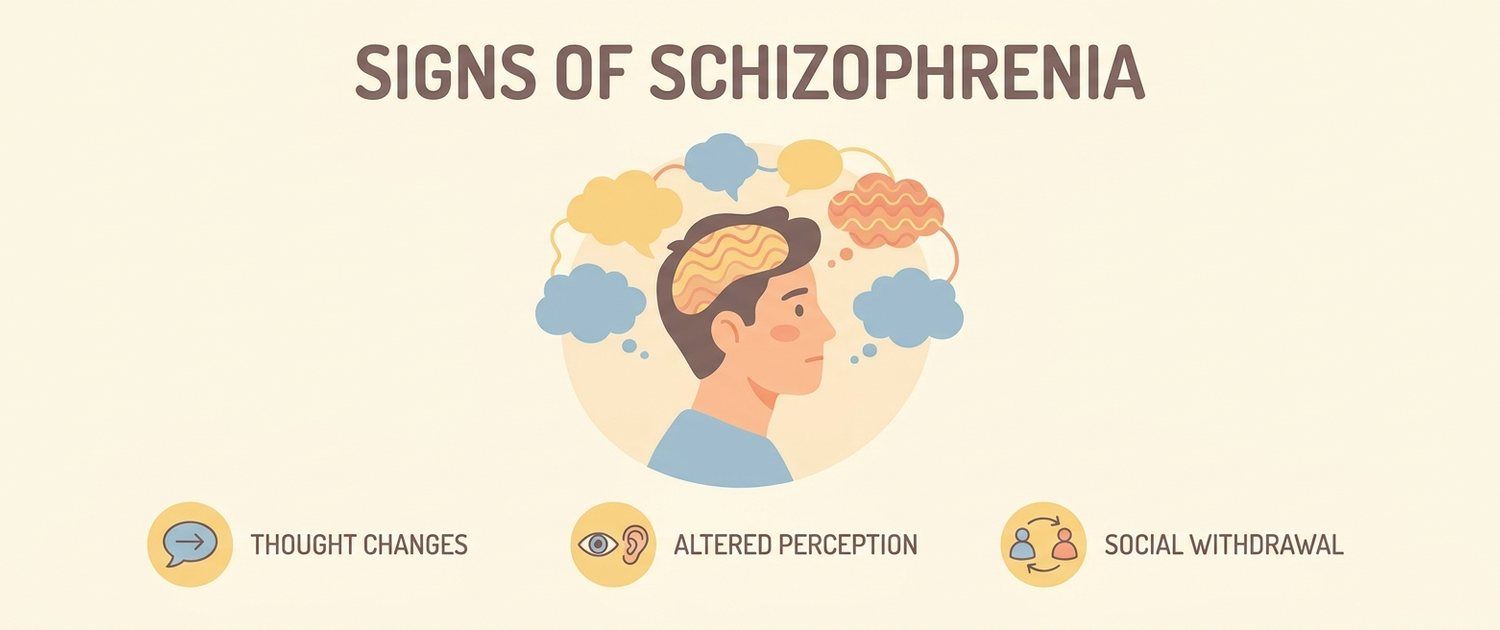
Schizophrenia is a chronic mental disorder in which the link between thinking, perception, emotions and behaviour and reality breaks down. A person may hear voices, believe things that aren't real, and lose the ability to carry on ordinary activities. There's a lot of fear and myth around the diagnosis, but at its core it's a brain illness that is treatable: with early treatment a substantial proportion of people return to study, work and relationships. The key is recognising the signals in time and not confusing them with other causes.
What schizophrenia is, in plain words
The simplest way to picture schizophrenia is a breakdown in the brain's "filters": it starts assigning meaning to the random, confuses internal signals with external ones, and loses coherence of thought. It is not "split personality" (a common myth) and not weakness of character. The illness usually appears in adolescence or young adulthood (most often 15–35), often earlier in men than in women.
Symptoms of schizophrenia
Features are conventionally divided into three groups:
Positive symptoms (something appears that isn't normally there):
- Delusions — fixed false beliefs (of persecution, special mission, being controlled) not open to reasoning.
- Hallucinations — most often "voices" that comment or command.
- Disorganised thinking and speech — jumping between ideas, incoherence, "word salad."
Negative symptoms (something that was there fades):
- flattened emotion, poverty of facial expression and speech;
- apathy, loss of motivation, self-care becomes hard;
- withdrawal from contact, anhedonia — loss of pleasure.
Cognitive symptoms:
- difficulty with attention, memory, planning and decision-making.
Early signs of schizophrenia
Before the full picture there's often a prodromal period — months of non-specific change that's easy to dismiss as adolescence or stress:
- growing withdrawal, pulling away from friends and family;
- dropping performance at school or work;
- odd, "magical" ideas, suspiciousness;
- a sense of being watched or that thoughts are "being read";
- sleep problems, anxiety, emotional coldness;
- neglect of daily life and appearance.
No single sign equals a diagnosis. What should raise concern is a steady, escalating change in behaviour, especially in an adolescent or young adult.
Types of schizophrenia
Modern classifications move away from rigid subtypes, but in everyday use and older schemes you'll see:
- Paranoid — delusions and hallucinations predominate (the most familiar image of the illness).
- Disorganised — thought and behaviour disturbance is at the forefront.
- Catatonic — motor disturbances (immobility or agitation).
- Simple/negative — a gradual build-up of apathy and flattening without vivid hallucinations.
What to rule out
Psychosis-like states aren't caused only by schizophrenia. Before drawing conclusions, a doctor rules out organic and reversible causes:
- severe hypothyroidism or other endocrine problems (TSH, thyroid panel);
- marked vitamin B12 deficiency;
- effects of psychoactive substances and certain medications;
- neurological disease, infections, autoimmune encephalitis.
These tests don't "detect schizophrenia" (there's no lab test for it) — they help avoid missing a treatable cause of psychotic symptoms. If you already have results, our service can read them in plain language.
When to seek help
See a psychiatrist if a person develops persistent odd beliefs, "voices," marked withdrawal and a breakdown of ordinary life. Remember: the earlier treatment starts, the better the outcome.
Urgent help is needed immediately if there is:
- thoughts or talk of self-harm or of harming others;
- command voices ordering actions;
- acute agitation, disorientation or dangerous behaviour.
If you're outside Russia, contact your local emergency number or a crisis line. In an immediate life-threatening situation, call emergency services.
This article is for information only and does not replace a psychiatrist's consultation. Only a doctor makes the diagnosis; modern treatment lets many people live full lives.
For informational purposes only
This article is for informational purposes only and does not constitute medical advice, diagnosis, or treatment. Please consult a healthcare professional for medical guidance.