Vitamin B12: Blood Levels, Deficiency Symptoms and Causes
Reviewed by the LabReadAI medical team
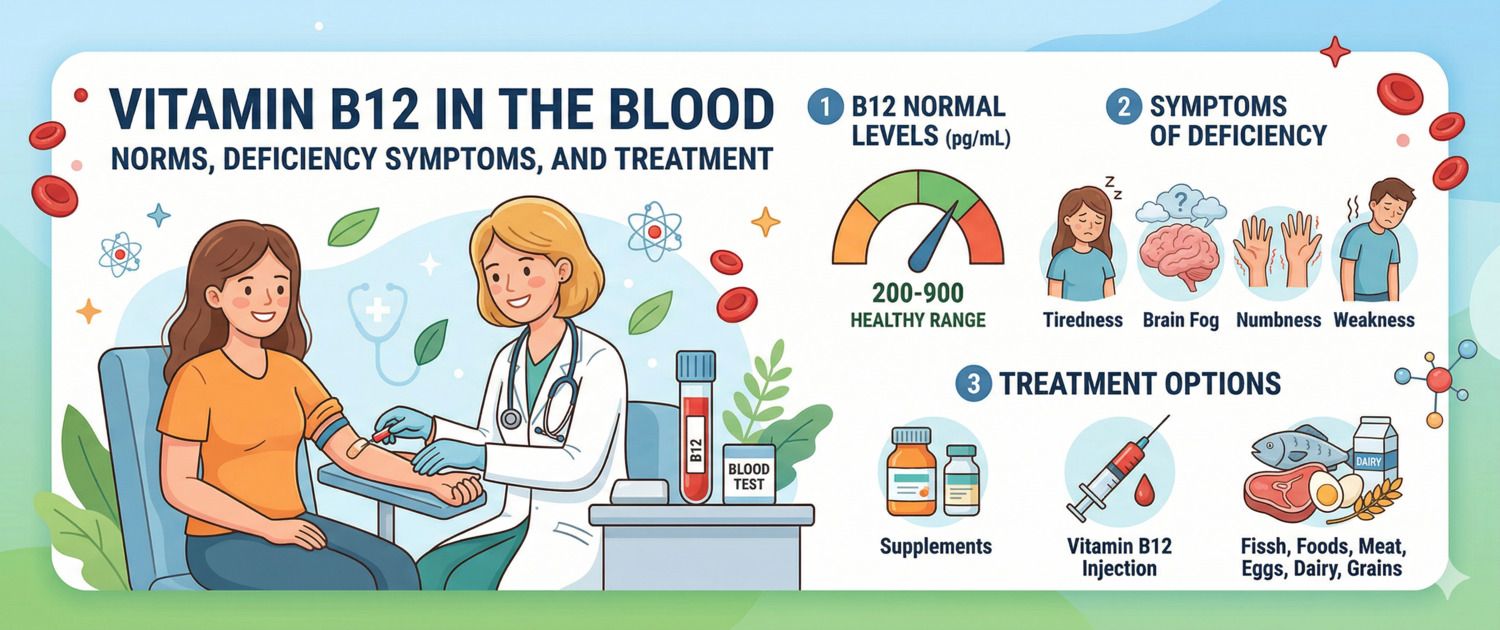
Fatigue, tingling in the hands and feet, persistent forgetfulness — these symptoms are easy to blame on stress or poor sleep. Yet behind them, surprisingly often, lies vitamin B12 deficiency: a condition that develops slowly over years and leaves irreversible damage in the nervous system if it goes undetected. A complete blood count is usually the first clue — enlarged red blood cells and falling haemoglobin — but confirmation requires a direct measurement of serum B12. This article explains what makes B12 irreplaceable, what normal and abnormal results look like, and what to do when deficiency is confirmed.
What Is Vitamin B12 and What Does It Do?
Vitamin B12, or cobalamin, is a water-soluble vitamin the body cannot synthesise on its own. It is obtained exclusively from animal-source foods: meat, fish, eggs, and dairy. In the stomach lining, a protein called intrinsic factor is produced — without it, B12 simply cannot be absorbed in the small intestine. This makes the journey from plate to cell unusually long and vulnerable.
What B12 does at the cellular level:
- DNA synthesis — B12 is a cofactor for an enzyme essential for cell division. Rapidly dividing cells — primarily blood cells and mucosal epithelium — are the first to suffer.
- Myelin sheath formation — the vitamin participates in myelin synthesis, the protective coating around nerve fibres. Without it, nerve conduction becomes impaired, producing neurological symptoms.
- Homocysteine conversion — B12 is required to convert homocysteine into methionine. Deficiency leads to homocysteine accumulation — an independent risk factor for cardiovascular disease.
- Haematopoiesis — together with folate, B12 ensures normal maturation of red blood cell precursors in the bone marrow.
The body's hepatic reserves are substantial — 2–5 mg — sufficient to sustain normal function for three to five years after intake completely stops. This is precisely why deficiency develops silently and goes unnoticed for so long.
How to Get Tested: Preparation and What Is Measured
Vitamin B12 is measured in serum using immunoassay or chemiluminescence methods. Functional deficiency markers — methylmalonic acid (MMA) and homocysteine — may also be ordered: they rise before serum B12 falls, revealing tissue-level deficiency when serum values are borderline.
Preparation guidelines:
- Blood is drawn fasting in the morning — no food for at least 8–12 hours.
- Avoid alcohol and intense exercise for 24 hours.
- B12 supplements must be stopped 1–2 weeks before the test — otherwise the result will appear falsely normal while tissue deficiency persists.
- High-dose biotin interferes with immunoassay methods — discontinue 48 hours before the draw.
- Metformin reduces intestinal B12 absorption: patients on long-term therapy should check their level every one to two years.
For a complete anaemia workup, B12 results are interpreted alongside MCV and the full blood count: enlarged red blood cells (macrocytosis) with low B12 immediately point to a megaloblastic pattern.
Vitamin B12 Normal Range: Table by Age and Group
Reference ranges vary by analytical method and laboratory. The values below are approximate — always check the reference range on your own report.
| Category | Normal (pmol/L) | Normal (pg/mL) |
|---|---|---|
| Adults | 148–664 | 200–900 |
| Elderly (> 65 years) | 148–664 | 200–900 |
| Pregnant women | 118–438 | 160–600 |
| Infants under 1 year | 216–935 | 293–1268 |
| Children 1–12 years | 185–779 | 251–1056 |
| Adolescents | 148–664 | 200–900 |
Interpretation zones for adults:
- > 300 pmol/L (> 406 pg/mL) — sufficient; deficiency unlikely
- 148–300 pmol/L (200–406 pg/mL) — grey zone: tissue deficiency is possible even with a normal serum level; homocysteine and MMA should be assessed
- < 148 pmol/L (< 200 pg/mL) — vitamin B12 deficiency requiring treatment
In older adults, functional deficiency frequently develops at "normal" serum levels due to declining transcobalamin-II — the transport protein that delivers B12 into cells. This is another reason to rely on homocysteine rather than the raw serum value alone when clinical suspicion is high.
Symptoms and Causes of Vitamin B12 Deficiency
B12 deficiency mimics dozens of other conditions — which is what makes it clinically deceptive. Symptoms fall into haematological, neurological, and psychiatric categories.
Haematological symptoms:
- Weakness, shortness of breath on exertion, pallor — signs of anaemia
- Burning and soreness of the tongue (Hunner's glossitis)
- Slight yellowish skin tint from mild haemolysis
Neurological symptoms (appear with prolonged deficiency):
- Tingling, numbness, "pins and needles" in hands and feet
- Impaired coordination, unsteady gait
- Leg weakness
- In severe cases — subacute combined degeneration of the spinal cord
Cognitive and psychiatric symptoms:
- Impaired memory and concentration
- Depression and irritability
- In older adults — a clinical picture that can mimic dementia
An important caveat: neurological damage may be irreversible if deficiency goes untreated for a prolonged period. B12-deficiency anaemia responds well to treatment; neuropathy responds much less reliably.
Causes fall into dietary and absorptive categories:
- Insufficient intake — vegan and strict vegetarian diets without B12 supplementation. With an extremely restricted diet that excludes both animal products and fresh produce, vitamin C is depleted simultaneously: in this setting, scurvy can develop as a co-occurring manifestation of combined nutritional depletion
- Atrophic gastritis — reduced or absent intrinsic factor secretion; the most common cause in older adults
- Pernicious anaemia — autoimmune destruction of gastric parietal cells, completely blocking absorption
- Gastric surgery — gastrectomy, bariatric procedures
- Small bowel disease — Crohn's disease, coeliac disease, small intestinal bacterial overgrowth
- Long-term metformin use — reduces B12 absorption in the ileum
- Proton pump inhibitors taken for more than two years
Megaloblastic Anaemia: How B12 Deficiency Changes the Blood Count
The classic laboratory portrait of B12-deficiency anaemia is distinctive and immediately recognisable.
Haemoglobin is reduced — below 120 g/L in women, below 130 g/L in men. But the hallmark is the size of the red blood cells. B12 deficiency impairs DNA synthesis in erythroid precursors: they cannot divide normally and grow large and immature — megaloblasts. In peripheral blood this appears as macrocytosis: MCV exceeds 100 fL, often reaching 110–120 fL.
Simultaneously, the blood smear shows hypersegmented neutrophils — their nuclei contain five or more lobes instead of the normal two to three. This is a pathognomonic sign of megaloblastic haematopoiesis.
In severe deficiency, all three cell lines are affected: pancytopenia develops — a simultaneous fall in red cells, white cells, and platelets. Ferritin in B12-deficiency anaemia is often normal or elevated — unlike iron deficiency anaemia, where it is reduced. This is a key differential diagnostic point when deciding on treatment. For the complete clinical picture, diagnostic criteria and treatment approach, see the dedicated article on megaloblastic anaemia.
High Vitamin B12: When It Is a Warning Sign
Finding excess B12 in the serum is surprising for most patients — after all, "a vitamin can't be harmful." In fact, it can be a signal worth investigating.
Physiological reasons for high B12 (not dangerous):
- Supplementation or high-dose injectable B12
- Diet very rich in animal products
Pathological causes requiring investigation:
- Liver disease — cirrhosis, acute hepatitis, fatty liver disease. Damaged hepatocytes release stored B12 into the circulation.
- Myeloproliferative disorders — chronic myelogenous leukaemia, polycythemia vera, myelofibrosis. Tumour cells produce excessive amounts of B12 transport proteins.
- Solid tumours — breast, colorectal, and gastric cancer.
Persistently unexplained B12 above 1000 pmol/L without supplement use warrants oncological screening and liver function evaluation. Hypervitaminosis from oral supplements does not cause toxicity — excess is excreted in urine. However, supplementation can mask a pathologically elevated level of clinical significance.
When Results Require Urgent Medical Attention
Mild deficiency without pronounced symptoms calls for a scheduled appointment. Several situations require prompt evaluation:
- B12 below 100 pmol/L — severe deficiency, regardless of how the person feels
- Neurological symptoms: unsteady gait, limb numbness, weakness — even with borderline B12
- Haemoglobin below 80 g/L combined with macrocytosis
- Pancytopenia — simultaneous decline in all three blood cell lines
- Cognitive impairment or new depression in an older person with low B12
- Persistently elevated B12 without an obvious cause — rule out malignancy and liver disease
Treatment depends on the underlying cause. For dietary deficiency, oral supplementation is sufficient. For absorption failure (atrophic gastritis, pernicious anaemia, gastrectomy), intramuscular injections of cyanocobalamin or hydroxocobalamin are required — the oral route does not work when intrinsic factor is absent.
Conclusion
Vitamin B12 is one of those deficiencies that is easy to miss but difficult to correct once neurological damage has taken hold. A normal serum level does not always mean adequate tissue supply — in borderline cases, homocysteine and MMA provide the missing piece of the picture. High-risk groups — vegans, older adults, post-gastric surgery patients, and long-term metformin users — should check their B12 at least annually. Treatment at any stage reverses the anaemia completely, but neurological recovery depends heavily on how early therapy begins.
This content is for informational purposes only and does not replace professional medical advice.
For informational purposes only
This article is for informational purposes only and does not constitute medical advice, diagnosis, or treatment. Please consult a healthcare professional for medical guidance.