Iron Panel: Ferritin, Serum Iron and TIBC — Normal Ranges
Reviewed by the LabReadAI medical team
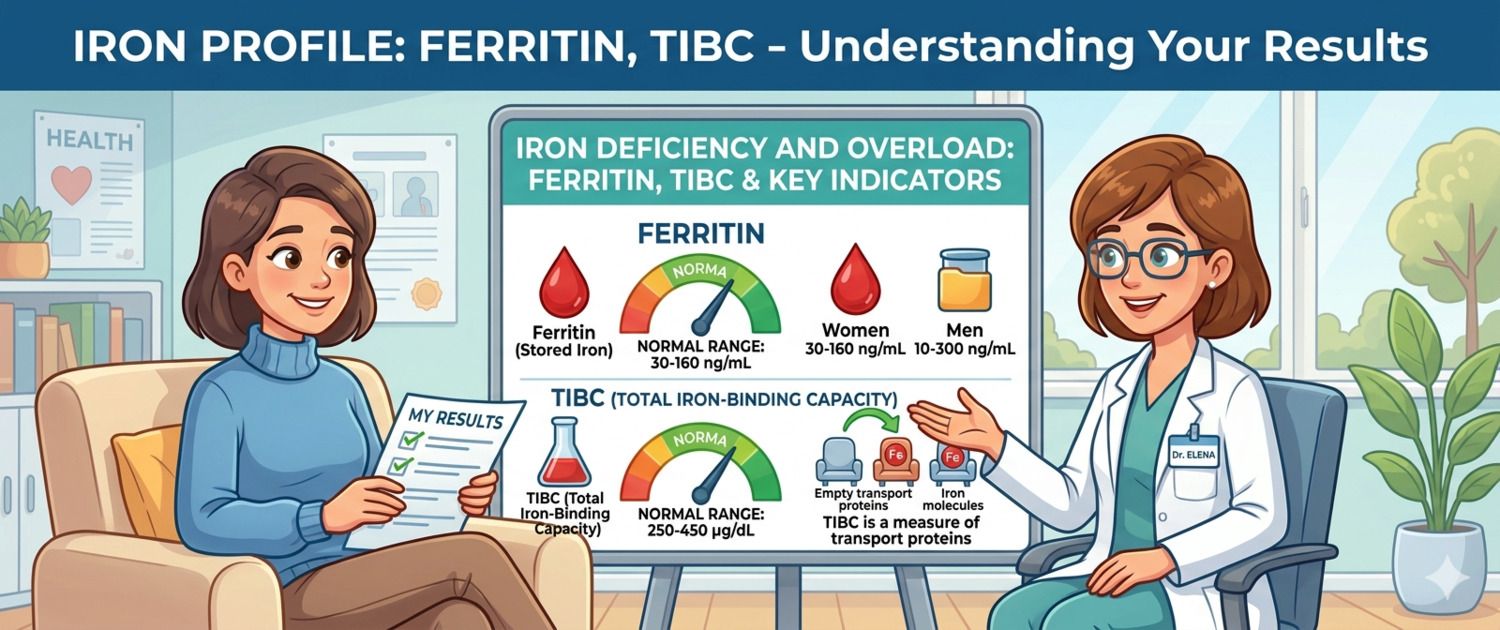
You got a complete blood count — hemoglobin is normal, but you're exhausted, your hair is falling out, and your nails keep breaking. Or the CBC already shows low hemoglobin and your doctor wants to find the cause. Either way, the next step is the iron panel: ferritin, serum iron, and TIBC. Here's what each value means and how to read them together.
Why You Need the Iron Panel if You Already Have a CBC
A CBC shows the consequence of iron deficiency — low hemoglobin and reduced red blood cells. The iron panel shows the cause and the stores — and catches the problem earlier.
Iron deficiency develops in stages. First, stores are depleted: ferritin drops, but hemoglobin is still normal. The person feels tired, loses hair — yet the CBC looks clean. Then iron transport fails: TIBC rises, transferrin saturation drops. Only at the third stage does iron-deficiency anemia appear in the CBC.
A full iron panel detects the problem at the first two stages — before anemia has developed. That's why doctors order it when someone feels drained with a "normal" CBC.
How to Prepare for the Test
The iron panel is one of the most preparation-sensitive blood tests. Mistakes in collection cause false results more often than with most other tests.
- Strictly fasting, in the morning. Serum iron can rise 2–3× after eating — the result will appear falsely normal.
- Stop iron supplements 5–7 days before. Even a single dose the night before makes the result unreliable.
- Don't test during menstruation — iron levels will be falsely low.
- Avoid alcohol and intense exercise for 48 hours beforehand.
- Tell your doctor about hormonal medications, antibiotics, and oral contraceptives — they affect ferritin and transferrin levels.
Ferritin — The Primary Marker of Iron Stores
Ferritin is a storage protein that holds iron inside cells as a reserve. Its blood level directly reflects the body's total iron stores. It is the earliest and most sensitive marker of iron deficiency.
Normal ferritin ranges:
| Group | Normal (µg/L) |
|---|---|
| Men | 30–300 |
| Women | 12–150 |
| Pregnant | 12–60 |
A value below normal is the first sign of depleted stores — even with a normal hemoglobin. This is latent iron deficiency: reserves are exhausted, no anemia yet — but the person already feels fatigue, hair loss, and cold intolerance.
Key caveat: ferritin is an acute-phase protein. Any inflammation, infection, liver disease, or malignancy raises ferritin independently of iron stores. A ferritin of 80 µg/L during active inflammation may conceal a true deficiency. That's why ferritin must always be interpreted together with TIBC and transferrin saturation — never in isolation.
Serum Iron, TIBC and Transferrin Saturation
Three values that work as a system. Each one alone is unreliable; together they tell the full story. MCV also helps classify the type of anaemia once it has developed.
Serum iron — how much iron is currently circulating in the blood bound to transferrin. Normal: men 11.6–31.3 µmol/L, women 9.0–30.4 µmol/L. This value is unstable: it shifts after meals, with stress, and throughout the day. It must be read alongside TIBC.
TIBC (total iron-binding capacity) — the maximum amount of iron transferrin can carry. Normal: 45–75 µmol/L. Think of transferrin as a bus: TIBC is how many passengers (iron molecules) it can hold. When iron is scarce, transferrin goes "hungry" — TIBC rises. In inflammation or liver disease — it falls.
Transferrin saturation (TSAT) = serum iron ÷ TIBC × 100%. Normal: 20–45%. Below 16% means not enough iron is reaching the bone marrow for hemoglobin synthesis — even if hemoglobin hasn't dropped yet.
How to Read the Results: Interpretation Table
The combination of all values distinguishes conditions that look similar on a CBC:
| Condition | Ferritin | Serum iron | TIBC | TSAT |
|---|---|---|---|---|
| Normal | N | N | N | 20–45% |
| Latent iron deficiency | ↓ | N | ↑ | N or ↓ |
| Iron-deficiency anemia | ↓↓ | ↓ | ↑↑ | ↓↓ |
| Anemia of chronic disease | N or ↑ | ↓ | ↓ or N | ↓ |
| Hemochromatosis | ↑↑ | ↑ | ↓ | ↑↑ |
This table is most critical for separating iron-deficiency anemia from anemia of chronic disease — they can look almost identical in a CBC but require completely different treatment. IDA needs iron supplementation; anemia of chronic disease needs treatment of the underlying condition.
When Is the Iron Panel Ordered
- Low hemoglobin on CBC — to find the cause of anemia
- Chronic fatigue, hair loss, brittle nails with a normal CBC
- Pregnancy planning and pregnancy — iron deficiency in pregnancy carries serious risks
- Heavy menstrual bleeding or chronic gastrointestinal blood loss
- Monitoring iron supplementation (retest 4–8 weeks after starting treatment)
- Before surgery when anemia is suspected
When to See a Doctor
Routine visit — when ferritin is below normal or TSAT is below 16% with symptoms. Treatment usually involves iron supplementation with a follow-up test in 4–8 weeks.
Urgently — if ferritin exceeds 500 µg/L without obvious inflammation or acute infection: hemochromatosis, liver disease, and malignancy must be ruled out.
Don't self-prescribe iron supplements. When ferritin is normal, they provide no benefit — and chronic iron excess is toxic to the liver and heart. The type, dose, and duration of treatment are determined by a doctor based on the cause of the deficiency.
Conclusion
An iron panel isn't just "checking iron." It's three interconnected values that together paint a complete picture: is there a deficiency, how far along is it, and what's causing it. It's especially valuable when a CBC still looks normal — but the person already feels something is wrong.
Interpreting an iron panel requires looking at all values together in the context of the clinical picture. A single low ferritin during active inflammation is not a diagnosis. Only a doctor can interpret these results correctly.
For informational purposes only
This article is for informational purposes only and does not constitute medical advice, diagnosis, or treatment. Please consult a healthcare professional for medical guidance.