ESR Blood Test: Normal Range by Age and Sex Explained
Reviewed by the LabReadAI medical team
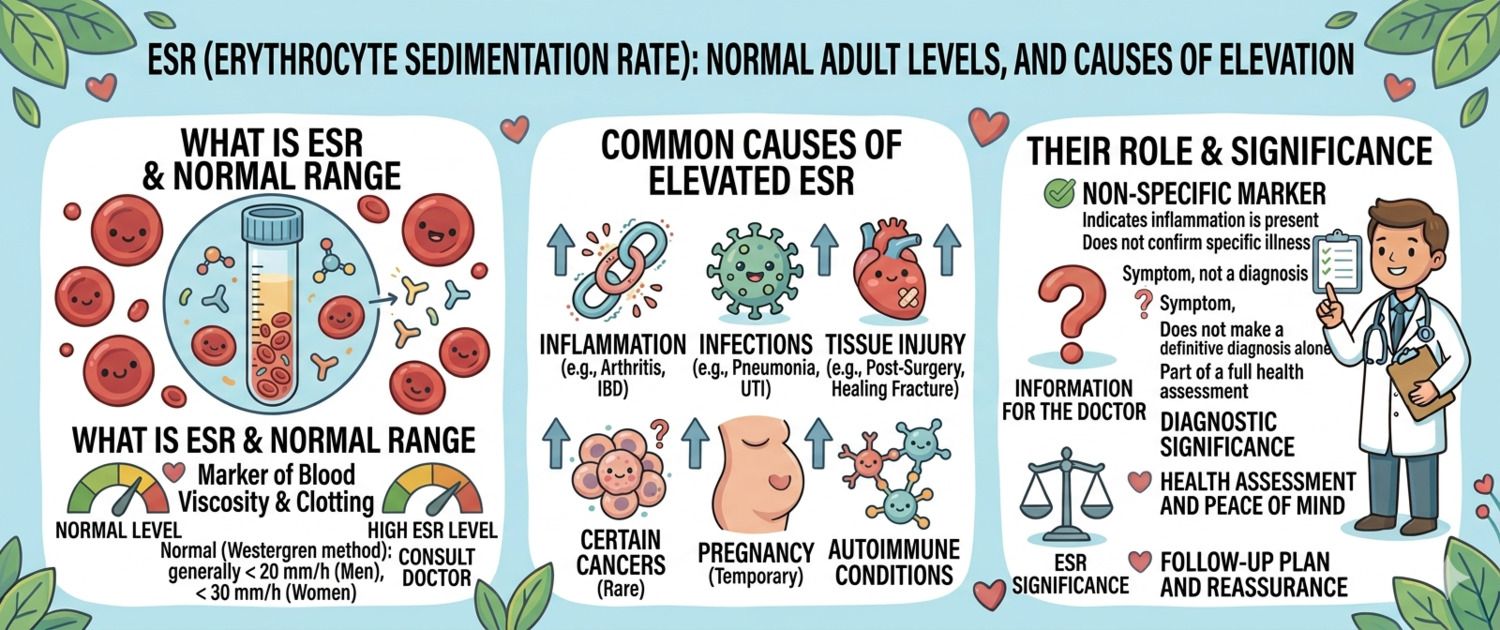
In a complete blood count, ESR stands apart: it's the only value that doesn't count cells or measure proteins. It simply watches how fast red blood cells settle. And that simplicity makes it both useful and tricky — ESR responds to almost everything but points to nothing precisely. Here's what this value means, how to read it correctly, and when elevated ESR actually requires action.
What Is ESR and How Is It Measured
ESR (erythrocyte sedimentation rate) measures how quickly red blood cells settle to the bottom of a test tube in one hour. Normally they settle slowly — they carry a negative charge and repel each other. During inflammation, acute-phase proteins accumulate in the blood: fibrinogen, immunoglobulins, C-reactive protein. They neutralize the cells' charge, causing them to clump into "coin stacks" and settle faster.
The standard method is Westergren (international standard). The result is expressed in mm/h. No strict fasting is required, but the test is best done in the morning under standard conditions — no intense exercise or acute stress the day before.
Normal ESR in Adults
| Group | Normal (mm/h) |
|---|---|
| Men under 50 | up to 15 |
| Men over 50 | up to 20 |
| Women under 50 | up to 20 |
| Women over 50 | up to 30 |
| Pregnant (3rd trimester) | up to 45 |
Normal ESR values rise with age — this is physiological. In pregnancy, ESR is elevated due to changes in blood protein composition and the physiological rise in fibrinogen — this is normal and requires no investigation.
Normal ESR in Children by Age
Children's ranges are lower than adults' and depend on age. The ranges are approximate — methods (Panchenkov vs Westergren) and labs differ:
| Age | Normal (mm/h) |
|---|---|
| Newborns | 0–2 |
| Under 6 months | 2–10 |
| 6 months – 5 years | 5–11 |
| 6–14 years | 4–12 |
| Adolescents | girls 2–15, boys 1–10 |
In children ESR is just as nonspecific as in adults: it rises after any infection and stays elevated for another 2–4 weeks after recovery — a "tail" after a cold is a reason to retest later, not to panic. A child's ESR only makes sense read together with the rest of the report and age-specific ranges — you can upload it and get every marker explained on the child lab test decoding page.
Causes of Elevated ESR
ESR responds to any change in blood protein composition without pointing to a specific cause. This makes it sensitive but non-specific.
Infections
Bacterial infections (pneumonia, pyelonephritis, tuberculosis, endocarditis) raise ESR significantly and quickly — often above 40–60 mm/h. Viral infections produce a moderate response or leave ESR normal. High ESR combined with elevated WBC and a left shift is the classic picture of acute bacterial infection.
Autoimmune and rheumatic diseases
Rheumatoid arthritis, systemic lupus erythematosus, systemic vasculitis, polymyalgia rheumatica — ESR can be persistently high (60–100+ mm/h). Here ESR is used to track disease activity and treatment response.
Anemia
When hemoglobin is low, fewer red blood cells are present to slow sedimentation through their charge. ESR rises mechanically, without any connection to inflammation. Important to remember: high ESR in the setting of anemia is not a reason to look for hidden inflammation.
Malignancies
Especially multiple myeloma and lymphomas — ESR can exceed 100 mm/h. But ESR is not a tumor marker: many cancers have no effect on it. Unexplained elevated ESR is one signal to consider a malignancy workup — not more.
Physiological causes
Menstruation, pregnancy, the first 2–4 weeks after surgery, older age. A mild elevation (up to 30–35 mm/h) in middle-aged women often has no pathological explanation.
Causes of Low ESR
A drop below 2 mm/h is rare. Seen in polycythemia (excess red cells slow sedimentation), sickle cell anemia (altered cell shape prevents clumping), and severe dehydration.
How to Correctly Interpret ESR
The cardinal rule: ESR is never interpreted in isolation. It must always be read alongside the rest of the CBC and the clinical picture.
Normal ESR does not mean "all clear." ESR stays normal at the start of many infections, in most viral diseases, in some cancers, and in most surgical conditions.
Elevated ESR does not make a diagnosis. The same value can be physiological in a pregnant woman, a consequence of anemia, a sign of infection, or a symptom of autoimmune disease.
ESR is a "warning light on the dashboard": it signals that something is happening. What to investigate next depends on symptoms, medical history, and other test results.
When to Seek Medical Evaluation
- ESR above 40 mm/h with no obvious cause → full CBC, GP consultation
- ESR above 80 mm/h → urgent evaluation: severe infection, autoimmune disease, malignancy must be ruled out
- ESR persistently elevated across two or three tests with a normal CBC → expanded workup, possibly a rheumatologist or oncologist
- Normal ESR but worsening symptoms → ESR doesn't rule out disease, further investigation needed
Conclusion
ESR is one of the oldest laboratory tests — over a century in use. Its strength is sensitivity: it responds to inflammation quickly and reliably. Its weakness is non-specificity: the same value can reflect dozens of different conditions. Using ESR correctly means not asking "what does this mean?" but rather "what should I check next?"
ESR is not a diagnosis. It's a starting point for further investigation. What to investigate is determined by a doctor based on symptoms and the full clinical picture.
For informational purposes only
This article is for informational purposes only and does not constitute medical advice, diagnosis, or treatment. Please consult a healthcare professional for medical guidance.