Adrenal Stress Panel: Cortisol, DHEA-S, ACTH and Prolactin Test
Reviewed by the LabReadAI medical team
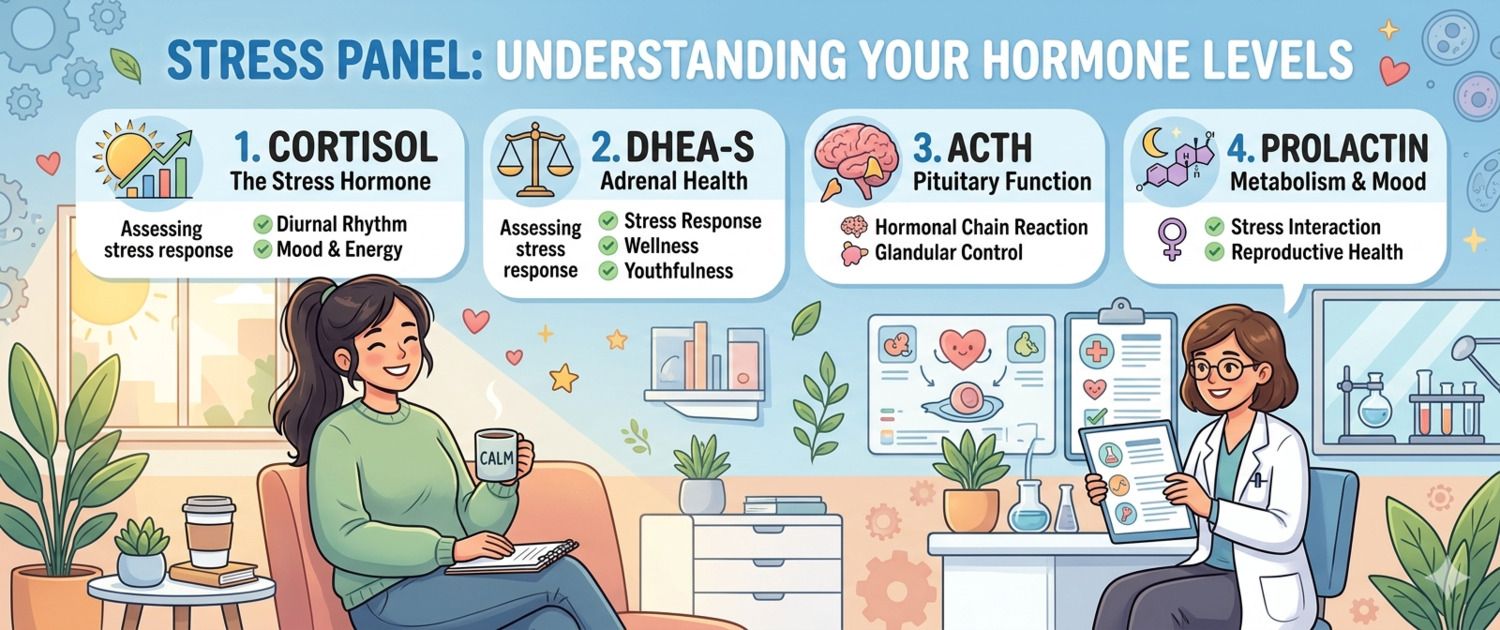
Chronic stress is not a diagnosis you can make from complaints alone. Fatigue, insomnia, anxiety, menstrual disruption, central weight gain — all of these can be stress, hypothyroidism, depression, iron deficiency, or Cushing's syndrome. To separate these causes you need not isolated tests, but a complete picture of the hypothalamic-pituitary-adrenal (HPA) axis. The adrenal stress panel is built for exactly that.
What the Adrenal Stress Panel Is
The adrenal stress panel is a set of tests assessing HPA-axis function: hypothalamus → pituitary → adrenal glands → peripheral effects. It allows simultaneous evaluation of every regulatory layer and pinpoints where the failure has occurred.
Unlike a generic hormone panel, which surveys multiple endocrine systems superficially, the stress panel zooms in specifically on the adrenals and stress reactivity. This makes it indispensable for suspected chronic stress, burnout, Cushing's syndrome, Addison's disease, and steroid-induced adrenal insufficiency.
A critical feature: meaningful interpretation requires simultaneous measurement of several hormones on the same day at strictly defined time points. A single isolated cortisol value is far less informative than a stress panel — because the pathological signal lives in the ratios, not in absolute numbers.
What Hormones Are Included
The base panel covers four to five markers:
Morning cortisol (8:00–10:00 AM) — the principal stress hormone, peaking in the morning by physiology. A significant drop signals adrenal insufficiency; an upper-range or above-range value points to hypercortisolism.
Evening cortisol (4:00–6:00 PM) — a second time point reflecting the integrity of the circadian rhythm. In a healthy person, evening cortisol is 2–3-fold lower than morning. A flattened rhythm (evening close to morning) is a hallmark of Cushing's syndrome.
DHEA-S — the principal adrenal androgen, reflecting adrenal cortex "reserve" and anabolic status. Peaks in youth and falls with age. Low DHEA-S with high cortisol is the classic biomarker of chronic stress and burnout.
ACTH — the pituitary hormone driving the adrenals. Drawn in the morning at the same time point as cortisol. ACTH is essential for localizing the lesion: pituitary, adrenal, or external stimulation.
Prolactin — an optional but informative component: prolactin rises in acute psychoemotional stress and is chronically suppressed in marked hypercortisolism.
Extended versions of the panel may include late-night salivary cortisol (the most sensitive marker of Cushing's syndrome), 24-hour urinary free cortisol, and tetracosactide stimulation testing.
When the Stress Panel Is Indicated
The stress panel is meaningful when several of the following coexist:
- Chronic fatigue not relieved by rest, with anemia and hypothyroidism already excluded
- Burnout features: apathy, cynicism, declining productivity, insomnia
- Weight gain with central distribution (abdomen, neck) alongside thin limbs
- Hypertension at a young age or resistant to therapy
- Striae wider than 1 cm on abdomen or thighs, especially purple in color
- Menstrual cycle disruption without obvious gynecological cause
- Suspected Cushing's syndrome or Addison's disease
- Concurrent anxiety, panic, and sleep disturbance
- Follow-up after long-term glucocorticoid therapy
Isolated complaints of fatigue or anxiety without somatic features do not require a first-line stress panel — workup typically begins with a basic blood count, ferritin, and a thyroid panel. The stress panel is added when symptoms persist and adrenal dysfunction is plausible.
How to Prepare
Stress panel assays are among the most pre-analytically sensitive in endocrinology. Failure to follow conditions can fully invalidate the results.
General rules:
- Strictly fasting (8–12 hours), water only
- Morning cortisol and ACTH drawn between 8:00 and 10:00 AM
- Avoid alcohol, intense exercise, and sauna for 2–3 days
- No smoking for at least 3 hours before the draw
- Avoid stressful situations on the day of testing; rest 15–30 minutes before the draw
- Disclose all medications: glucocorticoids (including inhaled), oral contraceptives, antidepressants, lithium — all alter results
Marker-specific notes:
Morning cortisol: strictly between 8:00 and 10:00 AM; afternoon collection is unsuitable for screening.
Evening cortisol: between 4:00 and 6:00 PM; not later than 6 PM, otherwise the value loses interpretability.
ACTH: critically unstable — the tube must be chilled and centrifuged immediately, otherwise ACTH degrades within 10–15 minutes. Confirm laboratory readiness before drawing.
Prolactin: calm matters — venipuncture itself can raise prolactin 2–3-fold. Ideally drawn second, after a few minutes of rest.
DHEA-S: the only panel marker not requiring strict timing — it is stable over the 24-hour cycle.
Reference Ranges
Reference values vary by laboratory, sex, and age.
| Marker | Reference (adults) | Units |
|---|---|---|
| Morning cortisol (8:00 AM) | 138–690 | nmol/L |
| Evening cortisol (4:00–6:00 PM) | 69–345 | nmol/L |
| Morning ACTH | 7.2–63 | pg/mL |
| DHEA-S (men 30–40 years) | 2.4–11.7 | µmol/L |
| DHEA-S (women 30–40 years) | 1.2–7.5 | µmol/L |
| Prolactin (men) | 73–407 | mIU/L |
| Prolactin (women) | 102–496 | mIU/L |
DHEA-S norms are heavily age-dependent: by age 70 the lower bound drops 3–4-fold. Always compare DHEA-S against the age-specific reference, never against young-adult norms.
Interpretation: Four Typical Patterns
The stress panel's strength is in pattern analysis, not in single numbers.
1. Chronic stress / early burnout. Morning cortisol upper-normal or modestly elevated; evening cortisol elevated (flattened circadian rhythm); DHEA-S reduced (often 30–50% below age norm); ACTH modestly elevated. This is the most common clinical pattern — functional hypercortisolism without organic disease.
2. Late-stage burnout / adrenal exhaustion. Morning cortisol low or lower-normal; evening cortisol paradoxically elevated; DHEA-S markedly reduced; ACTH normal or modestly low. A signal that the adrenals are failing to keep up with prolonged chronic load.
3. Cushing's syndrome. Morning and evening cortisol both high, circadian rhythm lost; ACTH either high (Cushing's disease — pituitary tumor) or suppressed (adrenal corticosteroma); DHEA-S can be either elevated (ACTH-dependent) or reduced (adrenal tumor). Confirmation requires dexamethasone suppression and imaging.
4. Addison's disease. Morning cortisol low (< 138 nmol/L); ACTH sharply elevated (> 100 pg/mL) — pituitary attempting to drive destroyed adrenals; DHEA-S reduced; prolactin usually normal. Requires immediate confirmation by tetracosactide stimulation.
Cortisol vs DHEA-S: The Key Ratio
The cortisol/DHEA-S ratio is one of the most useful integrative markers of stress reactivity. In a healthy young adult it is balanced: cortisol and DHEA-S act as two opposing arms — catabolic (cortisol) and anabolic (DHEA-S).
Under chronic stress and aging the balance shifts: cortisol rises, DHEA-S falls. A high cortisol/DHEA-S ratio is associated with accelerated aging, immunosuppression, muscle loss, and cardiovascular risk. This is one reason DHEA-S is included in comprehensive biological-age monitoring programs.
For DHEA-S in longevity and endocrine balance, see the review DHEA-S and aging. For a practical guide on lowering chronically elevated cortisol in women, see how to lower cortisol in women.
Connections to Other Hormone Panels
The stress panel rarely operates in isolation. Common combinations:
- With the thyroid panel — cortisol suppresses T4-to-T3 conversion, and chronic hypercortisolism mimics functional hypothyroidism
- With the sex hormone panel — for suspected "progesterone steal" in chronically stressed women
- With the broader hormone panel for multiple nonspecific complaints
- With the sleep disorders panel — when chronic stress coexists with insomnia
These combined assessments turn the stress panel from a standalone test into a full diagnostic tool for the HPA axis and its interaction with other endocrine systems.
When to See an Endocrinologist
Any non-physiological stress-panel result warrants an in-person consultation:
- Morning cortisol < 138 nmol/L on two measurements — adrenal insufficiency must be excluded
- Morning cortisol > 690 nmol/L + flattened circadian rhythm — Cushing's syndrome screening is mandatory (dexamethasone suppression test, 11 PM salivary cortisol)
- ACTH < 5 pg/mL with elevated cortisol — adrenal CT is mandatory
- DHEA-S 3-fold below age norm — search for the cause (hypopituitarism, long-term steroid therapy, severe wasting)
- Combined low cortisol, hypotension, nausea and weakness — emergency care to exclude Addisonian crisis
This article is for informational purposes only and does not replace professional medical advice. Stress-panel interpretation requires simultaneous assessment of all markers by an endocrinologist.
For informational purposes only
This article is for informational purposes only and does not constitute medical advice, diagnosis, or treatment. Please consult a healthcare professional for medical guidance.