Prolactin: Normal Levels, Causes and Blood Test Interpretation
Reviewed by the LabReadAI medical team
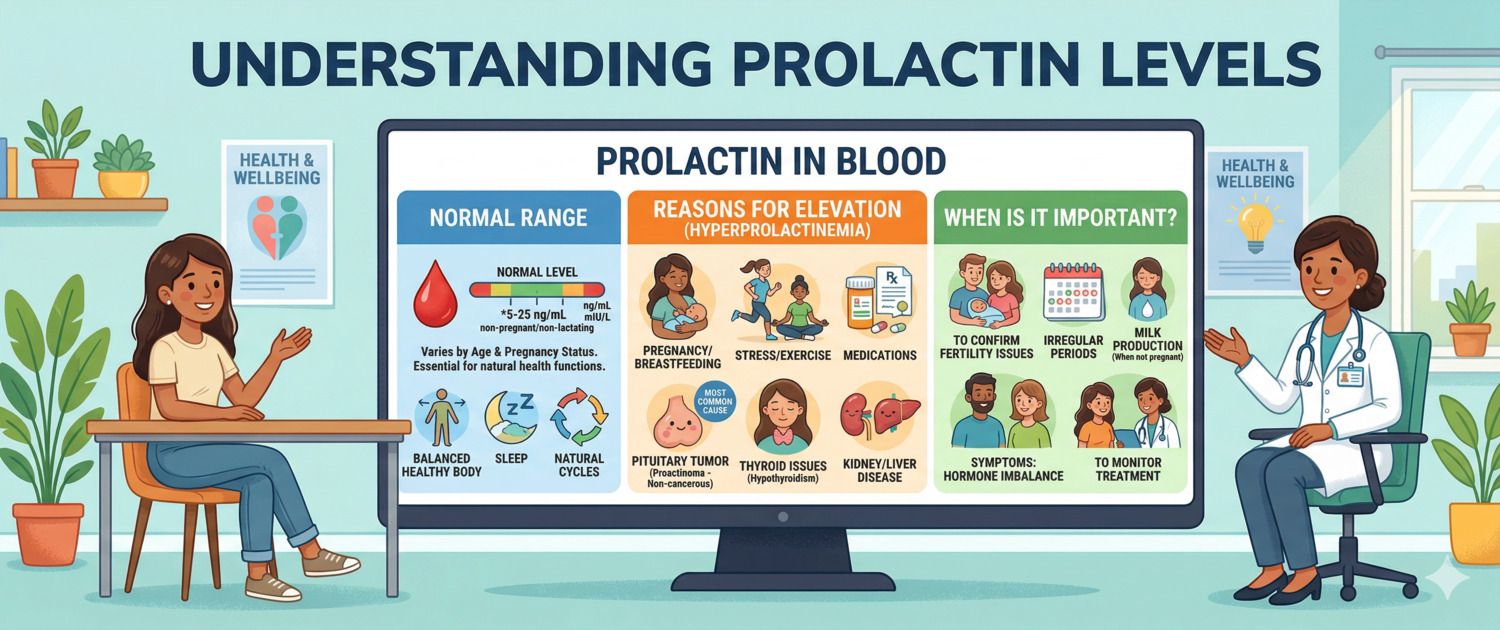
Prolactin is one of those hormones people only think about when something goes wrong: a disrupted menstrual cycle, lost libido, or an above-range figure on a lab report. Yet it is a multifunctional hormone with more than 300 known biological effects — and one of the noisiest in terms of laboratory diagnostics: its level shifts with stress, sleep, food, and even the act of having blood drawn. Let's break down what it does, when an elevated result is genuinely pathological, and what to do about it.
What Prolactin Is and What It Does
Prolactin is a polypeptide hormone produced by lactotroph cells in the anterior pituitary. It is structurally related to growth hormone and placental lactogen — all three belong to the same protein family. Unlike most pituitary hormones, prolactin is under predominantly inhibitory control: dopamine released by the hypothalamus continuously suppresses its secretion. The moment dopaminergic tone falls, prolactin rises immediately.
Core functions of prolactin:
- Lactation — stimulates milk production in the mammary glands after delivery; the key postpartum hormone
- Suppression of reproductive function during lactation — physiological lactational amenorrhea: elevated prolactin inhibits GnRH → reduces LH and FSH → suppresses ovulation
- Immunomodulation — prolactin influences lymphocyte activity and participates in immune response regulation
- Osmoregulation — regulates water-electrolyte balance in the kidneys and mammary glands
- Behavior and stress response — prolactin rises acutely with stress as part of the adaptive response
Regulation is exquisitely sensitive to external stimuli. This is critically important for result interpretation: physical discomfort during venipuncture, breast examination before blood draw, sleep disruption, food intake, and even sexual intercourse within a few hours before testing can significantly raise prolactin — without any pathology. A full discussion of the physiology and clinical role of this hormone is available in the article prolactin: what this hormone is.
Normal Prolactin Levels
Reference values differ substantially by sex, age, and physiological state. Units used: mIU/L (international units) and ng/mL. Conversion: 1 ng/mL ≈ 21 mIU/L.
| Group | Normal (mIU/L) | Normal (ng/mL) |
|---|---|---|
| Men | 53–360 | 2.5–17 |
| Non-pregnant women | 109–557 | 5–26 |
| 1st trimester of pregnancy | 500–2000 | 24–95 |
| 2nd trimester of pregnancy | 1500–4500 | 71–214 |
| 3rd trimester of pregnancy | 2500–9000 | 119–428 |
| Breastfeeding women | up to 4000–5000 | up to 200–240 |
| Infants under 1 year | 630–1820 | 30–87 |
| Children 1–10 years | 40–400 | 2–19 |
During pregnancy, prolactin rises 5–10 fold above the non-pregnant range — this is physiological. After delivery, non-breastfeeding women normalize within 2–4 weeks; breastfeeding women remain elevated throughout lactation.
Laboratories use different assay platforms and units — always compare with the reference range on the specific lab report. When prolactin is first found elevated, a diagnostically significant result is one that consistently exceeds the reference range across two to three independent measurements under proper conditions.
How to Prepare for a Prolactin Blood Test
Prolactin is one of the most unstable hormonal markers. No other pituitary hormone demands more careful attention to collection conditions.
Essential requirements:
- Draw blood strictly in the morning — between 9:00 and 11:00 AM. Prolactin has a clear circadian rhythm: maximum during sleep (especially early morning), rapid decline toward midday
- Arrive at the lab early and rest quietly for 20–30 minutes before the draw — even walking up stairs elevates prolactin
- Fasting or 3–4 hours after a light breakfast without coffee
- Abstain from sexual intercourse for 24 hours before
- Avoid breast examination or nipple stimulation for 24 hours before — mechanical nipple stimulation is a powerful secretory stimulus
- Avoid intense exercise for 24 hours before
- Avoid emotional stress immediately before testing — reschedule if necessary
At first elevation: a repeat test is mandatory under different conditions on a different day. A diagnosis of hyperprolactinemia requires confirmation by at least two measurements. Up to 40% of initially "elevated" results normalize on correctly repeated sampling.
The phase of the menstrual cycle has a modest effect on prolactin in most women — for standardization, testing on days 3–5 of the cycle is recommended.
Causes of High Prolactin (Hyperprolactinemia)
Elevated prolactin is the most common pituitary disorder in women of reproductive age. A diagnostically meaningful result is one that consistently exceeds the reference range after excluding physiological and functional causes.
| Cause | Prolactin level | Characteristic features |
|---|---|---|
| Prolactinoma (pituitary adenoma) | > 2000–3000 mIU/L; often very high | Persistent elevation; MRI findings |
| Hypothyroidism | Moderate elevation | Combined with elevated TSH |
| Polycystic ovary syndrome (PCOS) | Moderate (up to 1000–1500 mIU/L) | Cycle disruption, hyperandrogenism |
| Chronic stress / hypercortisolism | Moderate, unstable | Falls with cortisol normalization |
| Medications | Variable | Clearly linked to drug initiation |
| Renal failure | Moderate | Impaired prolactin clearance |
| Hypothalamic lesion | Moderate | Reduced dopaminergic tone |
| Physiological causes | Normal or mildly elevated | Pregnancy, lactation, stress |
| Macroprolactinemia | Falsely high | No symptoms; no treatment response |
Drug-induced hyperprolactinemia is one of the most frequent causes of moderate elevation in clinical practice. Prolactin-raising drugs include: antipsychotics (all typical agents and many atypical ones), metoclopramide, domperidone, antidepressants (especially SSRIs and tricyclics), verapamil, high-dose estrogens, and opiates. Always confirm the complete medication list before interpreting a result.
Macroprolactinemia — a condition in which prolactin circulates as large, biologically inactive aggregates bound to immunoglobulins. The assay reads high, but there are no clinical symptoms. Confirmed by polyethylene glycol (PEG) precipitation: after removing macroprolactin, the bioactive fraction is normal or minimally elevated. Critically: macroprolactinemia requires no treatment — prescribing dopamine agonists for it is an error.
Causes of Low Prolactin
Prolactin below the reference range is far less common and carries less independent clinical significance.
Main causes of hypoprolactinemia:
- Pituitary insufficiency (hypopituitarism) — damage to lactotroph cells from tumors, ischemia (Sheehan's syndrome), or infiltration; often accompanied by deficiency of other trophic hormones
- Sheehan's syndrome — postpartum pituitary necrosis following massive obstetric hemorrhage; agalactia (inability to breastfeed) is one of the earliest symptoms
- Dopamine agonists (bromocriptine, cabergoline) — iatrogenic reduction during prolactinoma or PCOS treatment
- High-dose glucocorticoids — suppress prolactin secretion
Isolated low prolactin in a woman not taking relevant medications is an indication for a full pituitary function assessment to rule out hypopituitarism.
Prolactin and the Reproductive System
Hyperprolactinemia is one of the leading endocrine causes of menstrual cycle disruption and infertility. The mechanism is direct: excess prolactin suppresses pulsatile GnRH secretion → LH and FSH fall → folliculogenesis and ovulation are impaired.
Clinical spectrum in women:
- Menstrual irregularities: from shortening of the luteal phase to complete amenorrhea
- Anovulation and infertility
- Galactorrhea (breast discharge outside pregnancy and lactation) — classic but inconstant symptom: present in 30–80% of women with hyperprolactinemia
- Reduced libido
- Hypoestrogenism with osteoporosis when long-standing
Prolactin suppresses estradiol indirectly — through reduced LH/FSH, not directly on the ovary. This is why women with hyperprolactinemia often show low estradiol and reduced ovarian reserve even with a normal pituitary MRI — functional hyperprolactinemia from chronic stress can produce the same hormonal pattern as a structural cause.
In men, hyperprolactinemia is less common but often more disruptive subjectively:
- Reduced libido and erectile dysfunction — typically the first symptoms
- Gynecomastia and galactorrhea — less common than in women
- Reduced testosterone through suppression of the pituitary–testicular axis
- Infertility (impaired spermatogenesis)
- With prolactinoma — neurological symptoms (headache, visual field defects with macroadenoma)
Thyroid function assessment is mandatory in all patients with hyperprolactinemia: hypothyroidism is one of the few fully reversible causes. A thyroid panel should be ordered for every patient with newly identified elevated prolactin.
When Prolactin Abnormalities Require Medical Attention
The approach to a prolactin deviation is strictly two-step: first confirm on repeat testing — then find the cause.
Scheduled visit to an endocrinologist when:
- Consistent elevation above normal in two measurements with full adherence to preparation conditions
- Prolactin > 700–1000 mIU/L (> 33–48 ng/mL) — threshold above which functional causes become less likely
- Menstrual cycle disruption combined with any degree of prolactin elevation
- Galactorrhea in a woman outside pregnancy and breastfeeding
- Reduced libido or erectile dysfunction in a man
Seek urgent care when:
- Prolactin > 5000–6000 mIU/L — high probability of prolactinoma requiring pituitary MRI
- Visual field defects — sign of optic chiasm compression by a macroadenoma
- Sudden severe headache with visual disturbance — pituitary apoplexy (a medical emergency)
Treatment of confirmed hyperprolactinemia with dopamine agonists (cabergoline, bromocriptine) is highly effective: prolactin normalization is achieved in 80–90% of patients with prolactinoma. Self-discontinuation of treatment after normalization without medical consultation is a frequent and clinically significant error. Prolactin is part of the hormonal profile relevant to the pace of ageing — a comprehensive longevity programme is available in the article how to live long and healthy.
This article is for informational purposes only and does not replace professional medical advice. Consult an endocrinologist or reproductive endocrinologist if your prolactin level is outside the normal range.
For informational purposes only
This article is for informational purposes only and does not constitute medical advice, diagnosis, or treatment. Please consult a healthcare professional for medical guidance.