Sleep Disorders Panel: Hormones and Nutrients Behind Insomnia
Reviewed by the LabReadAI medical team
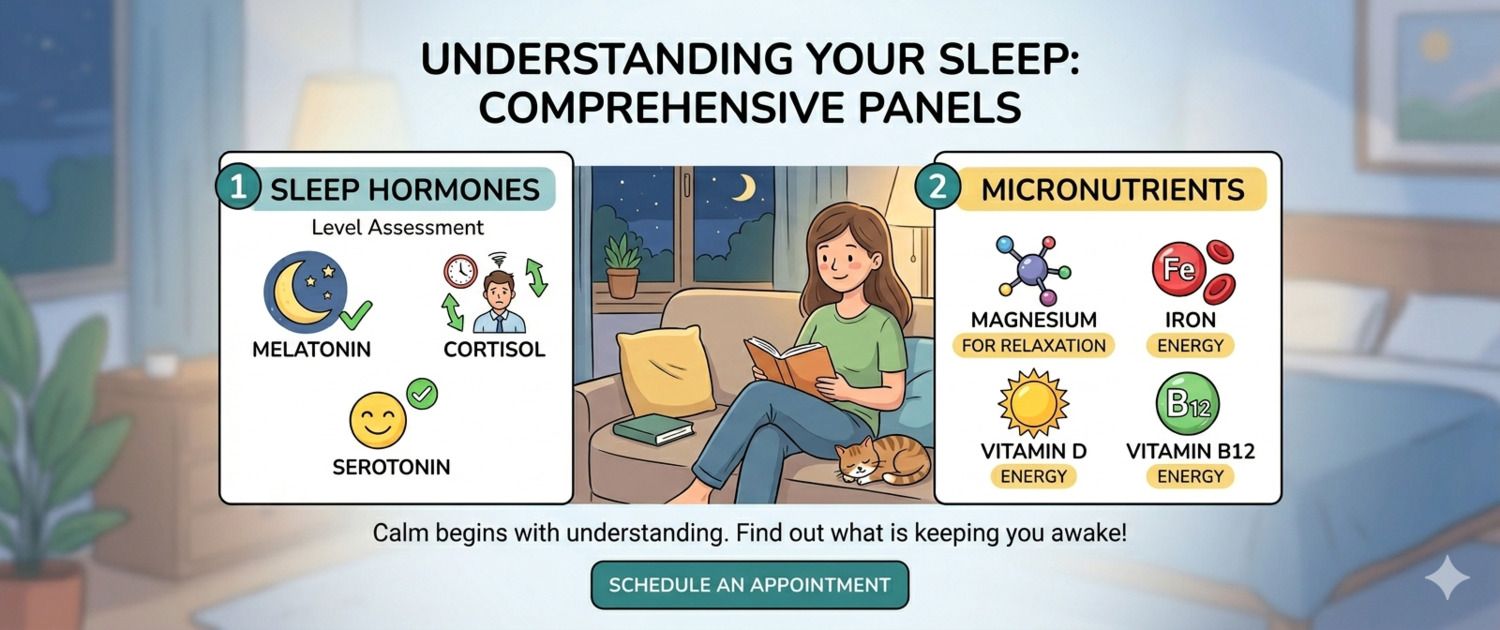
Insomnia and poor sleep are almost always a symptom — not a stand-alone disease. Behind "I can't fall asleep," "I wake up at 3 AM," or "I sleep but feel exhausted" lie different biochemical causes: melatonin deficiency, a shifted circadian rhythm, occult hypothyroidism, iron deficiency, low vitamin D, hypercortisolism. Each requires its own solution. A lab panel for insomnia is needed to find the cause — not guess at it — and to avoid blind sleeping-pill therapy.
What the Sleep Disorders Panel Is
The sleep disorders panel is a set of tests covering all major biochemical drivers of sleep regulation: circadian-rhythm hormones, stress hormones, thyroid markers, and the key micronutrients whose deficiency disrupts sleep. The idea is to check, in a single visit, all the routinely missed causes of insomnia rather than circle back for new tests every two weeks.
The key difference from a generic hormone workup: the sleep panel includes specific markers that are usually absent from standard panels — for example, ferritin and vitamin D, which are too often overlooked in "ordinary insomnia." Without them the picture is incomplete.
What's Included in the Insomnia Test Panel
The base panel covers three blocks of markers.
Circadian-rhythm hormones:
Melatonin — the principal sleep hormone, synthesized by the pineal gland at night. It is drawn either by night blood sampling (1:00–3:00 AM) or, more conveniently, as a salivary series (morning/evening/night). Low nighttime melatonin is a direct indicator of circadian dysregulation.
Evening cortisol (4:00–6:00 PM) — the antagonist of melatonin. Elevated evening cortisol means the brain "isn't shutting down": a typical pattern in people with sleep-onset difficulty and chronic stress. Best evaluated together with morning cortisol — this gives the diurnal cortisol picture.
Thyroid hormones:
TSH — subclinical hypothyroidism is among the top three missed causes of "unexplained" insomnia. Conversely, thyrotoxicosis produces the opposite problem — light, fragmented sleep with frequent awakenings. TSH is a mandatory component of any sleep panel.
Sleep-relevant micronutrients:
Ferritin — the marker of iron stores. Low ferritin (< 30 ng/mL, with > 50 desirable for sleep quality) is associated with restless legs syndrome and fragmented sleep. It is one of the most common and most missed causes of insomnia.
Vitamin D — receptors for it exist in the hypothalamus and sleep regulation centers. Deficiency (< 30 ng/mL) is linked to shortened deep-sleep phase and overall poor sleep architecture.
Magnesium — a melatonin-synthesis cofactor and an activator of the GABAergic inhibitory system. Deficiency manifests as sleep-onset difficulty and nighttime awakenings. Red-cell magnesium is more informative than serum magnesium.
Extended versions of the panel may include vitamin B12, folate, homocysteine (for suspected occult inflammation), fasting glucose (to exclude nocturnal hypoglycemia), and prolactin when an endocrine cause is suspected.
When to Order the Insomnia Panel
The panel is meaningful when several of the following coexist:
- Insomnia lasting more than 4 weeks, unexplained by stress or external factors
- Difficulty falling asleep, evening anxiety, the feeling that "the head won't switch off"
- Early-morning awakenings (3–4 AM) with inability to fall back asleep
- Light sleep, frequent awakenings, and feeling unrested despite adequate sleep duration
- Restless legs syndrome — that "creeping" sensation in the legs in the evening
- Daytime sleepiness and chronic fatigue with formally adequate sleep duration
- Sleep disturbance alongside reduced libido, menstrual irregularities, hair loss (suspected endocrine cause)
- Perimenopausal insomnia — adds the sex hormone panel
If insomnia coexists with chronic stress and anxiety, it is reasonable to combine the sleep panel with the adrenal stress panel for cortisol/DHEA-S balance and circadian rhythm assessment.
How to Prepare
Most panel markers are pre-analytically sensitive.
General rules:
- Morning blood draw — fasting, 8:00–10:00 AM (for TSH, ferritin, vitamin D, magnesium)
- Cortisol drawn morning (8:00–10:00) and evening (4:00–6:00 PM) on the same day
- Avoid alcohol, intense exercise, and evening coffee for 24 hours
- 1–3 days before melatonin testing — withhold (after medical consultation) melatonin supplements, beta blockers, and antidepressants
- On the test day avoid major stress; no smoking for 3 hours before the draw
Marker-specific notes:
Melatonin: a circadian profile requires night blood sampling (about 2:00–3:00 AM) or a salivary series. A morning draw is uninformative — melatonin has already dropped sharply.
Vitamin D: preferably tested at the same season each year, since concentration depends heavily on sunlight exposure — higher in summer, lower in winter.
Ferritin: as an acute-phase marker, ferritin can be artifactually elevated by acute infection or chronic disease flare. Test outside acute conditions.
Magnesium: serum magnesium reflects only a small fraction of total body magnesium — a low value is meaningful, a normal value does not exclude deficiency. Red-cell magnesium is more accurate.
Reference Ranges
Reference values vary by laboratory and method. Approximate targets are shown.
| Marker | Normal / target value | Units |
|---|---|---|
| Nighttime melatonin (3 AM) | 80–250 | pg/mL |
| Morning cortisol (8 AM) | 138–690 | nmol/L |
| Evening cortisol (4–6 PM) | 69–345; target — < 200 | nmol/L |
| TSH | 0.4–4.0; target — < 2.5 | mIU/L |
| Ferritin | 20–250; target — > 50 | ng/mL |
| Vitamin D (25-OH) | 30–100; target — 40–60 | ng/mL |
| Red-cell magnesium | 1.65–2.65 | mmol/L |
The "target" column shows the optimal, not merely "normal," level for sleep quality. For example, TSH of 3.5 is formally normal, but for insomnia it is reasonable to aim lower; ferritin of 25 is formally normal, yet > 50 is desirable for healthy sleep.
Insomnia Patterns and Lab Marker Interpretation
The sleep panel is interpreted as a picture, not as a list of single numbers.
"Can't fall asleep" pattern: often — elevated evening cortisol, low magnesium, sometimes subclinical hyperthyroidism (TSH < 0.4). Points to a "hyperaroused" nervous system.
"Wake at 3–4 AM, can't return to sleep" pattern: characteristic of hypercortisolism (the early-morning cortisol surge has shifted 3–4 hours earlier), low ferritin, nocturnal hypoglycemia. Sometimes — subclinical hypothyroidism (high TSH).
"Slept but unrested" pattern: low melatonin (poorly initiates slow-wave sleep), vitamin D deficiency, elevated evening cortisol with loss of circadian rhythm.
"Restless legs" pattern: ferritin < 50 ng/mL (even with "normal" hemoglobin). Restoring iron stores to target often resolves the syndrome entirely.
"Perimenopausal insomnia" pattern: add FSH, estradiol, progesterone. Falling progesterone (it is GABAergic) and estradiol fluctuations are the main culprits of sleep disruption in this period.
Sleep Hormones and Nutrients: How the Markers Interact
All markers in the panel are interconnected: magnesium deficiency reduces melatonin synthesis and simultaneously raises cortisol; low vitamin D worsens serotonin (the precursor of melatonin) function; chronically high cortisol suppresses T4-to-T3 conversion, producing "functional hypothyroidism" with formally normal TSH.
Low ferritin triggers nighttime sympathetic activation — hence the characteristic sleep fragmentation. Magnesium deficiency disrupts the GABA receptors that provide natural evening neural inhibition. So the sleep panel is not "seven tests in a row" — it is a tool for building a coherent biochemical picture of insomnia.
For melatonin biochemistry and circadian rhythms in detail, see the article melatonin: what it is. For serotonin as the biochemical precursor of melatonin and a mood regulator, see serotonin: what it is.
When to Refer to a Sleep Specialist
- If even one panel marker is abnormal — clinical consultation (endocrinologist for hormonal abnormalities, primary care for nutrient deficiencies)
- Insomnia lasting more than 6 months or with clear daytime impairment — sleep medicine referral
- Suspected sleep apnea (loud snoring, witnessed apneas, morning headaches) — polysomnography is mandatory; a lab panel alone is insufficient
- Insomnia combined with anxiety and intrusive thoughts — parallel referral to a psychotherapist or psychiatrist
This article is for informational purposes only and does not replace professional medical advice. The sleep disorders panel is a starting point for diagnostics, not a stand-alone diagnosis.
For informational purposes only
This article is for informational purposes only and does not constitute medical advice, diagnosis, or treatment. Please consult a healthcare professional for medical guidance.