Melatonin: What This Sleep Hormone Is, Levels and How to Fix Sleep
Reviewed by the LabReadAI medical team
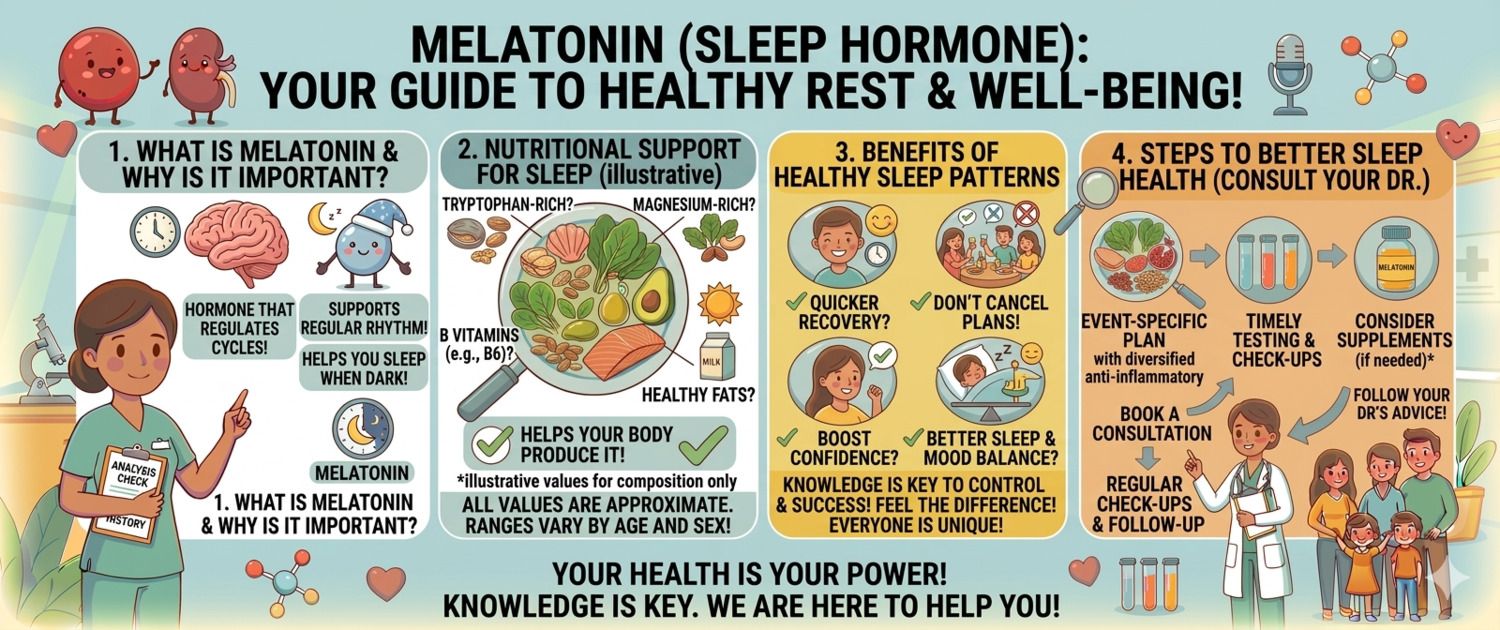
You lie down but sleep does not come for hours. Or you wake at three in the morning and cannot drift off again. Or after a transatlantic flight your body is running on an entirely different schedule. Behind all of this is a disruption of one small hormone that most people know only by name. Melatonin is produced by the pineal gland exclusively in darkness and acts as the master conductor of the body's daily rhythms. This article explains how it works, what disrupts it, what normal levels look like, and what genuinely helps when it is deficient.
What Is Melatonin and Where Is It Produced?
Melatonin is a derivative of the amino acid tryptophan, synthesised primarily in the pineal gland of the brain. Small amounts are also produced in the retina, intestine, leukocytes, and platelets — but it is pineal melatonin that governs sleep regulation and circadian rhythms.
The defining feature of melatonin: it is produced only in darkness. The signal travels from the retina through the retinohypothalamic tract to the suprachiasmatic nucleus of the hypothalamus — the body's master biological clock — and from there to the pineal gland. Even low-level light, particularly in the blue spectrum (smartphones, screens), suppresses melatonin synthesis.
Melatonin does not directly induce sleep — it signals to the body that night has arrived and triggers a cascade of changes: falling core body temperature, slowed metabolism, reduced heart rate. This creates the conditions for sleep onset, but it is not a sedative in the strict sense.
The relationship between melatonin and other hormones is reciprocal: elevated cortisol suppresses melatonin synthesis, and vice versa. This is why chronic stress is one of the primary enemies of healthy sleep.
Melatonin Levels: When and How It Is Tested
A melatonin test is a specialised assay, rarely ordered in routine clinical practice. This reflects the hormone's unusual behaviour: its level shifts by a factor of ten or more across the day, making a single blood draw largely uninformative. The standard method is a 24-hour melatonin profile from saliva or urine, with samples collected at fixed time points.
Approximate reference values for serum melatonin:
| Time of day | Level (pg/mL) |
|---|---|
| Daytime (10:00–12:00) | 1–10 |
| Early night (23:00–01:00) | 20–70 |
| Peak night (02:00–04:00) | 70–200 |
| Elderly > 65 years (night) | 20–80 |
The melatonin peak falls between 2 and 4 a.m., after which levels gradually decline toward dawn. With age, the nocturnal peak becomes lower and shorter — one of the physiological reasons older adults experience lighter and shorter sleep.
Indications for testing:
- Chronic insomnia unresponsive to standard treatment
- Diagnosis of circadian rhythm disorders (delayed sleep phase syndrome)
- Evaluating light therapy efficacy in seasonal depression
- Research and specialised sleep medicine protocols
In most cases, a clinical diagnosis of a sleep disorder is made without a melatonin assay — based on symptoms, a sleep diary, and actigraphy.
How Melatonin Affects Health: Beyond Sleep
Melatonin is a far more multifunctional hormone than simply a "night signal." Its receptors have been identified in virtually every tissue in the body.
Antioxidant protection. Melatonin is one of the most potent natural antioxidants. It neutralises free radicals directly in mitochondria — where oxidative stress is generated most heavily. Unlike most antioxidants, it crosses all biological barriers, including the blood-brain barrier.
Immune regulation. The nocturnal melatonin peak coincides with peak immune system activity: cytokine synthesis, NK cell activation, lymphocyte proliferation. Chronic melatonin deficiency impairs immune response and accelerates immune ageing.
Oncological protection. Epidemiological data show higher rates of breast, prostate, and colorectal cancer in people with chronic circadian disruption — night shift workers, blind individuals without light input, patients with chronic sleep disorders. Melatonin inhibits tumour cell proliferation and angiogenesis in vitro, though clinical evidence remains preliminary.
Metabolic regulation. The relationship between melatonin, glucose metabolism, and metabolic syndrome is under active investigation. Melatonin deficiency impairs insulin sensitivity, potentially contributing to type 2 diabetes in night-shift workers.
Neuroprotection. In Alzheimer's disease, melatonin levels are substantially reduced, correlating with the circadian disruption characteristic of these patients. Melatonin protects neurons from beta-amyloid toxicity in experimental models.
Causes of Melatonin Deficiency
Melatonin deficiency is rarely isolated — it is most often a consequence of lifestyle or age-related changes.
Light pollution and screens. The primary modern cause. Blue light (wavelength 460–480 nm) from smartphone, tablet, and laptop screens maximally suppresses melatonin synthesis. Two hours of evening smartphone use delays melatonin onset by 1.5–3 hours and reduces the nocturnal peak by 22%.
Night and shift work. Chronic exposure to artificial light at night irreversibly disrupts the circadian rhythm. The WHO classifies shift work involving circadian disruption as a probable carcinogen (Group 2A).
Age. After age 40–45, melatonin synthesis begins to decline; after 60, the drop becomes substantial. This is one mechanism behind the age-related deterioration in sleep quality and immune function in older adults.
Stress and hypercortisolaemia. Chronically elevated cortisol directly suppresses melatonin synthesis in the pineal gland. This creates a vicious cycle: stress → poor sleep → greater stress.
Certain medications:
- Beta-blockers (atenolol, metoprolol) — suppress synthesis via β₁-adrenergic receptors
- NSAIDs with prolonged use
- Benzodiazepines paradoxically disrupt sleep architecture despite their sedative effect
- Evening caffeine
Tryptophan deficiency — the essential amino acid from which serotonin and then melatonin are synthesised. Strict low-protein diets reduce the substrate for synthesis.
How to Raise Melatonin: Behavioural Strategies and Supplements
Most sleep problems related to melatonin deficiency respond to behavioural interventions — without medication.
Light hygiene:
- Bright morning light exposure (sunlight especially) — synchronises biological clocks and amplifies the nocturnal melatonin peak
- Dark sleeping environment: blackout curtains, sleep mask. Even dim ambient light suppresses synthesis
- Avoid screens 1–2 hours before bed, or use amber-tinted glasses (block blue light)
- Night mode apps (Night Shift, f.lux) reduce melatonin suppression but do not eliminate it
Temperature:
- Bedroom temperature of 17–19 °C — mimics the nocturnal core body temperature drop that accompanies melatonin release
- A warm bath or shower 1–2 hours before bed paradoxically helps — the subsequent body cooling accelerates sleep onset
Nutrition:
- Tryptophan-rich foods: turkey, eggs, hard cheeses, nuts, bananas
- Melatonin-containing foods: tart cherries (especially concentrated juice), walnuts, tomatoes. Concentrations are low but clinical effects have been described
- Moderate carbohydrates at dinner increase tryptophan availability, improving serotonin and melatonin synthesis
Melatonin supplements: Synthetic melatonin is indicated in specific situations: jet lag, delayed sleep phase syndrome, insomnia in older adults (age-related deficiency), shift work adaptation.
Principles of use:
- Low doses (0.5–1 mg) are more effective than high doses (5–10 mg) for circadian phase-shifting
- For jet lag — take by destination time zone, starting on arrival day
- For insomnia — 30–60 minutes before the desired sleep time
- Not a sedative — does not cause immediate sleep, not suitable for acute insomnia
Melatonin is safe for short-term use in adults. Long-term data in children are limited — use only on medical recommendation.
Melatonin and Seasonal Disorders: Winter, Depression and Photoperiodism
Day length is the primary photoperiodism signal in most mammals. In humans, this mechanism is partially preserved: during short winter days, the duration of the nocturnal melatonin peak lengthens, which can influence mood, appetite, and energy.
Seasonal affective disorder (SAD, "winter depression") involves circadian rhythm disruption under conditions of insufficient light exposure. The primary treatment is bright light therapy (10,000 lux, 20–30 minutes in the morning): it suppresses excessive melatonin synthesis and normalises the secretion phase. In severe cases, combined with antidepressants.
Melatonin also modulates reproductive function through its influence on estradiol and gonadotropins. Women with chronic sleep disturbance show higher rates of menstrual irregularities — for more on hormonal links to the cycle, see ovulation: what it is and how to track it.
When Sleep and Melatonin Disorders Require Medical Attention
Most sleep problems respond to sleep hygiene and lifestyle adjustments. But several situations warrant medical consultation:
- Insomnia persists for more than 3 months despite proper sleep hygiene
- Sleep disturbance is accompanied by depressed mood, anxiety, or loss of interest in life
- Excessive daytime sleepiness despite adequate night sleep — possible sleep apnoea
- Pronounced delayed sleep phase: unable to fall asleep before 2–3 a.m.
- Sleep behaviour disorders: movements, talking, getting out of bed — possible REM parasomnia
- Older adult with worsening cognition and disrupted sleep — exclude neurodegeneration
- Sleep disruption on beta-blockers — discuss switching medication with prescribing doctor
This content is for informational purposes only and does not replace professional medical advice.
For informational purposes only
This article is for informational purposes only and does not constitute medical advice, diagnosis, or treatment. Please consult a healthcare professional for medical guidance.