Melatonin for Insomnia: Dosage, Indications and Lab Tests
Reviewed by the LabReadAI medical team
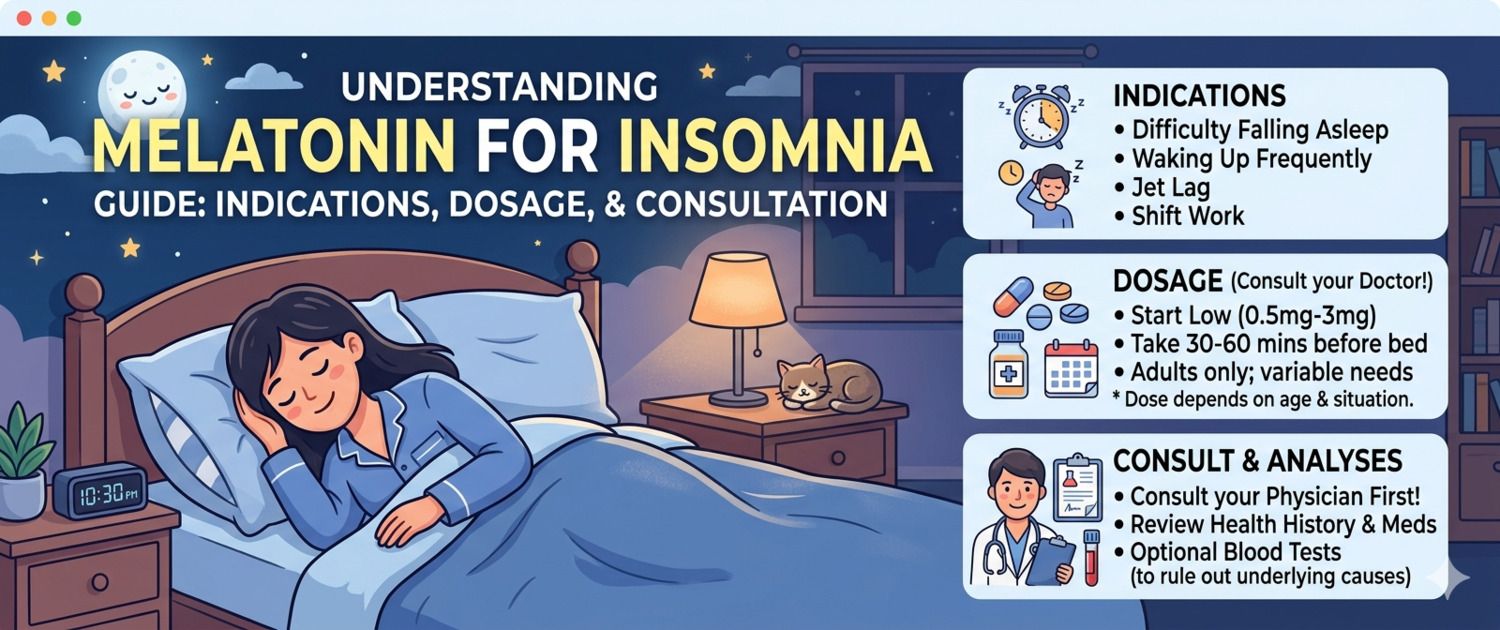
Melatonin is the world's best-selling "sleep aid" — and one of the most misused. People take it for any reason, treating it as a "harmless supplement," and then wonder why sleep doesn't improve. In reality, melatonin is a hormone with clear indications, specific dosing, and a narrow list of cases where it actually works. Here's when melatonin for insomnia is justified, which doses are effective, and which lab tests it makes sense to do before reaching for the bottle.
What Melatonin Is and Why It's Taken
Melatonin is a pineal hormone synthesized at night when darkness sets in. Its main function is to signal the whole body "time to sleep" — it doesn't induce sleep mechanically; it shifts the circadian rhythm and eases sleep onset.
Melatonin supplements are a synthetic analog of the endogenous hormone, producing a brief blood concentration peak that mimics the nighttime release. They are useful in strictly defined situations:
- Shifted circadian rhythm (delayed sleep phase syndrome)
- Shift work and night shifts
- Jet lag across several time zones
- Age-related melatonin deficiency (in older adults nighttime synthesis drops 50–70%)
- Poor "darkness coupling" in people exposed to screens late in the evening
The effect of melatonin is NOT sedative. It does not "knock out" like a hypnotic — it merely facilitates natural sleep onset. So in "classic" stress- or iron-deficiency-related insomnia, melatonin often disappoints.
For melatonin biochemistry and physiology in detail, see the article melatonin: what it is.
When Melatonin Actually Works
Controlled trials show melatonin's effectiveness in:
High effectiveness:
- Delayed sleep phase syndrome (falling asleep after midnight) — sleep onset shortened by 30–60 minutes
- Jet lag (especially eastbound) — adaptation 1–2 days faster
- Shift work — better sleep after a night shift
- Insomnia in older adults with age-related melatonin deficiency — improved sleep quality
- Insomnia in blind patients (loss of light context for the pineal gland)
Moderate effectiveness:
- Insomnia in children with ADHD or ASD (under pediatrician supervision)
- Insomnia on β-blockers (which suppress melatonin synthesis)
Low or no effectiveness:
- Insomnia in stress with hypercortisolism
- Insomnia with low ferritin, hypothyroidism, or hyperthyroidism
- Chronic psychophysiological insomnia
- Insomnia from sleep apnea
When Melatonin Doesn't Help
If a person takes melatonin for 4–6 weeks at an adequate dose and sees no effect — another insomnia cause must be found. The most common "opaque" causes:
- Low ferritin (< 50 ng/mL) — restless legs syndrome and sleep fragmentation
- Subclinical hypothyroidism (TSH > 2.5)
- High evening cortisol — melatonin and cortisol are antagonists; in hypercortisolism exogenous melatonin gets lost in the signal
- Magnesium deficiency — impaired GABA receptor function
- Sleep apnea — laboratory and instrumental workup is mandatory
Full insomnia workup is in insomnia: causes and tests.
Dosage: Low Doses vs High Doses
Paradoxically, in insomnia low melatonin doses (0.3–0.5 mg) are often more effective than high (5–10 mg). The reason: a low dose produces a physiological peak mimicking the natural release; a high dose causes a pharmacological "flood" that quickly desensitizes receptors.
| Condition | Recommended dose | Timing |
|---|---|---|
| Circadian rhythm shift | 0.3–0.5 mg | 5–7 hours before desired sleep |
| Jet lag | 0.5–3 mg | 30 minutes before sleep at new local time |
| Age-related deficiency | 0.5–1 mg | 30 minutes before sleep |
| Shift work | 1–3 mg | Before daytime sleep after a night shift |
| Children (with clinician) | 0.5–3 mg | 30 minutes before sleep |
Doses of 5–10 mg are usually excessive and confer no advantage. Long-term use of high doses suppresses endogenous melatonin synthesis — after stopping, sleep can be worse than before starting.
Which Tests to Take Before Starting
Before self-prescribed melatonin, it makes sense to check:
- TSH + free T4 — exclude hypo- or hyperthyroidism
- Ferritin — target > 50 ng/mL
- Vitamin D (25-OH) — target 40–60 ng/mL
- Morning and evening cortisol — assess circadian rhythm; if evening cortisol is elevated, melatonin may not work without lowering cortisol
For long-term use (more than 3 months) — assess nighttime melatonin (or a salivary series): low endogenous melatonin justifies replacement; normal levels suggest looking elsewhere.
All of these are conveniently drawn together as a sleep disorders panel.
Melatonin and Cortisol: An Antagonistic Pair
Melatonin and cortisol are biological opposites. In a healthy person their diurnal rhythms mirror each other: melatonin high at night, cortisol high in the morning. In chronic stress, evening cortisol stays elevated — blocking the "shift to night mode" even with exogenous melatonin.
So in cases of "the brain won't switch off" insomnia, the priority is lowering evening cortisol — not adding melatonin. For more, see how to lower cortisol and how to lower cortisol in women.
Once cortisol is normalized and melatonin remains low (visible on a nighttime sample), melatonin replacement is justified.
Side Effects and Contraindications
Melatonin in physiological doses (0.5–3 mg) is usually well tolerated. Possible side effects:
- Morning sleepiness (especially with large doses or late timing)
- Headache, dizziness
- Nausea
- Vivid dreams
- Reduced libido (rare)
- Mild immunosuppression with long-term high-dose use
Contraindications and caution:
- Pregnancy and breastfeeding (limited data, not routinely prescribed)
- Autoimmune disease (melatonin is an immunomodulator)
- Epilepsy
- Depression with suicidal ideation (melatonin may worsen)
- Anticoagulants (potentiation)
- Children — only under pediatric/sleep specialist supervision
Melatonin does not cause classic dependence, but long-term high-dose use can produce functional dependence by suppressing endogenous synthesis.
When to See a Sleep Specialist
If insomnia persists despite proper melatonin use — deeper assessment is needed:
- Loud snoring with witnessed apneas (rule out sleep apnea)
- Daytime sleepiness with adequate sleep duration
- Parasomnias (sleepwalking, night terrors)
- Chronic insomnia for more than 6 months
Laboratory diagnostics and sleep medicine are different tools. Melatonin belongs to the lab-endocrine approach; apnea is diagnosed only by polysomnography.
This article is for informational purposes only and does not replace professional medical advice. For long-term or regular melatonin use, clinical consultation is advisable.
For informational purposes only
This article is for informational purposes only and does not constitute medical advice, diagnosis, or treatment. Please consult a healthcare professional for medical guidance.