Blood Magnesium: Normal Levels and Causes of Abnormality
Reviewed by the LabReadAI medical team
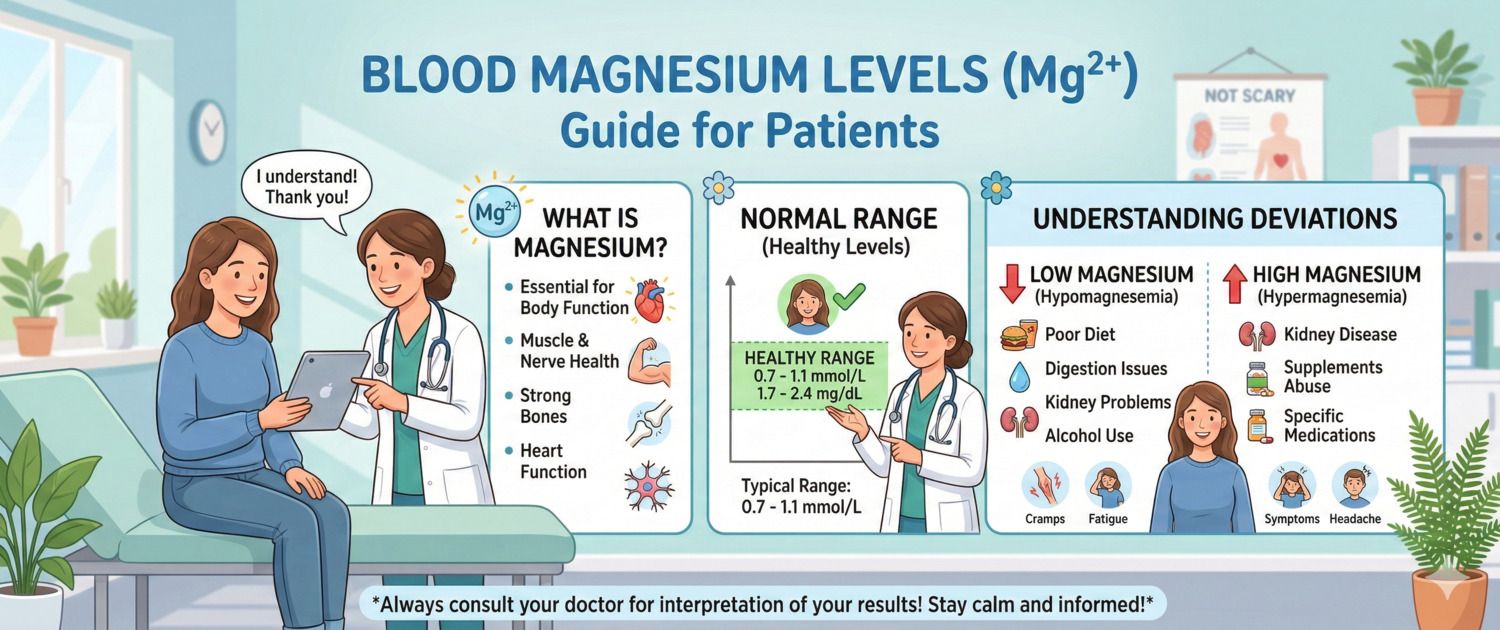
Magnesium is the fourth most abundant cation in the body and the second most abundant intracellular cation after potassium. It participates in more than 300 enzymatic reactions: protein and DNA synthesis, nerve impulse transmission, muscle contraction regulation, and cardiac rhythm maintenance. Yet a blood magnesium test is one of the most frequently overlooked laboratory investigations, even though deficiency affects 10–15% of the general population and 60–65% of ICU patients.
What the Magnesium Test Shows — and Why It Is Difficult to Interpret
The critical limitation of serum magnesium testing: serum reflects only approximately 1% of total body magnesium stores. The remaining 99% reside intracellularly — primarily in bone, muscle, and liver. This means a normal serum magnesium result does not exclude intracellular deficiency.
The body tightly maintains serum magnesium within a narrow range through renal regulation: when dietary intake falls, the kidneys increase magnesium reabsorption. Deficiency symptoms can appear before serum levels drop below the reference range — the classic "normal magnesium trap."
Nevertheless, serum magnesium remains the standard clinical diagnostic tool: when it is low, intracellular deficiency is guaranteed; when it is normal, deficiency is possible but not certain.
Normal Magnesium Levels
| Group | mmol/L | mg/dL |
|---|---|---|
| Adults | 0.75–1.25 | 1.82–3.04 |
| Children under 5 | 0.65–1.05 | 1.58–2.55 |
| Children 5–18 years | 0.70–1.20 | 1.70–2.92 |
| Pregnant women | 0.65–1.05 | 1.58–2.55 |
Unit conversion: 1 mmol/L = 2.43 mg/dL = 2.43 mEq/L.
During pregnancy, magnesium physiologically falls — partly from haemodilution, partly from increased fetal demand.
Clinically significant thresholds:
- < 0.5 mmol/L — severe hypomagnesaemia; risk of arrhythmia and seizures
1.5 mmol/L — hypermagnesaemia; neuromuscular conduction suppression
2.5 mmol/L — life-threatening hypermagnesaemia
How to Prepare for a Magnesium Blood Test
- Fasting: at least 8 hours after the last meal
- Magnesium supplements: stop 48–72 hours before the test — otherwise results reflect the supplement, not actual status
- Haemolysis sharply elevates results — intracellular magnesium is released from lysed red cells. A haemolysed sample is unsuitable for analysis
- Heparin (the tube anticoagulant) may reduce serum magnesium in some assay methods — check with the laboratory
- Time of day: diurnal magnesium variation is minimal; strict timing is not required
Causes of Low Magnesium (Hypomagnesaemia)
Hypomagnesaemia develops from insufficient intake, impaired absorption, or excessive losses.
Insufficient intake:
- Poor diet, starvation, alcoholism
- Parenteral nutrition without magnesium supplementation
- Prolonged tube feeding without adequate magnesium
Impaired intestinal absorption:
- Coeliac disease, Crohn's disease, short bowel syndrome
- Chronic diarrhoea of any cause
- Bariatric surgery
Excessive renal losses:
- Diuretics (loop and thiazide) — the most common iatrogenic cause
- Primary aldosteronism, Bartter syndrome
- Aminoglycoside antibiotics (gentamicin, amikacin)
- Cisplatin and other platinum agents — marked tubular toxicity
- Proton pump inhibitors (omeprazole, esomeprazole) with long-term use — reduce intestinal Mg²⁺ absorption
- Amphotericin B
Endocrine causes:
- Type 2 diabetes and type 1 diabetes — hyperglycaemia causes osmotic magnesium loss in urine; magnesium deficiency in turn worsens insulin sensitivity
- Hyperthyroidism — accelerated catabolism and urinary magnesium wasting
Other causes:
- Acute pancreatitis (saponification — magnesium soaps)
- Major burns
- Post-parathyroidectomy hungry bone syndrome
Symptoms of Magnesium Deficiency
Magnesium deficiency affects multiple systems simultaneously.
Neuromuscular symptoms — the most characteristic:
- Muscle cramps, especially in the legs and feet (nocturnal cramps)
- Tremor, muscle fasciculations
- Paraesthesiae — tingling, numbness
- Trousseau's sign (carpopedal spasm with blood pressure cuff inflation)
- Chvostek's sign (facial muscle contraction with facial nerve tapping)
Cardiovascular symptoms:
- Cardiac arrhythmias — tachycardia, ectopic beats, atrial fibrillation
- QT prolongation → risk of ventricular tachycardia (torsades de pointes)
- Arterial hypertension
Neuropsychiatric symptoms:
- Irritability, anxiety, depression
- Sleep disturbances
- Impaired concentration and memory
Associated laboratory abnormalities:
- Hypokalaemia — magnesium deficiency blocks renal potassium reabsorption; treatment-resistant hypokalaemia is a classic sign of concurrent magnesium deficiency
- Hypocalcaemia — magnesium deficiency impairs parathyroid hormone secretion and reduces end-organ responsiveness to PTH
The Magnesium–Vitamin D–Calcium Triangle
Magnesium, vitamin D, and calcium are three closely linked elements of mineral metabolism.
Magnesium and vitamin D: magnesium is required for two key vitamin D activation enzymes — hepatic 25-hydroxylase (producing 25-OH D) and renal 1α-hydroxylase (producing active calcitriol). In magnesium deficiency, vitamin D supplements are not properly activated: the 25(OH)D blood level normalises, but no biological effect is achieved — classic "vitamin D resistance" that resolves with magnesium repletion.
Magnesium and calcium: magnesium regulates PTH secretion and receptor sensitivity. In hypomagnesaemia, "functional hypoparathyroidism" develops — PTH is low or inadequate for the degree of hypocalcaemia. Hypocalcaemia in hypomagnesaemia does not respond to calcium supplementation until magnesium is first corrected.
Practical rule: in persistent hypocalcaemia or treatment-resistant hypokalaemia, always check magnesium.
Causes of High Magnesium (Hypermagnesaemia)
Hypermagnesaemia is less common than deficiency and is almost always iatrogenic or related to renal failure.
Main causes:
- Chronic kidney disease (especially CKD stages 4–5) — kidneys cannot excrete excess magnesium; in dialysis patients, magnesium content of the dialysate must be controlled
- Excessive magnesium administration: pre-eclampsia treatment (intravenous MgSO₄), overdose of magnesium supplements
- Magnesium-containing antacids and laxatives — especially in older adults with CKD
- Addison's disease (adrenocortical insufficiency)
- Severe hypothyroidism
Symptoms of hypermagnesaemia:
- Mild (1.25–1.75 mmol/L): nausea, weakness, reduced deep tendon reflexes
- Moderate (1.75–2.5 mmol/L): respiratory depression, hypotension, bradycardia
- Severe (> 2.5 mmol/L): respiratory arrest, potentially fatal cardiac arrhythmia
The antidote for acute severe hypermagnesaemia is intravenous calcium gluconate.
When to Order a Magnesium Blood Test
Indications:
- Seizures or muscle cramps of unclear aetiology, especially nocturnal cramps
- Cardiac arrhythmias, particularly atrial fibrillation
- Treatment-resistant hypokalaemia or hypocalcaemia
- Long-term use of diuretics, proton pump inhibitors, or cisplatin
- Diabetes mellitus — magnesium monitoring when glycaemic control is poor
- Severe diarrhoea or malabsorption syndromes
- Alcoholism
- After major surgery
- Resistance to vitamin D or calcium supplementation
Correcting Magnesium Deficiency
Oral supplements: magnesium citrate and glycinate — best bioavailability (up to 60%). Magnesium oxide — low bioavailability (~4%) but widely marketed. Magnesium sulphate orally — irritates the bowel; limited use.
Therapeutic dose: 300–600 mg elemental magnesium/day in 2–3 divided doses (splitting reduces diarrhoeal side effects).
Intravenous magnesium: for severe hypomagnesaemia (< 0.5 mmol/L), arrhythmias, seizures, or inability to take oral supplements — magnesium sulphate IV infusion in hospital.
Dietary sources of magnesium: pumpkin seeds (550 mg/100 g), nuts (200–300 mg/100 g), dark chocolate (230 mg/100 g), legumes (130–180 mg/100 g), whole grains, spinach, avocado.
This article is for informational purposes only and does not replace consultation with a qualified physician.
For informational purposes only
This article is for informational purposes only and does not constitute medical advice, diagnosis, or treatment. Please consult a healthcare professional for medical guidance.