Type 1 Diabetes: Symptoms, Diagnosis and Treatment
Reviewed by the LabReadAI medical team
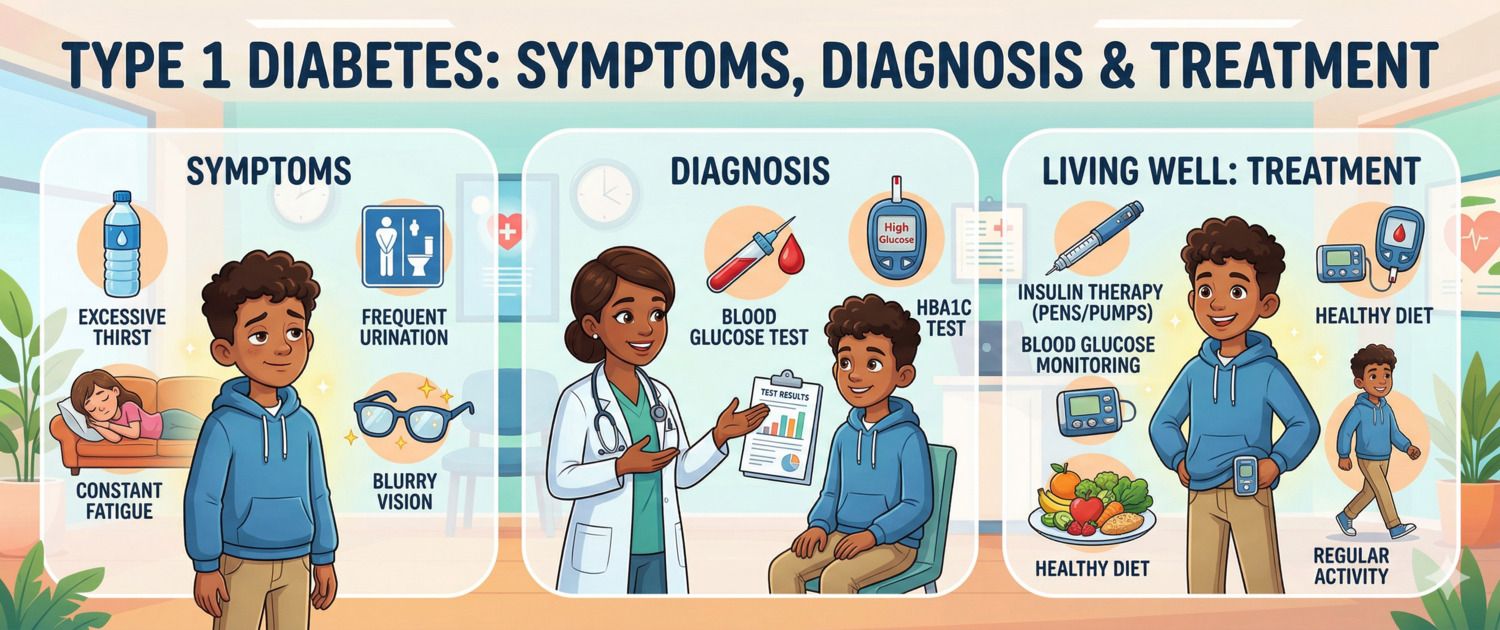
Type 1 diabetes is a disease that changes life in a single day. Yesterday a young person was healthy; today — thirst, frequent urination, rapid weight loss and, if the moment is missed, ketoacidosis and intensive care. Unlike type 2 diabetes, no diet will help and there is no "wait and see" period: the β-cells are gone, and insulin is needed from day one — for life.
What Type 1 Diabetes Is
Type 1 diabetes mellitus (T1DM) is a chronic autoimmune disease in which the immune system destroys the insulin-producing β-cells of the islets of Langerhans in the pancreas. When 80–90% of β-cells are lost, absolute insulin deficiency develops and clinical diabetes manifests.
Insulin is the key anabolic hormone: it unlocks cellular access to glucose. Without it, glucose accumulates in the blood (hyperglycaemia) while cells "starve." In response, the body switches to fat breakdown → ketone bodies are produced → metabolic acidosis develops (ketoacidosis) — a direct threat to life.
Epidemiology: T1DM accounts for 5–10% of all diabetes cases. Incidence is highest in children and adolescents (peak age 10–14 years), but T1DM can manifest at any age, including adults (LADA — latent autoimmune diabetes of adults). Incidence varies considerably by country and ethnicity.
Genetics and triggers: 90% of T1DM patients carry HLA-DR3 or HLA-DR4 haplotypes. Concordance in identical twins is only 30–50%, confirming that external triggers are required: viral infections (Coxsackievirus B), microbiome changes, early exposure to cow's milk protein. The precise mechanism initiating the autoimmune attack remains incompletely understood.
Onset Symptoms: When Time Cannot Be Wasted
The classic "four Ps" of T1DM presentation:
Polyuria — frequent, high-volume urination including at night. Mechanism: hyperglycaemia → glucose filtered into urine → osmotic diuresis → fluid and electrolyte loss.
Polydipsia — unquenchable thirst in response to fluid loss.
Weight loss — rapid loss (5–10 kg or more over a few weeks) without reduced appetite. Mechanism: cells cannot access glucose → catabolism of protein and fat.
Polyphagia — increased appetite despite ongoing weight loss (the paradox of "hunger amid plenty").
Additional symptoms: fatigue and weakness, blurred vision (from osmotic lens changes in hyperglycaemia), slow wound healing, fungal infections (candidiasis).
In children, onset is often rapid — progressing to full ketoacidosis within days. Secondary nocturnal enuresis in a previously toilet-trained child is a warning sign.
LADA (in adults): onset after age 30, frequently misclassified as T2DM. Distinguishing features: lean patient, rapid insulin requirement, positive autoantibodies (GADA, IA-2A).
Diagnosis of Type 1 Diabetes
Diagnostic criteria for diabetes (WHO)
Diabetes is diagnosed when at least one of the following is present:
- Fasting glucose ≥ 7.0 mmol/L (on two occasions)
- 2-hour glucose ≥ 11.1 mmol/L on OGTT
- Random glucose ≥ 11.1 mmol/L + symptoms
- HbA1c ≥ 6.5% (on two occasions)
With classic symptoms and random glucose ≥ 11.1 mmol/L, repeat confirmation is not required.
Specific markers of T1DM
Autoantibodies — confirm autoimmune aetiology:
- GADA (glutamic acid decarboxylase antibodies) — most sensitive; positive in 70–80%
- IA-2A (islet antigen-2 antibodies) — in 60–70%
- ZnT8A (zinc transporter 8 antibodies) — in 60–70%
- IAA (insulin autoantibodies) — important before insulin therapy begins
C-peptide — marker of residual insulin secretion. Markedly reduced or undetectable in T1DM. Distinguishes T1DM (low C-peptide) from T2DM (normal or elevated) and LADA.
Blood glucose and HbA1c — current and medium-term glycaemic assessment.
Urine ketones and blood β-hydroxybutyrate — when ketoacidosis is suspected.
Ketoacidosis — The Primary Threat at Onset and Decompensation
Diabetic ketoacidosis (DKA) is the most life-threatening acute complication of T1DM — often the initial presentation in undiagnosed patients or the result of missed insulin injections.
Mechanism: absolute insulin deficiency → intense lipolysis → hepatic ketogenesis → accumulation of β-hydroxybutyrate and acetoacetate → metabolic acidosis.
DKA symptoms:
- Nausea, vomiting, abdominal pain
- Acetone breath ("fruity" odour)
- Kussmaul breathing — deep, rapid compensatory respiration
- Dehydration, dry skin and mucous membranes
- Impaired consciousness to coma
Laboratory findings: glucose > 11 mmol/L, urine ketones +++, pH < 7.3, bicarbonate < 15 mmol/L, potassium may be normal or elevated despite total body K⁺ depletion.
DKA treatment: inpatient only — fluid resuscitation, intravenous insulin, electrolyte correction. Mortality in specialist centres < 1%; without treatment, fatal.
Insulin Therapy and Glucose Monitoring in Type 1 Diabetes
T1DM requires lifelong insulin replacement therapy — this is not a choice but a biological necessity.
Insulin regimens
Basal-bolus regimen — the physiological standard:
- Basal insulin (long-acting: glargine, detemir, degludec) — once or twice daily, covering background requirements
- Bolus insulin (rapid-acting: aspart, lispro, glulisine) — before each meal, dose calculated by carbohydrate content
Insulin pump (CSII) — continuous subcutaneous infusion of rapid-acting insulin. More precisely mimics physiological secretion; indicated for unstable glycaemia and frequent hypoglycaemia.
Glucose monitoring
Traditional self-monitoring (glucometer) — minimum 4 measurements daily (before meals and before bed).
Continuous glucose monitoring (CGM) — a subcutaneous sensor measures glucose every 1–5 minutes. Has revolutionised glycaemic control: reduces hypoglycaemia frequency (especially nocturnal) and time outside target range. "Time in range" (TIR, 3.9–10 mmol/L) is more informative than HbA1c alone for assessing control quality.
HbA1c — every 3 months with unstable control; every 6 months when stable. Target for most T1DM patients: < 7.0%.
Hypoglycaemia — the primary treatment risk
Hypoglycaemia (glucose < 3.9 mmol/L) is the most frequent acute complication of insulin therapy.
Mild symptoms: tremor, sweating, palpitations, anxiety, hunger — adrenergic. Severe hypoglycaemia (< 2.8 mmol/L): confusion, seizures, loss of consciousness — requires external assistance.
Treatment: the "15–15 rule" — 15 g of fast-acting carbohydrates (3–4 glucose tablets, 150 mL juice), recheck after 15 minutes; repeat if symptomatic. If unconscious — intramuscular glucagon or intravenous 40% dextrose.
Closed-loop technology
"Artificial pancreas" systems automatically adjust the pump's insulin delivery based on real-time CGM data. Commercially available systems (Omnipod 5, MiniMed 780G) have demonstrated significant TIR improvement and reduced hypoglycaemia frequency.
Long-Term Complications of T1DM
Chronic hyperglycaemia damages blood vessels and nerves:
Microvascular: diabetic retinopathy (leading cause of adult blindness), nephropathy (progresses to CKD), neuropathy (painful, autonomic).
Macrovascular: accelerated atherosclerosis → myocardial infarction, stroke, peripheral artery disease.
Each 1% reduction in HbA1c reduces the risk of microvascular complications by 25–35% — a powerful rationale for tight glycaemic control.
When to Seek Urgent Medical Attention
- Thirst + frequent urination + weight loss in a child or young adult — rule out T1DM; check blood glucose immediately
- Acetone breath, vomiting, abdominal pain in a patient with diabetes — signs of DKA; call emergency services immediately
- Loss of consciousness in a patient with diabetes — hypoglycaemia or DKA; emergency services
- Glucose > 15 mmol/L + urine ketones — do not wait; go to emergency care
In children the onset is often confused with ketosis — the difference is explained in ketotic syndrome in children.
Type 1 diabetes is itself autoimmune, and sometimes it is part of a wider picture — alongside autoimmune thyroiditis or adrenal insufficiency. When to suspect such a combination and what gets checked is covered in the article on polyendocrine syndrome.
This article is for informational purposes only and does not replace consultation with a qualified endocrinologist.
For informational purposes only
This article is for informational purposes only and does not constitute medical advice, diagnosis, or treatment. Please consult a healthcare professional for medical guidance.