Blood Glucose: Normal Range, Causes of High and Low Levels
Reviewed by the LabReadAI medical team
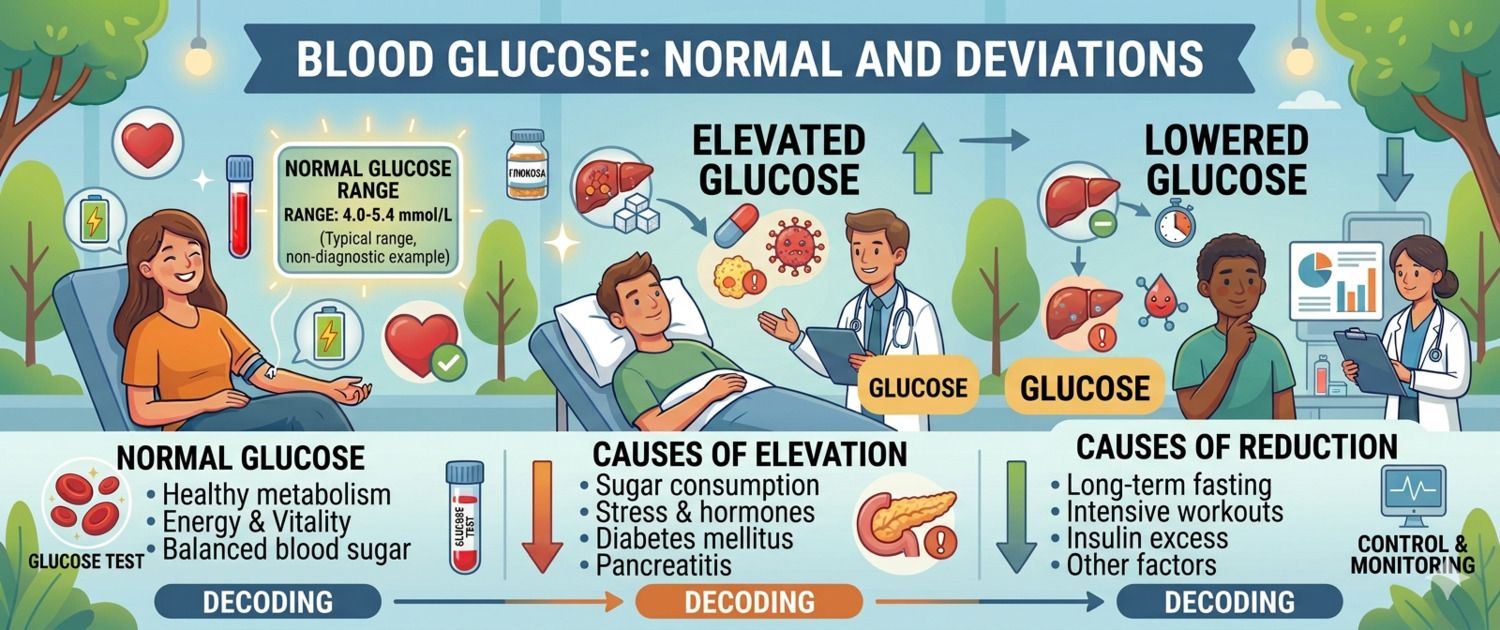
You got a blood test and see a number next to "GLU" — or your doctor mentioned "prediabetes" for the first time. Blood glucose is one of the most important health indicators, and understanding it matters to everyone, not just people with diabetes. Here's what normal looks like, what abnormal values mean, and how to prepare for the test so the result is actually reliable.
What Is Blood Glucose and Why Is It Measured
Glucose is the primary fuel for every cell in the body. The brain, muscles, and heart all run on glucose. It enters from food, is absorbed in the intestines, and distributed to tissues with the help of insulin — a hormone produced by the pancreas. Insulin acts like a key: it unlocks cells so glucose can enter.
When this mechanism breaks down, glucose accumulates in the blood. Chronically elevated glucose damages blood vessels, kidneys, nerves, and vision. That's why a blood glucose test is a standard part of any preventive check-up — ordered alongside a complete blood count and other baseline tests.
How to Prepare for the Test
Glucose is one of the most unstable blood values. Improper preparation makes the result meaningless.
- Strictly fasting, in the morning. At least 8–12 hours without food. Even black coffee or chewing gum can shift the result.
- Plain water is allowed — still, not sparkling.
- Avoid alcohol and intense exercise for 24 hours beforehand.
- Don't test during illness. Any infection temporarily raises glucose — the result will be unreliable.
- Tell your doctor about corticosteroids, diuretics, and oral contraceptives — they affect blood sugar levels.
If you're having a post-meal test or an oral glucose tolerance test, the conditions are different. Always confirm with your doctor or lab.
Normal Blood Glucose Levels in Adults
Normal ranges depend on when the blood was drawn — fasting or after eating:
| Timing | Normal | Prediabetes | Diabetes |
|---|---|---|---|
| Fasting (mmol/L) | 3.9–5.5 | 5.6–6.9 | ≥ 7.0 |
| 2h after eating (mmol/L) | < 7.8 | 7.8–11.0 | ≥ 11.1 |
| Fasting (mg/dL) | 70–99 | 100–125 | ≥ 126 |
| 2h after eating (mg/dL) | < 140 | 140–199 | ≥ 200 |
Values are for venous plasma — the standard in most modern laboratories. Fingerstick capillary values may differ slightly. Always use the reference range on your specific lab report.
One elevated result is not a diagnosis. Diabetes is only diagnosed when glucose is elevated on two separate occasions, or when elevated with characteristic symptoms.
Normal Glucose in Children
Children's fasting ranges are lower than adults' — a "lowish" value by the adult chart is most often a child's normal. Approximately:
| Age | Fasting normal (mmol/L) |
|---|---|
| Newborns | 2.8–4.4 |
| Children under 14 | 3.3–5.5 |
| Over 14 | 3.9–5.5 (as in adults) |
The key rule for a child's glucose test is strict fasting: children struggle with the fasting window, and "high sugar" after juice or breakfast is the most common false alarm. Persistently elevated fasting glucose with thirst, frequent urination and weight loss is a reason not to keep retesting but to see a pediatrician or pediatric endocrinologist promptly. You can have the whole report read against age-specific ranges on the child lab test decoding page.
High Blood Glucose: Prediabetes and Diabetes
Fasting glucose of 5.6–6.9 mmol/L (100–125 mg/dL) is prediabetes — impaired fasting glucose. This doesn't yet cause organ damage, but it's a signal: the regulation mechanism is already under strain. With lifestyle changes — weight loss, physical activity, dietary adjustments — prediabetes is reversible in most people.
Fasting glucose ≥ 7.0 mmol/L (≥ 126 mg/dL) on two tests is the diagnostic criterion for type 2 diabetes. This is a chronic condition requiring ongoing management.
Other causes of elevated glucose:
- Type 1 diabetes (autoimmune destruction of pancreatic beta cells)
- Acute stress, severe infection, heart attack — transient reactive hyperglycemia
- Corticosteroids, antipsychotics, thiazide diuretics
- Pancreatic disease (pancreatitis, pancreatic cancer)
- Endocrine disorders (Cushing's syndrome, acromegaly)
Symptoms of high blood sugar: thirst and dry mouth, frequent urination, fatigue, blurred vision, slow-healing wounds. In gradual-onset type 2 diabetes, symptoms may be absent for years — which is exactly why screening matters.
If glucose is elevated, it's also worth checking a urinalysis: when blood glucose exceeds the renal threshold (~10 mmol/L), glucose appears in the urine — an additional diagnostic signal.
Low Blood Glucose: Hypoglycemia
Glucose below 3.9 mmol/L (70 mg/dL) is hypoglycemia. The brain is particularly sensitive to fuel shortage: when blood sugar drops rapidly, symptoms appear — weakness, trembling, sweating, palpitations, confusion.
Main causes:
- Insulin overdose or excess blood sugar medication in diabetics
- Prolonged fasting or skipped meals
- Intense exercise without extra carbohydrate intake
- Alcohol on an empty stomach — alcohol blocks hepatic glucose production
- Rarely — insulinoma (a pancreatic tumor that secretes excess insulin)
Glucose below 2.8 mmol/L (50 mg/dL) can cause loss of consciousness. This is a medical emergency.
Glycated Hemoglobin (HbA1c)
A single glucose test is a snapshot of one moment. HbA1c reflects the average blood sugar level over the past 2–3 months: glucose binds irreversibly to hemoglobin in red blood cells, and the higher the sugar has been, the greater the percentage of "glycated" cells.
| HbA1c | Interpretation |
|---|---|
| < 5.7% | Normal |
| 5.7–6.4% | Prediabetes |
| ≥ 6.5% | Diabetes |
| > 7.0% (in diabetics) | Inadequate control |
HbA1c requires no fasting and is independent of time of day. It's used for both diagnosis and monitoring treatment effectiveness. It is not reliable in hemolytic anemia or certain hemoglobin disorders — in those cases, a glucose test is used instead.
When to Seek Urgent Medical Attention
- Fasting glucose ≥ 7.0 mmol/L (≥ 126 mg/dL) on two tests
- Glucose ≥ 11.1 mmol/L (≥ 200 mg/dL) at any time with symptoms
- Glucose < 2.8 mmol/L (< 50 mg/dL) — severe hypoglycemia, call emergency services
- Glucose found in a urinalysis for the first time — check blood glucose the same day
Routine visit: fasting glucose 5.6–6.9 mmol/L (prediabetes) — consult your GP or endocrinologist, lifestyle changes, retest in 3–6 months. For practical tips on how to lower blood sugar, see our dedicated article.
Conclusion
Blood glucose is one of the few lab values where even a small deviation deserves attention: prediabetes is reversible, diabetes is not. Annual screening from age 40 — or earlier with risk factors — catches the problem at the stage where it can still be stopped.
An elevated glucose result in one test is not a verdict — but it's not something to ignore either. Show the result to your doctor: they'll decide whether further testing is needed.
For informational purposes only
This article is for informational purposes only and does not constitute medical advice, diagnosis, or treatment. Please consult a healthcare professional for medical guidance.