Hemoglobin: Normal Range, Causes of Low and High Values
Reviewed by the LabReadAI medical team
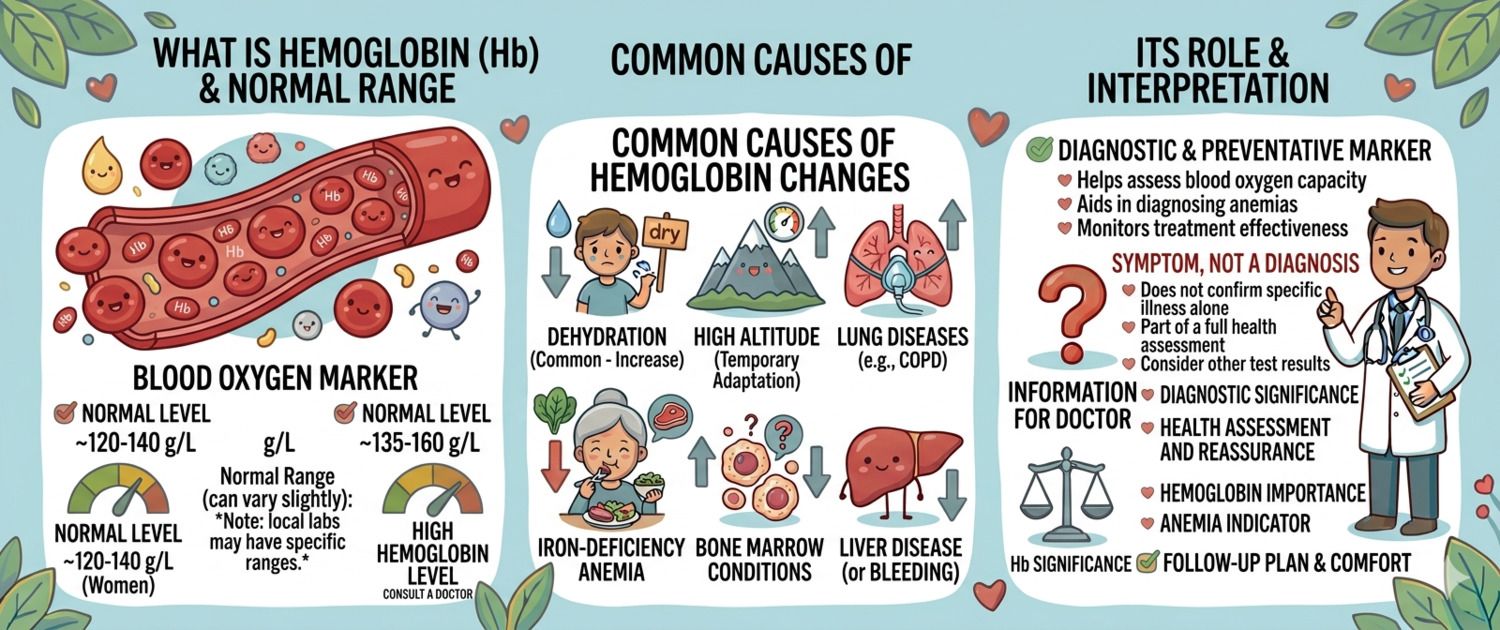
In a complete blood count, hemoglobin is the first value a doctor looks at. A downward arrow next to "HGB" signals anemia — and anemia always has a cause that needs to be found. Here's what the normal ranges look like for different groups, why hemoglobin drops, and what's behind it — from a simple iron deficiency to more serious conditions.
What Is Hemoglobin and What Does It Do
Hemoglobin is an iron-containing protein inside red blood cells that carries oxygen from the lungs to every cell in the body and returns carbon dioxide. Think of it as the lock in a taxi: the vehicle (red blood cell) without the lock (hemoglobin) can't carry the passenger (oxygen). When hemoglobin is low, tissues receive less oxygen — and the person feels it physically.
Hemoglobin contains iron — which is why iron-deficiency anemia is the most common cause of low hemoglobin, and why confirming it requires a separate ferritin and iron panel.
Normal Hemoglobin Levels in Adults
Normal values depend on sex and physiological state:
| Group | Normal (g/L) |
|---|---|
| Men | 130–170 |
| Women | 120–150 |
| Pregnant (1st trimester) | 110–150 |
| Pregnant (2nd–3rd trimester) | 105–120 |
Men have higher values — testosterone stimulates red blood cell production in the bone marrow. In women of reproductive age, levels are lower due to regular menstrual blood loss. During pregnancy, hemoglobin falls physiologically: plasma volume grows faster than red cell mass — the blood becomes "diluted." This is normal, but values below 105 g/L require ruling out iron-deficiency anemia.
Always use the reference ranges on your specific lab report.
Normal Hemoglobin in Children by Age
Children's hemoglobin follows its own schedule, and the adult chart does not apply. The ranges are approximate — labs and methods differ:
| Age | Normal (g/L) |
|---|---|
| Newborns (1–14 days) | 145–220 |
| 1 month | 100–180 |
| 2–3 months | 90–140 |
| 6 months – 2 years | 105–135 |
| 2–6 years | 110–140 |
| 6–12 years | 115–145 |
| 12–18 years | girls 120–155, boys 130–160 |
The most common parental worry — "low" hemoglobin at 2–3 months — is the physiological anemia of infancy, a natural dip as fetal hemoglobin is replaced by the adult form, not a disease. By adolescence the ranges split by sex, as in adults. A child's report should be read only against age-specific ranges — you can upload it and get every marker explained on the child lab test decoding page.
Low Hemoglobin: Types of Anemia and Their Causes
Low hemoglobin is the primary sign of anemia — but anemia is a syndrome, not a single diagnosis. The CBC pattern can point toward the cause before any additional tests.
Iron-deficiency anemia
The most common form — about 80% of all anemias. Low hemoglobin with low MCV and MCH (small, pale red blood cells). Causes: heavy menstrual bleeding, GI blood loss, pregnancy, and impaired iron absorption in celiac disease or after gastric surgery. Confirmed with a ferritin and iron panel.
B12 and folate deficiency anemia
Low hemoglobin with high MCV (large red blood cells). Seen in older adults, strict vegans, patients with atrophic gastritis or Crohn's disease, and those taking metformin. Hypersegmented neutrophils in the differential are a characteristic finding.
Anemia of chronic disease
Mild hemoglobin reduction accompanying chronic inflammation, autoimmune, or malignant conditions. Ferritin is normal or elevated — the key distinction from iron deficiency. Treatment targets the underlying condition, not iron levels.
Hemolytic anemia
Red blood cells are destroyed faster than they are produced. Can be hereditary (sickle cell, thalassemia) or acquired (autoimmune, drug-induced). Reticulocytes are elevated in the CBC.
Aplastic anemia
The bone marrow stops producing enough blood cells. All three cell lines fall simultaneously — hemoglobin, white blood cells, and platelets — a condition called pancytopenia. Rare but serious.
Symptoms of Low Hemoglobin
Symptom severity depends on how quickly hemoglobin has fallen and how low it is. With gradual decline, the body adapts — the person may go unaware for a long time.
Main signs: fatigue and weakness, pallor of skin and mucous membranes (check the inner lower eyelid), dizziness, shortness of breath on exertion, rapid heartbeat, headache.
In iron-deficiency anemia specifically: brittle and splitting nails, hair loss and thinning, dry skin, angular cheilitis (cracked mouth corners), pica (craving to eat ice, chalk, or dirt).
Anemia severity grades:
| Grade | Hemoglobin (g/L) |
|---|---|
| Mild | 90–120 (F) / 90–130 (M) |
| Moderate | 70–89 |
| Severe | below 70 |
High Hemoglobin: Causes
- Dehydration — the most common reason. Plasma volume drops, hemoglobin concentration rises falsely. Repeat the test after restoring normal fluid intake.
- Reactive erythrocytosis — a compensatory response to chronic hypoxia. Typical in smokers, people at high altitude, and patients with COPD or sleep apnea.
- Polycythemia vera — a bone marrow disorder. Rare but serious: hemoglobin can exceed 200 g/L, blood thickens, and thrombosis risk rises sharply.
Values above 185 g/L in men or 170 g/L in women require a medical evaluation.
When to See a Doctor
Routine visit — hemoglobin below normal with fatigue, pallor, or breathlessness; two consecutive low results.
Urgently:
- Hemoglobin below 70 g/L — severe anemia, often requires hospitalization
- Hemoglobin above 185 g/L (men) or 170 g/L (women)
- Rapid drop over a short period — possible occult bleeding
- Low hemoglobin with simultaneous drop in WBC and platelets (pancytopenia)
Conclusion
Hemoglobin is more than a number on a lab report — it's a measure of how much oxygen your tissues are getting. A drop in hemoglobin is always a symptom, never a standalone diagnosis. The type of anemia determines the treatment: iron-deficiency needs iron supplementation, B12-deficiency needs vitamin B12, anemia of chronic disease needs treatment of the underlying condition. For a detailed guide on how to increase hemoglobin, see our dedicated article.
Don't self-prescribe iron supplements without testing — they won't help B12-deficiency anemia. Always find the cause first.
For informational purposes only
This article is for informational purposes only and does not constitute medical advice, diagnosis, or treatment. Please consult a healthcare professional for medical guidance.