Platelets: Normal Count in Adults, Causes of Low and High Values
Reviewed by the LabReadAI medical team
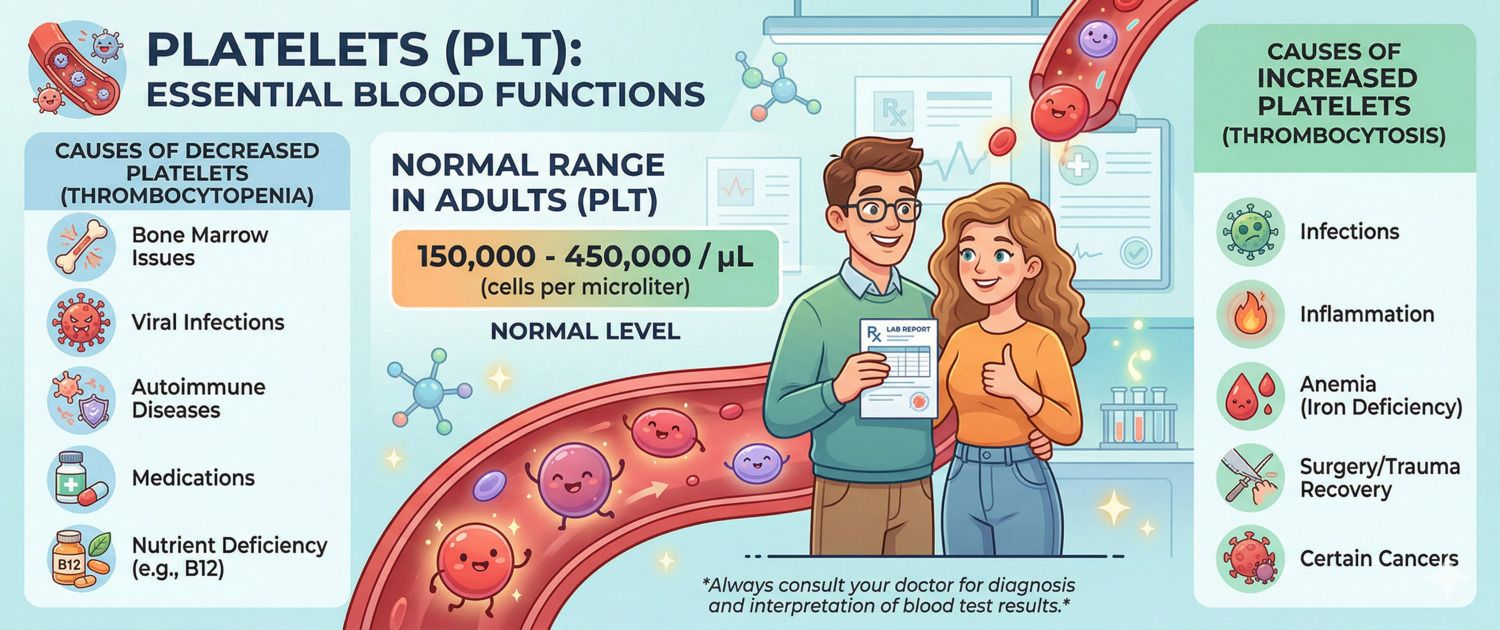
Platelets are the smallest cells in blood — but their role is critical: they are the first responders to blood vessel injury and the trigger for stopping bleeding. In a complete blood count, this value stands apart: abnormalities in both directions carry different risks — too few means bleeding risk, too many means clotting risk.
What Are Platelets and How Do They Work
Platelets are anucleate cells produced in the bone marrow from megakaryocytes. Their primary job is primary hemostasis: adhering to the damaged vessel wall, clumping together, and forming a platelet plug that stops bleeding. They also activate the clotting cascade and release growth factors that help tissues heal.
Platelets survive 7–10 days before being destroyed in the spleen. The balance between bone marrow production and splenic destruction determines their blood level.
Normal Platelet Count in Adults
PLT: 150–400 × 10⁹/L for adults of either sex.
In women, platelets may slightly decrease during menstruation. In pregnancy, mild reduction in the 2nd–3rd trimester (gestational thrombocytopenia) occurs in 5–10% of women — this is a normal variant requiring no treatment, and levels normalize after delivery.
Normal Platelet Count in Children
In newborns the range is wider than in adults, and through early childhood values sit above the adult range. Approximately:
| Age | Normal (× 10⁹/L) |
|---|---|
| Newborns | 150–450 |
| 1 month — 1 year | 180–500 |
| 1–6 years | 180–450 |
| 6–12 years | 160–450 |
| Over 12 years | 150–400 (as in adults) |
Newborns are allowed a wider spread, and mild deviations after a recent viral infection are common in children and usually transient — they are assessed over time. A child's report should be read as a whole against age-specific ranges — you can upload it on the child lab test decoding page.
Low Platelets: Thrombocytopenia
Thrombocytopenia — platelets below 150 × 10⁹/L. The mechanism can differ: insufficient bone marrow production, accelerated destruction, or redistribution (sequestration in the spleen).
Main causes:
- Immune thrombocytopenia (ITP) — autoantibodies destroy one's own platelets. The most common cause of isolated low platelets in adults.
- Viral infections — flu, mononucleosis, hepatitis, COVID-19 can temporarily lower platelets through several mechanisms.
- Drug-induced thrombocytopenia — heparin (especially dangerous HIT — heparin-induced thrombocytopenia), certain antibiotics, diuretics, anticonvulsants.
- Bone marrow disorders — aplastic anemia, leukemia, myelodysplasia. These conditions simultaneously lower hemoglobin and white blood cells.
- DIC (disseminated intravascular coagulation) — massive platelet consumption in sepsis, severe trauma, or obstetric emergencies.
- Hypersplenism — an enlarged spleen traps excess platelets.
Symptoms: petechiae (pinpoint skin hemorrhages resembling a rash), bruising from minimal trauma, prolonged bleeding from cuts, gum and nosebleeds, heavy periods. In severe thrombocytopenia — internal organ bleeding.
Risk by platelet level:
| Level (× 10⁹/L) | Clinical significance |
|---|---|
| 100–150 | Minimal risk — monitor |
| 50–100 | Moderate risk — activity restrictions |
| 20–50 | High risk — treatment indicated |
| < 20 | Critical — spontaneous bleeding risk |
High Platelets: Thrombocytosis
Thrombocytosis — platelets above 400 × 10⁹/L. The distinction between two types is critical.
Reactive (secondary) thrombocytosis — the most common form. It develops as a response to another process: iron deficiency, acute infections and inflammation, surgery, splenectomy. Platelets rarely exceed 700–800 × 10⁹/L, and the clotting risk is relatively low. It resolves once the underlying cause is treated.
Primary thrombocytosis (essential thrombocythemia) — a myeloproliferative bone marrow disorder. Platelets can exceed 1,000 × 10⁹/L, their function is impaired, and both clotting and bleeding risk are paradoxically high. Requires treatment by a hematologist.
When thrombocytosis is found alongside low hemoglobin, a ferritin test is the logical next step: correcting iron stores typically normalizes platelets too.
When to Seek Urgent Medical Attention
- Platelets below 50 × 10⁹/L — high bleeding risk
- Petechiae, spontaneous bruising, or nosebleeds not related to injury
- Platelets above 1,000 × 10⁹/L — risk of both clotting and bleeding
- Simultaneous fall in platelets, hemoglobin, and WBC — pancytopenia, emergency
- Sudden platelet drop in a patient receiving heparin — suspect HIT
Conclusion
Platelets work in concert with all other blood cells. An isolated high or low value is one conversation; simultaneous changes across multiple parameters is a very different one. That's why platelets are always evaluated in the context of the full CBC — never in isolation.
Significant platelet abnormalities must not be self-treated — the approach differs completely between thrombocytopenia and thrombocytosis. Only a doctor can identify the cause.
For informational purposes only
This article is for informational purposes only and does not constitute medical advice, diagnosis, or treatment. Please consult a healthcare professional for medical guidance.