Emotional Burnout: Symptoms and Which Lab Tests to Take
Reviewed by the LabReadAI medical team
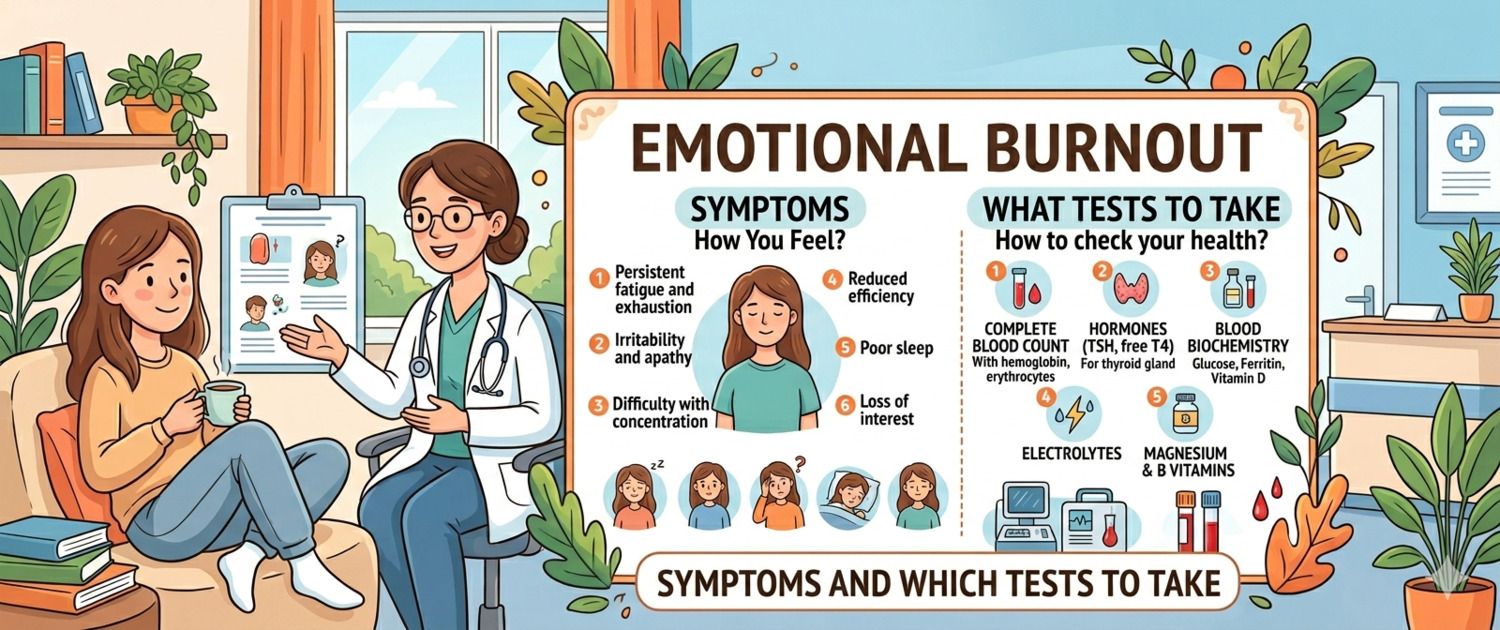
Emotional burnout is a diagnosis recognized by the WHO as a professional phenomenon — but not as a stand-alone disease. This creates a paradox: a person feels physically wrecked, yet "ordinary" tests come back "normal." Meanwhile the biochemistry of burnout is fairly well studied: the hormonal profile of someone in the exhaustion phase is predictable, and it is visible in the right laboratory markers. The key is not random testing but looking at specific markers of the stress system.
What Emotional Burnout Is: Symptoms and Stages
Emotional burnout is a sustained state of exhaustion developing in response to long-term professional or personal stress. By WHO classification (ICD-11), the burnout syndrome has three required features:
- Exhaustion — a sense of total fatigue not relieved by rest
- Cynicism and detachment — emotional distancing from work and people
- Reduced professional efficacy — the subjective sense of "I'm no longer coping"
The stages of burnout develop sequentially:
- Enthusiasm — high motivation, overwork seen as the norm
- Stagnation — first signs of fatigue, declining interest
- Frustration — irritability, sleep disturbance, somatic symptoms
- Apathy — detachment, the feeling that "nothing helps"
- Exhaustion — clinical burnout with the full symptom set
At stages 1–2, lab tests are usually normal. From stage 3 onward, biochemical shifts become visible. At stages 4–5, hormonal imbalance is overt and shows on a stress panel.
Somatic symptoms of burnout:
- Chronic fatigue, not relieved by sleep or holidays
- Insomnia: difficulty falling asleep, early awakenings, unrefreshed feeling
- Cognitive complaints — forgetfulness, scattered thinking, "brain fog"
- Weight and appetite changes
- Reduced libido, cycle disruption, erectile dysfunction
- Frequent infections, slower healing
- Anxiety, emotional lability, irritability
Burnout Biochemistry: Hormones and Cortisol Profile
Burnout is not only a psychological state but an endocrine one. Sustained HPA-axis activation passes through two phases:
Phase 1 (early stages): hypercortisolism. Cortisol is elevated (especially evening), DHEA-S is still normal or modestly reduced. The cortisol circadian rhythm flattens. The cortisol/DHEA-S ratio shifts toward cortisol.
Phase 2 (exhaustion): hypocortisolism. Morning cortisol falls (the adrenals can no longer keep up with the chronic load), evening cortisol may stay high. DHEA-S drops sharply. This is what alternative medicine often miscalls "adrenal fatigue" — yet it does have a real laboratory correlate.
In parallel, thyroid function changes: chronic hypercortisolism suppresses T4-to-T3 conversion, producing "low-T3 syndrome" with fatigue and low stress tolerance. TSH is often in the upper-normal range (3–4 mIU/L) — formally normal, clinically a marker of functional thyroid overload.
Falling ferritin is a separate theme: chronic stress impairs iron absorption, and gut inflammation reduces its availability. Low ferritin worsens fatigue and disrupts sleep.
Which Tests to Take for Burnout
The base set for assessing the lab profile of burnout:
Morning cortisol (8:00–10:00) and evening cortisol (4:00–6:00 PM) — circadian rhythm assessment. A flattened rhythm or low morning cortisol is the biochemical signature of late stages.
DHEA-S — the lower the DHEA/cortisol ratio, the deeper the stage. In a young patient with confirmed burnout, DHEA-S often matches the level of a 60-year-old.
ACTH (optional) — locates the lesion within the HPA axis. Usually normal in early stages, may be modestly low in late stages.
TSH + free T4 (+ free T3 if indicated) — to exclude hypothyroidism and assess thyroid hormone conversion. Target TSH in burnout is < 2.5 mIU/L.
Ferritin — desirable target for sleep and energy is > 50 ng/mL; in burnout often below 30.
Vitamin D, B12, folate, magnesium — the principal nutrients whose deficiency amplifies any stress reactivity.
Fasting glucose + insulin — hypercortisolism drives insulin resistance, and catching it early changes tactics.
Inflammation profile: CRP, ferritin (as an acute-phase marker), homocysteine where available.
The base block (cortisol × 2, DHEA-S, ACTH, prolactin) is conveniently drawn as one adrenal stress panel; the thyroid block — as a thyroid panel; the sleep-related block — as a sleep disorders panel.
Interpretation: Typical Burnout Patterns
Early burnout (stages 2–3): morning cortisol upper-normal or modestly elevated; evening cortisol elevated; DHEA-S normal or slightly reduced; TSH 2.5–4.0; ferritin 30–60. Strategy: lifestyle and baseline anti-stress measures (sleep, nutrition, exercise).
Mid burnout (stages 3–4): morning cortisol upper-normal or normal; evening significantly elevated; flattened circadian rhythm; DHEA-S 30–50% below age norm; ferritin < 30; subclinical hypothyroidism is common. Strategy: clinician support, replacement of deficiencies, work and load review.
Late burnout (stage 5): morning cortisol low (< 200 nmol/L); DHEA-S sharply reduced; prolactin may be elevated; complete loss of circadian rhythm. At this stage self-driven measures are largely ineffective — clinical strategy is required, often with a long pause from work.
For details on the cortisol/DHEA-S ratio see the article on how to lower cortisol.
Nutrient Deficiencies That Amplify Burnout Syndrome
Burnout rarely exists in pure form. Usually it "assembles" from hormonal imbalance plus nutrient deficits. The most common hidden amplifiers:
- Iron/ferritin — low ferritin causes fatigue, poor sleep, restless legs syndrome. In women of reproductive age — almost always the first candidate to check.
- Vitamin D — receptors in the hypothalamus and immune system. Deficiency < 30 ng/mL worsens anxiety and sleep.
- Vitamin B12 and folate — critical for neurotransmitter synthesis; deficiency mimics burnout symptoms.
- Magnesium — a GABA and melatonin synthesis cofactor and a cortisol antagonist; deficiency is an independent driver of insomnia and anxiety.
- Omega-3 fatty acids — low intake correlates with poorer stress resilience and stronger cortisol reactivity.
- Glucose dysregulation — frequent hypoglycemias activate the HPA axis and worsen burnout.
Without correcting deficiencies, anti-stress strategies underperform: the body can't "lower" cortisol while missing basic building blocks.
Professional Burnout vs Depression: How to Tell
This is the most common diagnostic dilemma. Symptoms overlap: fatigue, low mood, sleep disturbance, loss of interest. A third candidate often belongs in the same row — ADHD gives the same inattention but runs from childhood and does not lift on holiday; all the versions are compared in ADHD or burnout, anxiety, depression. The differences are:
- Trigger. Burnout is tightly bound to a specific context (work, role); depression often arises without an obvious external trigger.
- Preserved interests outside work. In burnout the person can still enjoy personal life, hobbies, friends; in depression anhedonia spreads to all spheres.
- Response to rest. Burnout partially eases with extended rest and a change of environment; depression does not.
- Biochemistry. Burnout shows a characteristic stress-panel pattern; depression may have a normal stress panel but altered monoamine metabolism and neuroinflammatory markers.
- Self-image. Burnout: "I'm tired." Depression: "I'm bad / guilty / worthless."
In practice, burnout and depression often coexist, and late burnout often develops into full depression. So with suspected severe burnout, a parallel consultation with a psychotherapist or psychiatrist is wise — not just an endocrinologist.
Burnout Recovery and When to See a Doctor
Self-care (sleep, nutrition, work limits) is appropriate in early stages. Hard criteria for in-person consultation:
- Burnout lasting more than 3 months and unresponsive to rest
- Anxiety, depressive thoughts, suicidal ideation — emergency psychiatric consultation
- Morning cortisol < 138 nmol/L — workup for adrenal insufficiency
- Morning cortisol > 690 nmol/L on two measurements — suspected hypercortisolism, dexamethasone testing required
- Somatic symptoms (weight loss > 10%, arrhythmia, marked weakness) — primary care + endocrinology
- Concurrent menstrual disruption, infertility, or erectile dysfunction — comprehensive hormone workup
If the exhaustion has run for months and rest has stopped restoring, the non-laboratory side is worth a look too: what burnout is and why it is not an illness and what gets checked first when there is no energy for anything.
This article is for informational purposes only and does not replace professional medical advice. Recovery from burnout is a clinical, psychological, and organizational process at once.
For informational purposes only
This article is for informational purposes only and does not constitute medical advice, diagnosis, or treatment. Please consult a healthcare professional for medical guidance.