How to Lower Cortisol: Causes of High Levels and How to Reduce
Reviewed by the LabReadAI medical team
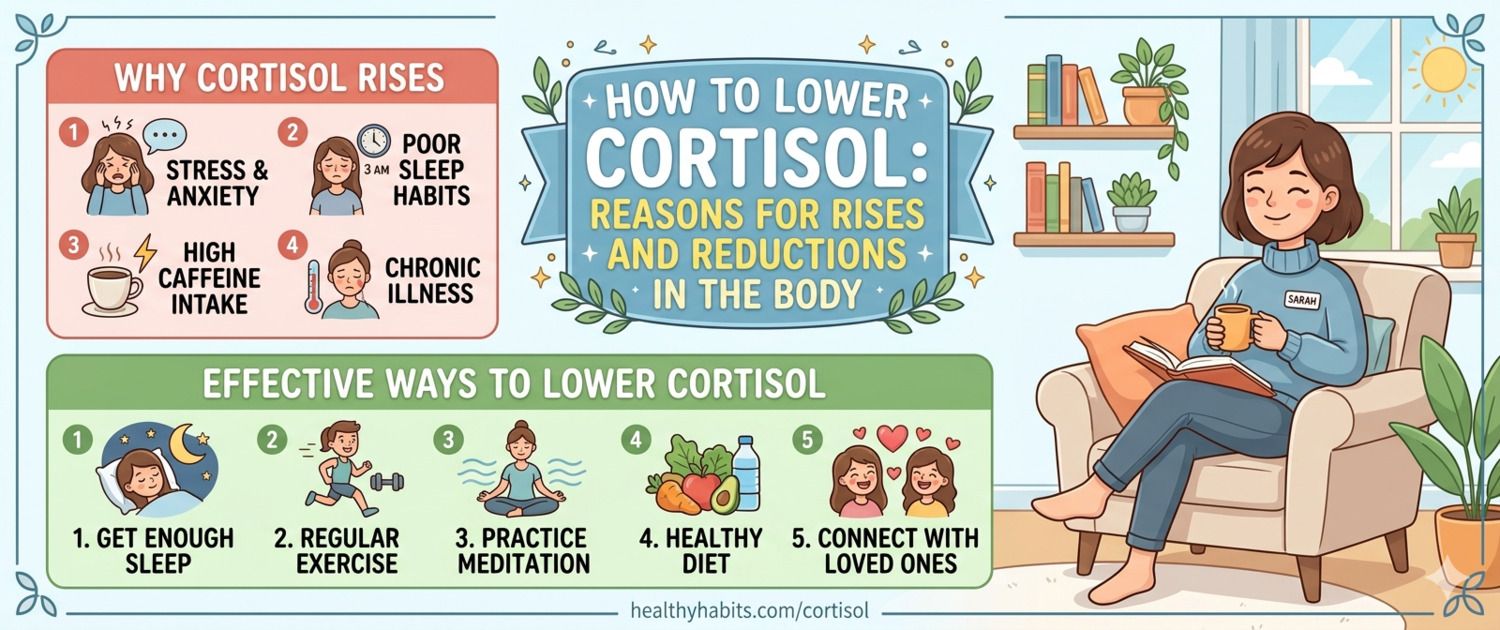
"Lower your cortisol" sounds like a universal recommendation — in reality it is a poorly framed task. Cortisol is not a "toxin" but a vital hormone. The problem is not its presence but chronic overload of the stress system. Before doing anything to cortisol you must know whether it is truly elevated, why, and how persistently. Only then can you choose a strategy — because the approach for functional hypercortisolism and the approach for Cushing's syndrome are radically different.
Why Lower Cortisol and Who Needs To
Cortisol is the hormone that mobilizes the body in response to stress. Acutely it saves lives: raises glucose, supports blood pressure, suppresses inflammation. But under chronic activation, cortisol begins to do exactly what it should protect against — breaking down muscle, raising blood pressure, impairing immunity, depositing abdominal fat, and suppressing sex hormones.
Lowering cortisol makes sense when its elevation is laboratory-confirmed or clinically obvious. Simply because someone "is anxious a lot" is not enough grounds for intervention. The real indications are usually these:
- Confirmed functional hypercortisolism (moderate elevation with normal dexamethasone suppression)
- Prolonged psychoemotional stress with symptoms and accompanying lab findings (low ferritin, rising TSH, reduced DHEA-S)
- Early burnout with loss of cortisol's circadian rhythm
- Chronic stress in perimenopausal women — here lowering cortisol directly improves other hormonal axes
Important exception: in Cushing's syndrome, lifestyle measures do not lower cortisol — medication or surgery is required. For details, see the article on Cushing's syndrome.
Symptoms of Chronically Elevated Cortisol
Chronic hypercortisolism rarely produces a "clean" picture — it usually appears as a combination of nonspecific symptoms:
- Central obesity (abdomen, neck, face) with thin arms and legs
- Hypertension poorly responsive to standard medications
- Insomnia with awakenings at 3–4 AM
- Fatigue, especially in the second half of the day
- Reduced libido, menstrual disruption, erectile dysfunction
- Sweet and salty cravings, frequent snacking
- Irritability, anxiety, the sense that "the mind won't switch off"
- Skin thinning, easy bruising
- Reduced muscle strength, especially proximal leg muscles
If 4 or more of these features are present — that's a reason for laboratory testing. Striae wider than 1 cm with a purple hue — a mandatory referral to an endocrinologist.
Which Tests to Take Before Lowering Cortisol
Without an objective baseline measurement, every intervention is a gamble. Minimum set:
Morning cortisol (8:00–10:00) — the baseline value. Reference range 138–690 nmol/L. A value above 690 in two independent measurements requires workup.
Evening cortisol (4:00–6:00 PM) — circadian rhythm assessment. In a healthy person, evening is 2–3-fold lower than morning. A flattened rhythm signals functional or organic hypercortisolism.
DHEA-S — for the cortisol/DHEA-S ratio. Low DHEA-S with high cortisol is a burnout biomarker.
ACTH — not required at baseline, but useful with marked cortisol elevation to localize the lesion.
Additionally — TSH, ferritin, vitamin D, fasting insulin, magnesium: often the root cause is not cortisol per se but underlying deficiencies that amplify stress reactivity.
The most convenient approach is to draw all of these as part of an adrenal stress panel, which includes both cortisol time points, DHEA-S, ACTH, and prolactin in a single visit.
Morning vs Evening Cortisol: What Matters
"High morning cortisol" and "high evening cortisol" are biochemically distinct problems requiring different strategies.
High morning cortisol — usually a sign of HPA-axis hyperreactivity to wake-up. Often associated with anxiety, early awakenings, anticipation of the workday. What helps: morning slowdown techniques (10–15 min meditation), avoiding coffee on an empty stomach, an early breakfast with protein and complex carbs.
High evening cortisol — clinically more serious: "the brain won't switch off," the person can't fall asleep, the mind keeps working. Often the consequence of late screen use, late-evening training, caffeine after 2 PM. What helps: a digital detox 1–2 hours before bed, moving training to the first half of the day, restricting caffeine to before noon.
Flattened circadian rhythm (evening close to morning) — the most serious pattern, requiring in-person endocrinology evaluation to exclude Cushing's syndrome. Not a self-management problem — dexamethasone testing and imaging are needed here.
Sleep, Nutrition and Physical Activity
The most powerful long-term levers for lowering functional cortisol are not supplements but the basics: sleep, food, movement.
Sleep. A consistent schedule (in bed by 11 PM) and a duration of 7–9 hours lower evening cortisol more than any supplement. Adequate sleep matters more than perfect nutrition: a single night with 4 hours of sleep raises the next evening's cortisol by 30–50%.
Nutrition.
- Stable blood sugar — priority #1. Sharp drops in glucose trigger cortisol release. Eat every 4–5 hours, combining protein with slow carbs.
- Adequate protein: at least 1.2–1.6 g/kg body weight. Chronic amino acid deficiency directly activates the HPA axis.
- Magnesium: 300–400 mg/day from food and/or supplements (preferably glycinate or citrate). Magnesium deficiency is an independent driver of elevated cortisol.
- Omega-3 fatty acids: 1–2 g EPA+DHA daily reduces HPA-axis reactivity.
- Caffeine: cap at 200 mg before noon. Coffee after 2 PM raises evening cortisol by 18–24% even in caffeine-tolerant people.
- Alcohol: even moderate intake raises nighttime cortisol and disrupts sleep architecture.
Physical activity.
- Regular moderate exercise (7–10k steps walking, swimming, yoga) lowers baseline cortisol.
- Strength training 2–3 times per week — the best strategy for raising the DHEA/cortisol ratio.
- High-intensity training more than 4 times per week or sessions longer than 60–75 minutes on an empty stomach raise cortisol. This is "training-induced hypercortisolism" in over-trained athletes — not normal.
Adaptogens: What the Evidence Supports
Adaptogens are plant compounds with conditionally validated stress-protective effects. Their reputation swings between "panacea" and "marketing." Here's the actual picture from controlled trials:
- Ashwagandha (Withania somnifera) 300–600 mg/day — the most studied adaptogen; in placebo-controlled trials it lowers cortisol by 20–30% in people with confirmed stress.
- Rhodiola rosea 200–400 mg/day — reduces fatigue and improves cognitive function in burnout; the cortisol effect is less robust.
- Phosphatidylserine 300–600 mg/day — a membrane phospholipid that blunts the cortisol response to exercise.
- L-theanine 200–400 mg — a tea-derived amino acid that does not directly lower cortisol but reduces subjective anxiety.
What does not work (or works at the placebo edge): regular ginseng, eleuthero (low-quality evidence), and most "anti-stress" supplements based on a vitamin blend.
Adaptogens do not replace sleep, food, and a clinician. And they are not indicated in confirmed Cushing's syndrome. Always consult a clinician before use, especially in pregnancy, autoimmune disease, or psychotropic medication.
When Lowering Cortisol Requires a Doctor
Self-management is appropriate only for moderate functional disturbances. Hard criteria for in-person endocrinology consultation:
- Morning cortisol > 690 nmol/L on two independent measurements — dexamethasone testing and ACTH evaluation are required
- Flattened circadian rhythm (evening > 75% of morning) — Cushing's screening required
- Striae wider than 1 cm with purple hue + central obesity + resistant hypertension — high probability of Cushing's syndrome
- Low morning cortisol (< 138 nmol/L) with fatigue and hypotension — workup for adrenal insufficiency
- Long-term glucocorticoid use with attempted withdrawal — mandatory cortisol and ACTH monitoring
- Infertility and cycle disruption with central obesity — HPA-axis evaluation
Additional context on hormonal balance in women is covered in the article on how to lower cortisol in women, with phase-specific considerations and interactions with sex hormones.
What Does NOT Lower Cortisol
A list of items often marketed as "lowering cortisol" that don't actually work or work only briefly:
- "Anti-stress" supplements with B-vitamin blends — without confirmed deficiency, vitamins change nothing
- Fasted-cardio marathons — raise, not lower, cortisol
- "Detox cleanses" and fasts > 24 hours — a powerful HPA-axis stressor
- Keto diets without adaptation — raise cortisol by 30–60% in the first 4–6 weeks
- Training to failure 5–6 times per week — leads to overtraining syndrome with the classic chronic-hypercortisolism picture
- Herbal "anti-stress blends" without standardization or dose listings — random effects
Lowering cortisol is a marathon, not a sprint. Real lab improvement under a properly chosen strategy is visible at 6–12 weeks, not in a week.
This article is for informational purposes only and does not replace professional medical advice. Cortisol-lowering decisions require laboratory testing and consultation with a clinician.
For informational purposes only
This article is for informational purposes only and does not constitute medical advice, diagnosis, or treatment. Please consult a healthcare professional for medical guidance.