Cushing's Syndrome: Symptoms, Causes and Diagnosis
Reviewed by the LabReadAI medical team
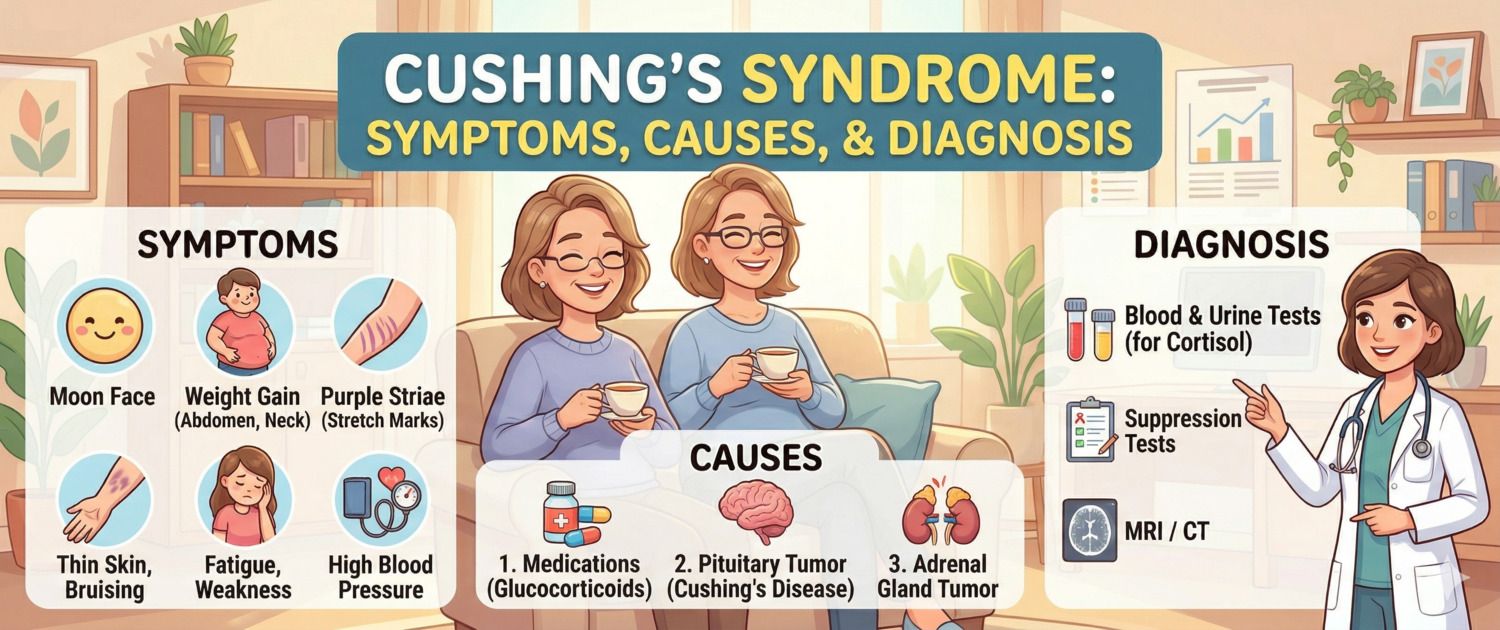
A moon-shaped face, a fat hump on the back of the neck, purple stretch marks across the abdomen, and blood pressure that refuses to respond to treatment — if this cluster of findings appeared over a matter of months, it is not simply weight gain or fatigue. Cushing's syndrome is one of the most serious endocrine disorders, in which the body is saturated with excess cortisol for months or years. Without treatment it simultaneously destroys bones, blood vessels, immunity, and mental health.
What Is Cushing's Syndrome and How It Differs from Cushing's Disease
Cushing's syndrome is the clinical picture that results from prolonged exposure of body tissues to excess glucocorticoids — primarily cortisol. Two terms are frequently confused:
- Cushing's disease — a specific cause of the syndrome: a pituitary adenoma that secretes excess ACTH. ACTH stimulates the adrenal glands, which produce too much cortisol.
- Cushing's syndrome — the broader term: any source of excess cortisol, including adrenal tumours, ectopic ACTH secretion by non-pituitary tumours, and — the most common cause globally — long-term glucocorticoid medication use (iatrogenic Cushing's syndrome).
In practice, Cushing's disease (pituitary origin) accounts for approximately 70% of endogenous cases, so the two terms are often used interchangeably in clinical speech — technically incorrectly.
Cortisol is essential in normal amounts: it regulates the stress response, maintains blood pressure, participates in glucose metabolism, and restrains excessive inflammation. The problem begins when there is too much for too long. Excess cortisol acts as a systemic wrecker: it breaks down muscle, redistributes fat, raises blood pressure, disrupts glucose regulation, suppresses immunity, and thins bones.
Causes of Cushing's Syndrome
Iatrogenic (drug-induced) — the most common cause worldwide. Long-term use of prednisolone, dexamethasone, or other glucocorticoids for asthma, rheumatoid arthritis, inflammatory bowel disease, or other conditions reproduces the full clinical picture of Cushing's syndrome. This form does not require a tumour search — only therapy adjustment.
Cushing's disease (ACTH-secreting pituitary adenoma) — 65–70% of endogenous cases. Most commonly a microadenoma (< 10 mm) — so small that MRI may not detect it even with obvious clinical signs. Three to five times more common in women, peak age 20–45 years.
Adrenal tumours (adenoma or carcinoma) — 15–20% of endogenous cases. The adrenal tumour autonomously produces cortisol, ignoring regulatory signals from the pituitary. ACTH is suppressed — an important diagnostic clue.
Ectopic ACTH secretion — lung tumours (especially small-cell carcinoma), pancreatic tumours, thymoma, or carcinoids secrete ACTH. The ectopic form often progresses rapidly and severely: the classic Cushingoid appearance may not have time to develop. Cortisol and ACTH levels are extremely high.
Symptoms of Cushing's Syndrome: The Classic Picture
Cushing's syndrome has several signs that together create an almost unmistakeable appearance — yet each individual sign occurs in many other conditions.
Fat redistribution:
- central obesity — prominent abdomen with relatively thin arms and legs;
- "moon face" — rounded, full, with flushed cheeks;
- "buffalo hump" — a fat pad between the shoulder blades at the back of the neck.
Skin changes — among the most specific signs:
- purple striae (stretch marks) > 1 cm wide on the abdomen, thighs, and armpits — violaceous, not the pale marks of ordinary weight gain;
- thinning of the skin with easy bruising from minor trauma;
- slow wound healing;
- acne, skin hyperpigmentation.
Muscle weakness — cortisol degrades muscle protein. Proximal muscle weakness is characteristic: difficulty rising from a chair without arm support, climbing stairs, lifting arms above the head.
Arterial hypertension — present in 70–85% of patients. Cortisol promotes sodium retention and activates mineralocorticoid receptors. Hypertension in Cushing's syndrome often responds poorly to standard antihypertensive regimens.
Glucose dysregulation — glucose is elevated in 30–40% of patients; 10–15% develop overt diabetes. HbA1c is frequently raised even when fasting glucose appears normal.
Osteoporosis — cortisol suppresses osteoblasts and enhances bone resorption. Vertebral compression fractures are a frequent serious complication.
Menstrual and sexual dysfunction — in women, periods become irregular or stop; in men, testosterone and libido fall.
Psychiatric disorders — depression, anxiety, emotional lability, memory and concentration difficulties. Occasionally severe psychosis. Psychiatric symptoms in Cushing's syndrome are not a reaction to illness — they are the direct biochemical effect of cortisol on the brain.
Immunosuppression — susceptibility to frequent infections, unusual organisms (fungi, atypical mycobacteria), and poor recovery from them.
Diagnosis: How to Confirm Cushing's Syndrome
Diagnosis proceeds in two stages: first confirm hypercortisolism, then localise its source.
Stage 1 — Confirming hypercortisolism (screening tests):
A single elevated serum cortisol is insufficient — cortisol normally follows a diurnal rhythm and spikes with any stress, including venepuncture itself. Three confirming tests are used:
- 24-hour urinary free cortisol — integrates secretion over the whole day. Normal < 250 nmol/day. Elevation more than 3–4 times the upper limit is a strong argument for the diagnosis.
- Overnight 1 mg dexamethasone suppression test — 1 mg of dexamethasone is taken in the evening; morning cortisol should suppress below 50 nmol/L. Failure to suppress is pathological.
- Late-night salivary cortisol — in Cushing's syndrome the normal nocturnal cortisol nadir is lost. Midnight cortisol remains inappropriately high.
The diagnosis requires two positive tests.
Stage 2 — Source localisation:
- Plasma ACTH — the key differentiating test. Elevated ACTH → pituitary or ectopic source. Suppressed ACTH → adrenal source.
- Pituitary MRI — when ACTH is elevated. Caveat: up to 40% of pituitary adenomas in Cushing's disease are invisible even on modern MRI.
- Adrenal CT — when ACTH is suppressed.
- Bilateral inferior petrosal sinus sampling (BIPSS) — the gold standard for confirming pituitary versus ectopic ACTH source when the picture is unclear; ACTH is measured in venous drainage from the pituitary and compared with peripheral levels.
- PET-CT or somatostatin scintigraphy — for locating an ectopic source.
Alongside diagnostic tests, consequences are assessed: blood potassium (hypokalaemia is characteristic of ectopic disease and requires differential diagnosis from primary aldosteronism, which also presents with resistant hypertension and hypokalaemia), glucose, LDH when malignancy is suspected, and bone densitometry.
Treatment of Cushing's Syndrome
Treatment differs fundamentally depending on the cause.
Iatrogenic Cushing's syndrome — gradual tapering of the glucocorticoid dose under medical supervision. Abrupt withdrawal is dangerous: the adrenal glands have atrophied and cannot immediately resume normal secretion, risking acute adrenal insufficiency.
Cushing's disease — transsphenoidal adenomectomy (endoscopic removal of the pituitary adenoma through the nose). Remission rates of 70–90% at expert centres. For recurrence or inoperable cases: repeat surgery, pituitary radiation, bilateral adrenalectomy (as a last resort), or pharmacological cortisol suppression.
Adrenal tumour — laparoscopic or open adrenalectomy. For a benign adenoma, surgery is almost always curative. For adrenocortical carcinoma, prognosis is considerably worse and additional mitotane therapy is required.
Ectopic ACTH secretion — removal of the tumour source; if unresectable, pharmacological cortisol suppression (ketoconazole, metyrapone, mitotane) or bilateral adrenalectomy.
After successful treatment, patients frequently go through a period of adrenal insufficiency requiring replacement therapy: adrenal glands suppressed for years cannot immediately resume normal function.
Complications and Prognosis
Untreated Cushing's syndrome shortens life: mortality is five times higher than in the general population — primarily from cardiovascular events, infections, and complications of type 2 diabetes. With successful treatment, most features are reversible, though full recovery of bone density and muscle mass takes years.
After bilateral adrenalectomy for Cushing's disease, Nelson's syndrome can develop: freed from cortisol's suppressive effect, the pituitary adenoma grows aggressively, driving an extreme rise in ACTH and generalised skin hyperpigmentation.
When to Seek Medical Attention
See an endocrinologist promptly if any of the following combination has developed or worsened over the past 6–12 months:
- rapid weight gain around the abdomen and face while limbs remain thin;
- wide purple marks on the abdomen or thighs;
- muscle weakness on rising from a chair or climbing stairs;
- blood pressure unresponsive to two or three medications;
- frequent infections or wounds that will not heal;
- irregular periods in a young woman without obvious cause.
Cushing's syndrome is a rare diagnosis — and that rarity causes delay: the average time from first symptom to diagnosis is 3–6 years. Do not interpret your symptoms on your own; see a doctor who can order the appropriate hormonal tests.
For informational purposes only
This article is for informational purposes only and does not constitute medical advice, diagnosis, or treatment. Please consult a healthcare professional for medical guidance.