Morning Cortisol: Normal Range, Elevation and Test Interpretation
Reviewed by the LabReadAI medical team
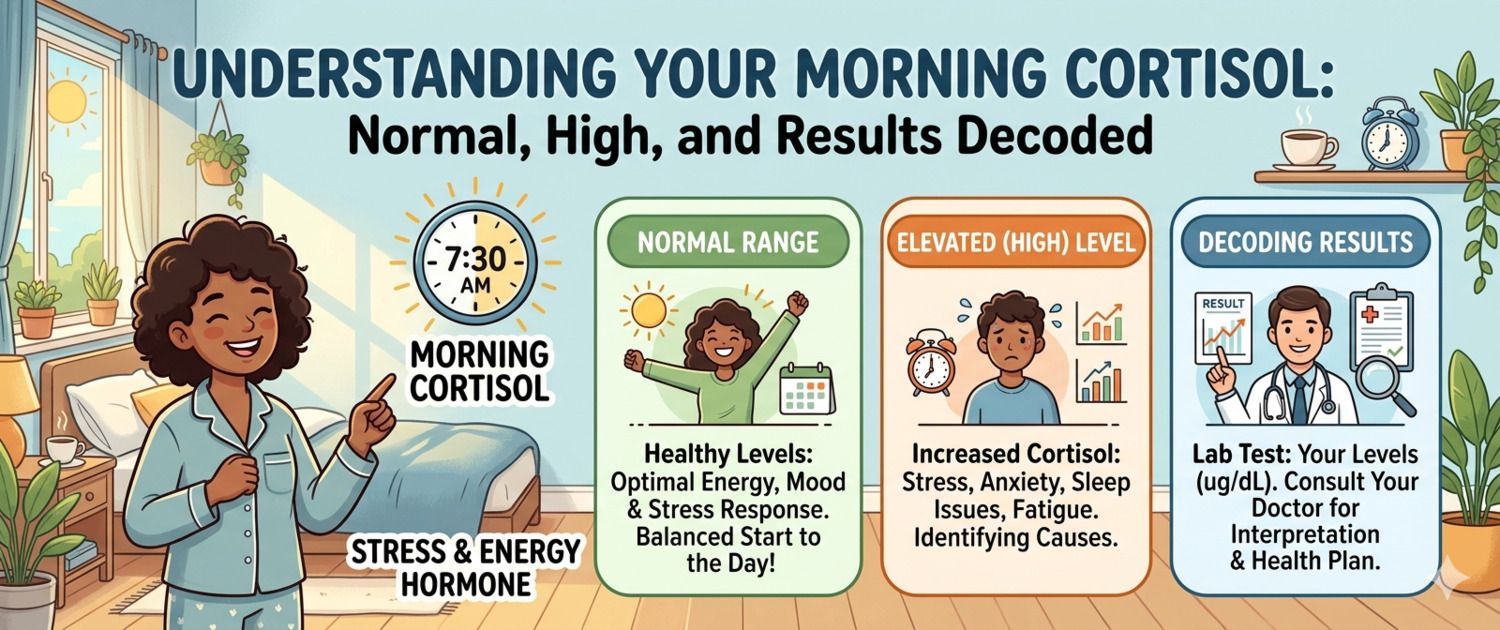
Morning cortisol is the main "window" into the hypothalamic-pituitary-adrenal axis. The stress hormone peaks in the morning hours — in a healthy person 8-fold higher than late at night. This peak isn't a side effect of stress but the biological foundation of waking and activity. Any deviation of morning cortisol is an indicator of the whole axis, and interpretation depends on exact collection time, method, and context.
What Morning Cortisol Is and Why to Measure It
Cortisol is the steroid hormone of the adrenal cortex — the main executor of the "stress program." Its secretion is rigidly tied to the circadian rhythm: peak in the morning (4–8 AM), nadir in the evening (10 PM–midnight). The morning surge is triggered overnight by ACTH from the pituitary and reaches its maximum at 6–8 AM.
Why measure morning cortisol specifically:
- It is the diagnostically informative window — deviations are easier to spot
- The reference range is set for morning collection (138–690 nmol/L)
- A drop signals adrenal insufficiency (Addison's disease, secondary AI)
- Elevation is a screening sign for hypercortisolism, including Cushing's syndrome
- The morning-to-evening dynamic assesses circadian rhythm integrity
A standalone morning cortisol has limited interpretation: a full picture needs evening cortisol, ACTH, and DHEA-S. The full set is in the adrenal stress panel.
Normal Range by Hour
Reference values depend on the precise collection time and method:
| Collection time | Blood normal (nmol/L) | Blood normal (µg/dL) |
|---|---|---|
| 6:00–8:00 AM (peak) | 170–700 | 6–25 |
| 8:00–10:00 AM | 138–690 | 5–25 |
| 10:00 AM–12:00 PM | 100–550 | 4–20 |
Salivary cortisol:
| Time | Normal (nmol/L) |
|---|---|
| 30 minutes after waking (CAR — Cortisol Awakening Response) | 10–45 |
| 1 hour after waking | 8–35 |
CAR (Cortisol Awakening Response) is a separate marker: in a healthy person cortisol rises another 50–75% within 30 minutes of waking, reflecting stress resilience. A blunted CAR is characteristic of burnout, depression, and PTSD.
Unit conversion: nmol/L ÷ 27.59 = µg/dL.
How to Take a Morning Cortisol Test Properly
Cortisol is among the most pre-analytically sensitive hormones. Failure to follow conditions can fully invalidate the result.
Collection conditions:
- Strictly fasting, between 8:00 and 10:00 AM (no later!)
- Avoid intense exercise and stress for 24 hours
- No smoking for at least 3 hours before the draw
- Sit/lie quietly for 30 minutes before the draw
- For suspected Cushing's — also late-night salivary cortisol (11 PM) for circadian rhythm
- Disclose glucocorticoids (prednisolone, dexamethasone, inhaled steroids), oral contraceptives, estrogens
By method:
- Blood — standard draw; sufficient for screening
- Saliva — convenient at-home collection at multiple times; reflects free (biologically active) cortisol more accurately
- 24-hour urine — reflects integrated daily output; informative for suspected Cushing's syndrome
Venipuncture itself raises cortisol 20–30% — so the "30 minutes of rest" is not a formality but a real condition for reliable results.
Causes of Elevated Morning Cortisol
Elevated morning cortisol can be seen in many conditions:
Transient (not pathological):
- Acute stress before the draw
- Insomnia the night before
- Intense physical exercise
- Alcohol the day before
- Coffee on an empty stomach 1–2 hours pre-draw
Functional:
- Chronic psychoemotional stress
- Depression and anxiety disorders
- Severe obesity
- Alcohol use disorder (pseudo-Cushing's)
Pathological (require deeper workup):
- Cushing's disease — pituitary ACTH-secreting adenoma
- Cushing's syndrome — adrenal corticosteroma
- Ectopic ACTH (lung, pancreatic tumors)
Iatrogenic:
- Oral contraceptives (raise binding globulin — total cortisol artifactually high)
- Estrogens, estrogen-containing medications
Important: a single elevated morning cortisol (e.g., 750 nmol/L with upper-normal 690) is not a diagnosis. Repeat in 2–3 days under calm conditions. If elevation persists across two independent measurements — that's grounds for workup. For pathological hypercortisolism, see Cushing's syndrome; for lowering approaches, see how to lower cortisol.
Causes of Reduced Morning Cortisol
Low morning cortisol is rarer but clinically more serious than elevated.
Primary adrenal insufficiency (Addison's disease):
- Autoimmune destruction of the adrenal cortex
- Cortisol low, ACTH sharply elevated
- Accompanied by hypotension, hyperpigmentation, weight loss, hyponatremia
- Requires immediate replacement therapy
Secondary adrenal insufficiency:
- Pituitary lesion (adenoma, Sheehan's syndrome, trauma)
- Cortisol low, ACTH also low or inappropriately normal
- Often accompanied by other pituitary hormone deficiencies
Tertiary (hypothalamic) insufficiency:
- Long-term glucocorticoids suppressing the HPA axis
- Abrupt steroid withdrawal after a long course
- Hypothalamic tumors
Late-stage burnout:
- Morning cortisol falls under prolonged exhaustion
- DHEA-S typically sharply reduced
- Doesn't need replacement therapy; treated with recovery — see emotional burnout: symptoms and tests
Low morning cortisol with low blood pressure, nausea, and weakness requires emergency care — Addisonian crisis is possible.
Dexamethasone Suppression Test
The low-dose overnight dexamethasone test is the gold-standard screen for hypercortisolism after detecting elevated morning cortisol.
Procedure:
- Take 1 mg dexamethasone at 11 PM
- Draw blood for cortisol at 8 AM (fasting)
Interpretation:
- Morning cortisol < 50 nmol/L — normal response, hypercortisolism unlikely
- Cortisol > 50 nmol/L — failure to suppress, sign of autonomous secretion; further workup required
High-dose dexamethasone test (2 mg every 6 hours over 2 days) differentiates:
- Cushing's disease (pituitary tumor) — partial cortisol suppression (≥ 50%)
- Ectopic ACTH or corticosteroma — no suppression
These tests are interpreted by an endocrinologist — self-interpretation is unproductive.
When to See a Doctor
Endocrinology consultation is indicated for:
- Morning cortisol > 690 nmol/L on two independent measurements with proper conditions
- Morning cortisol < 138 nmol/L on two measurements
- Positive dexamethasone test (failure to suppress)
- Flattened circadian rhythm (evening > 75% of morning)
- Any of the above combined with hyper- or hypocortisolism symptoms
Emergency care — for the combination of sudden hypotension (BP < 90/60), nausea, vomiting, and abdominal pain in a patient with known adrenal insufficiency or after glucocorticoid withdrawal: possible Addisonian crisis.
This article is for informational purposes only and does not replace professional medical advice. A standalone morning cortisol is interpreted in the context of the circadian rhythm, ACTH, and DHEA-S — best taken as an adrenal stress panel.
For informational purposes only
This article is for informational purposes only and does not constitute medical advice, diagnosis, or treatment. Please consult a healthcare professional for medical guidance.