Hormone Panel Test: What It Includes and How to Read Results
Reviewed by the LabReadAI medical team
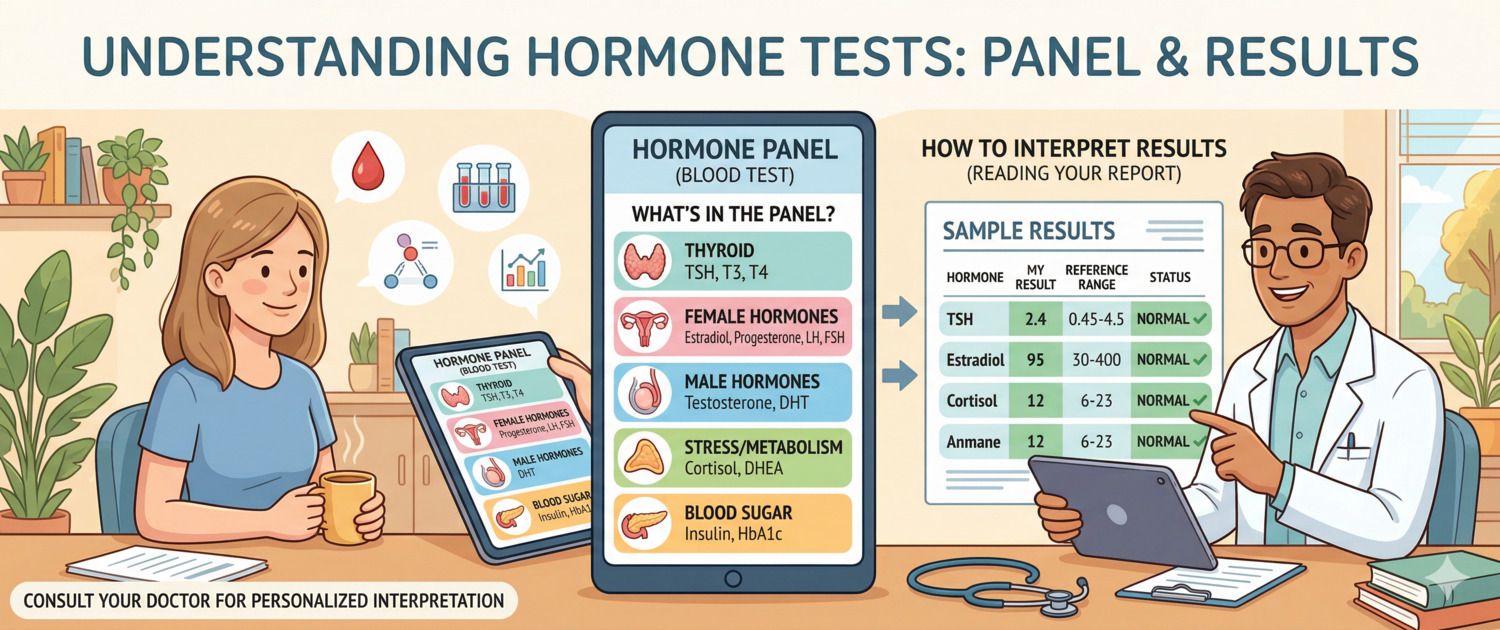
Fatigue, hair loss, unexplained weight gain, irregular periods, low libido, mood swings — all of these complaints share one possible underlying cause: hormonal imbalance. Hormones regulate virtually every process in the body, and their disruptions rarely produce a clear-cut clinical picture. A comprehensive hormone panel addresses exactly this diagnostic challenge.
What Is a Comprehensive Hormone Panel
A comprehensive hormone panel is a set of blood tests that simultaneously evaluates several hormonal systems, providing an overall picture of a patient's endocrine status. Unlike specialised panels — for example, the thyroid panel or the sex hormone panel, each covering a single axis — a comprehensive hormone panel combines markers from several regulatory systems in one blood draw.
This approach is particularly valuable for non-specific complaints: when symptoms are present but it is unclear which system to investigate first. The panel can cover multiple possible causes simultaneously, saving the time and cost of sequential testing.
The composition of a hormone panel is not standardised — different laboratories offer different combinations. Understanding which hormones were ordered and what each one means is therefore essential.
Which Hormones Are Included in the Panel
Thyroid hormones:
TSH (thyroid-stimulating hormone) is the primary regulator of thyroid function, produced by the pituitary gland. It rises in hypothyroidism and falls in hyperthyroidism — the standard first marker in any thyroid screening. Free T4 is the active form of thyroxine produced by the thyroid gland. It is assessed alongside TSH to understand the level and cause of any abnormality.
Adrenal hormones:
Cortisol — the "stress hormone" secreted by the adrenal cortex — is drawn strictly in the morning between 8:00 and 10:00 am, when its level is at its daily peak. Sustained elevation points toward hypercortisolism; a morning value below the lower reference limit raises concern for adrenal insufficiency.
Sex hormones:
Testosterone — the principal androgen — determines muscle mass, sexual drive, and energy levels in men; it is also present and important in women, albeit at far lower concentrations. FSH (follicle-stimulating hormone) regulates the maturation of reproductive cells. In women it reflects ovarian reserve; in men it reflects spermatogenesis quality. A sharp FSH rise in a woman of reproductive age is a sign of declining ovarian function.
Metabolic hormones:
Fasting insulin enables calculation of the HOMA-IR insulin resistance index when combined with fasting glucose. Elevated fasting insulin with normal glucose is an early marker of insulin resistance — detectable years before overt diabetes develops.
Circadian hormones:
Melatonin — the pineal gland hormone that regulates the sleep–wake cycle — is included in the panel when chronic sleep disturbance is the main complaint. Accurate measurement requires a night-time blood draw (around 2:00–3:00 am) or a salivary test; a standard morning sample does not reflect pineal function.
Extended versions of the panel may additionally include oestradiol, LH, prolactin, DHEA-S, and parathyroid hormone, depending on the clinical question.
How to Prepare for a Hormone Panel Test
Preparation is a critical step. Most hormones follow a diurnal rhythm, depend on menstrual cycle phase, food intake, and stress. Poor preparation produces false results and can lead to unnecessary treatment.
Universal rules for all hormones:
- blood is drawn strictly fasting after 10–12 hours without food; plain water is allowed;
- avoid alcohol, intense exercise, and sauna for 2–3 days beforehand;
- do not smoke for at least 1 hour before the blood draw;
- avoid testing during an acute illness with fever;
- inform your doctor of all medications — hormonal contraceptives, steroids, metformin, antidepressants, and others directly affect results.
Specific rules by hormone:
Cortisol: must be drawn between 8:00 and 10:00 am. An afternoon cortisol has no diagnostic value for primary screening.
Testosterone: drawn in the morning between 7:00 and 11:00 am, when levels are highest. An evening sample in men may show a falsely reduced result.
Sex hormones in women (FSH, LH, oestradiol, prolactin): typically drawn on cycle days 2–5, unless otherwise specified by the doctor. This timing captures basal hormone levels, which are most comparable to reference ranges.
Insulin: strictly fasting (8–12 hours). Even a small snack before the test sharply elevates insulin, making the result unreliable.
Melatonin: a circadian profile requires a night-time draw (around 2:00–3:00 am) or a salivary test; standard morning sampling is uninformative for pineal function evaluation.
Normal Hormone Levels: Reference Value Table
Reference ranges depend on age, sex, and menstrual cycle phase in women. The values below are approximate; always use the reference ranges of the specific laboratory where the sample was processed.
| Hormone | Men | Women (follicular phase) | Units |
|---|---|---|---|
| TSH | 0.4–4.0 | 0.4–4.0 | mIU/L |
| Free T4 | 10.3–24.5 | 10.3–24.5 | pmol/L |
| Cortisol (morning) | 140–690 | 140–690 | nmol/L |
| Testosterone | 12.1–38.0 | 0.3–2.8 | nmol/L |
| FSH | 1.5–12.4 | 2.5–10.2 | IU/L |
| Fasting insulin | 2.6–24.9 | 2.6–24.9 | µIU/mL |
A "normal" range represents the values seen in 95% of healthy individuals. Five per cent of healthy people will fall outside it by pure statistics. A result at the boundary of normal is therefore not automatically pathological — its clinical significance is always interpreted in the context of symptoms, age, and trends over time.
Causes of Hormone Abnormalities
A single abnormal result rarely points to one specific disease — what matters is the pattern of changes in the context of the patient's complaints.
TSH and thyroid hormone abnormalities. Elevated TSH with low free T4 is the picture of primary hypothyroidism: fatigue, cold intolerance, weight gain, and a slowed metabolism. Suppressed TSH with elevated free T4 indicates hyperthyroidism: palpitations, weight loss, tremor, and irritability.
Cortisol abnormalities. Chronically elevated cortisol combined with characteristic signs — central obesity, wide purple stretch marks, and proximal muscle weakness — requires exclusion of Cushing's syndrome. A morning cortisol below 140 nmol/L raises concern for adrenal insufficiency.
Sex hormone abnormalities. Elevated FSH combined with irregular cycles and raised androgens in a woman is one of the key laboratory findings in PCOS. Reduced testosterone in men is accompanied by fatigue, decreased libido, and muscle mass loss.
Insulin abnormalities. High fasting insulin with normal glucose is early insulin resistance — detectable years before diabetes. This is precisely why it is a valuable finding: it opens a preventive window.
Interpreting hormone tests horizontally — looking at the relationship between values — is more informative than reading each in isolation. TSH in the upper third of the normal range alongside low-normal free T4 may signal subclinical hypothyroidism even when both values are technically "normal".
Who Needs a Hormone Panel and When
Indications in women: irregular or absent periods, difficulty conceiving, acne and hirsutism in young women, significant mood swings or depression, symptoms of perimenopause.
Indications in men: reduced libido and erectile dysfunction, unexplained loss of muscle mass despite adequate nutrition, gynaecomastia, infertility.
General indications: unexplained chronic fatigue unrelieved by rest, diffuse hair loss, unexplained weight gain or loss, chronic sleep disturbance, elevated blood pressure in a young patient with a suspected endocrine cause, routine monitoring for an established endocrine condition.
Routine preventive screening without symptoms has no proven benefit for most hormones in healthy adults. The exception is TSH, which is recommended for women over 35 and for anyone with any symptoms suggestive of thyroid dysfunction.
How to Read Results and What to Do With Abnormalities
Several practical principles for making sense of a hormone panel report:
A single out-of-range value is not a diagnosis. Stress during venepuncture, a missed fasting window, and other preparatory errors can all skew individual hormones. A repeat test with proper preparation usually clarifies the picture.
Trends matter more than single values. A TSH that has fallen from 3.5 to 0.8 mIU/L over 6 months alongside worsening symptoms carries more weight than any single measurement.
Time of draw is critical. Cortisol measured at 4:00 pm cannot be compared against the morning reference range. Testosterone measured in the evening in men cannot be compared against the standard male morning reference.
Use your laboratory's own reference ranges. Reference intervals depend on the analytical method and the specific analyser — values from the internet may not apply to your result.
At any significant deviation from normal, see an endocrinologist or gynaecologist (for women with cycle-related complaints). Self-treating with hormonal preparations without an accurate diagnosis is dangerous: hormonal disorders require individually tailored therapy and regular laboratory monitoring.
For informational purposes only
This article is for informational purposes only and does not constitute medical advice, diagnosis, or treatment. Please consult a healthcare professional for medical guidance.