Free T3 (Triiodothyronine): Normal Levels and Test Interpretation
Reviewed by the LabReadAI medical team
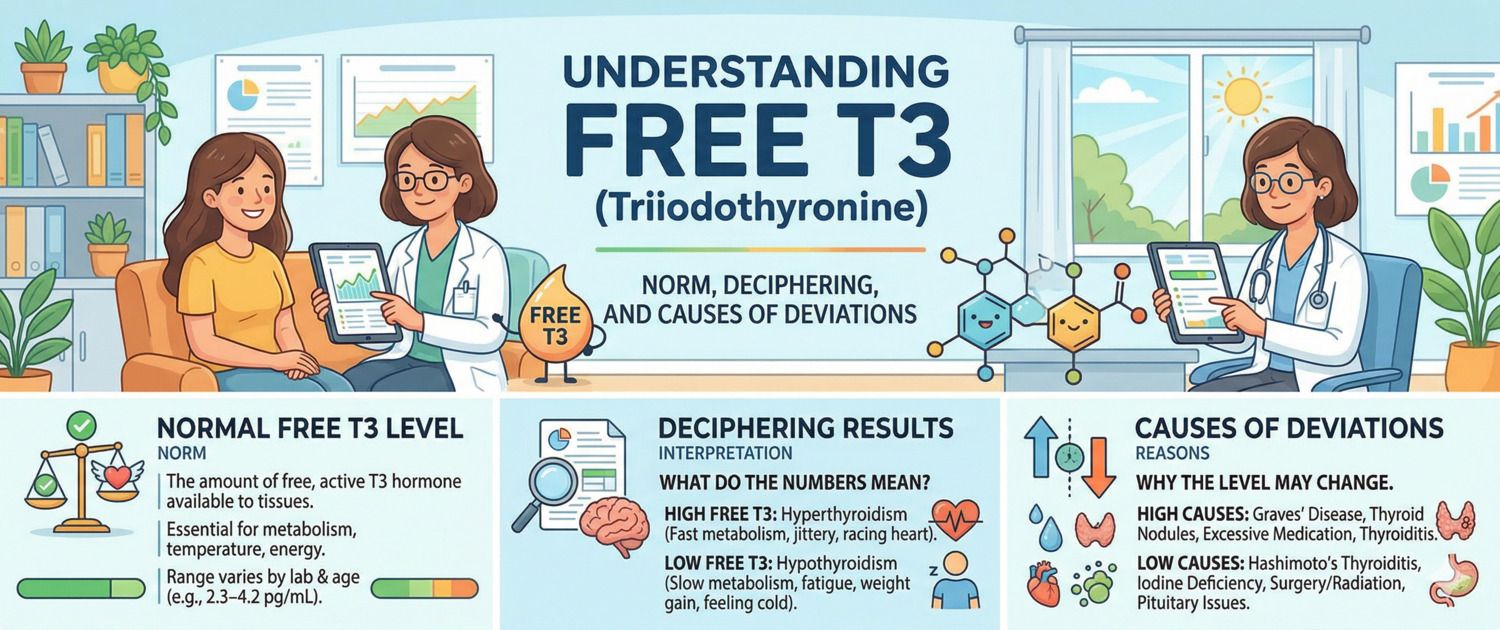
If T4 is the thyroid's "storage form," free T3 is the ready-to-act version: the most biologically potent thyroid hormone, which directly binds to cell receptors and activates metabolism. This article covers what free T3 is, its normal reference ranges, what high or low levels mean, and when to seek urgent medical attention.
What Is Free T3 and Why Does the Free Fraction Matter?
The thyroid gland produces two iodine-containing hormones: thyroxine (T4) and triiodothyronine (T3). T3 contains three iodine atoms — hence the "triiodo-" prefix. The difference from T4 seems minor, but the biological impact is profound: T3 is 3–4 times more potent than T4 and directly binds to nuclear cell receptors, triggering the expression of genes responsible for metabolism, growth, and tissue differentiation.
Most circulating T3 is not secreted directly by the thyroid gland — it is formed in peripheral tissues (liver, muscles, kidneys) by removing one iodine atom from T4. Only about 20% of T3 comes directly from the gland.
Like T4, most T3 in the blood is bound to carrier proteins and biologically inactive. Only the unbound fraction — free T3 (FT3) — acts on cells. It is measured as part of a full thyroid panel alongside TSH and free T4.
How to Prepare for a Free T3 Blood Test
Preparation rules mirror those for other thyroid hormones and are important to follow:
- Timing: morning blood draw between 8:00–10:00 AM, when daily fluctuations are minimised.
- Fasting: 8–12 hours without food; water is allowed.
- Thyroid medications: take levothyroxine or T3-containing drugs (liothyronine) after the blood draw, not before.
- Biotin (vitamin B7): high-dose biotin interferes with immunochemical assays — pause for 48 hours before testing.
- Amiodarone: strongly inhibits T4 → T3 conversion and can produce falsely low FT3 — inform your doctor if you take it.
- Exercise and stress: avoid intense physical activity and major stressors for 24 hours before the test.
Free T3 Normal Ranges by Age and Sex
Reference ranges depend on the specific laboratory and assay method. Always use the interval printed on your own lab report. General guideline values:
| Group | FT3, pmol/L | FT3, pg/mL |
|---|---|---|
| Adult men | 3.1–6.8 | 2.0–4.4 |
| Adult women | 3.1–6.8 | 2.0–4.4 |
| Pregnancy (all trimesters) | slightly below adult range | — |
| Older adults (60+) | lower end decreases | — |
| Children 1–5 years | 4.0–7.4 | 2.6–4.8 |
Unit conversion: 1 pg/mL = 1.54 pmol/L. FT3 must always be interpreted alongside TSH and FT4 — a single abnormal value without the full picture leads to incorrect conclusions.
High Free T3: Causes and Symptoms
Elevated FT3 means the thyroid or peripheral tissues are producing too much active triiodothyronine. The body shifts into a state of chronic over-stimulation.
Common causes of high FT3:
- Hyperthyroidism — Graves' disease, toxic nodular goiter, toxic adenoma
- Isolated T3 thyrotoxicosis — can precede classic hyperthyroidism with FT4 still in the normal range
- Acute thyroiditis (autoimmune or viral) with a massive hormone release
- Overdose of T3-containing medications (liothyronine, combination preparations)
Symptoms: palpitations and heart rhythm disturbances, weight loss despite good appetite, muscle weakness, anxiety, tremor, sweating, sleep disturbance, diarrhoea. In older patients, hyperthyroidism often presents atypically — predominantly with cardiac symptoms.
Low Free T3: Causes and Consequences
Insufficient FT3 means cells are literally under-receiving the signals needed for normal function — everything slows down, from metabolism to cognition.
Common causes of low FT3:
- Hypothyroidism — primary (thyroid gland failure) or central (pituitary pathology)
- Hashimoto's thyroiditis in the hypothyroid stage
- Impaired peripheral T4 → T3 conversion: severe systemic illness, prolonged fasting, stress, liver cirrhosis, kidney failure — euthyroid sick syndrome (low T3 syndrome)
- Amiodarone, propranolol, high-dose corticosteroids
- Selenium deficiency — selenium is required for deiodinase enzyme activity
Symptoms: fatigue, cold intolerance, bradycardia, constipation, dry skin, hair loss, depression, impaired concentration. In euthyroid sick syndrome, TSH and FT4 can remain normal — the abnormality appears only in FT3.
Free T3 and Free T4: How the Two Hormones Work Together
T3 and T4 cannot be fully understood in isolation — they are two parts of the same system. The thyroid primarily produces T4 (roughly 80% of total secretion), and peripheral tissues convert it into active T3 via deiodinase enzymes.
This is why both values must be assessed together: if free T4 is normal but FT3 is low, the problem lies in peripheral conversion rather than the thyroid gland itself. The reverse — normal FT4 with elevated FT3 — is typical of early T3 thyrotoxicosis. Your doctor will always evaluate both hormones in the context of TSH and clinical presentation.
When to See a Doctor Urgently
Certain FT3 abnormalities require immediate attention rather than a routine appointment:
- Sharply elevated FT3 + heart rate above 120 bpm, high fever, agitation or altered consciousness — signs of thyrotoxic crisis, a medical emergency requiring immediate hospitalisation.
- Critically low FT3 + impaired consciousness, hypothermia, severe oedema — possible myxedema coma.
- Newly discovered significant abnormality with symptoms — see an endocrinologist within a few days.
- Isolated moderate abnormality without symptoms — routine consultation; additional tests may be needed to rule out systemic illness.
Interpreting FT3 without TSH and FT4 is almost always misleading. Do not draw diagnostic conclusions from a single thyroid value.
This article is for informational purposes only and does not replace consultation with a qualified endocrinologist.
For informational purposes only
This article is for informational purposes only and does not constitute medical advice, diagnosis, or treatment. Please consult a healthcare professional for medical guidance.