Hyperthyroidism: Symptoms, TSH Diagnosis and Treatment
Reviewed by the LabReadAI medical team
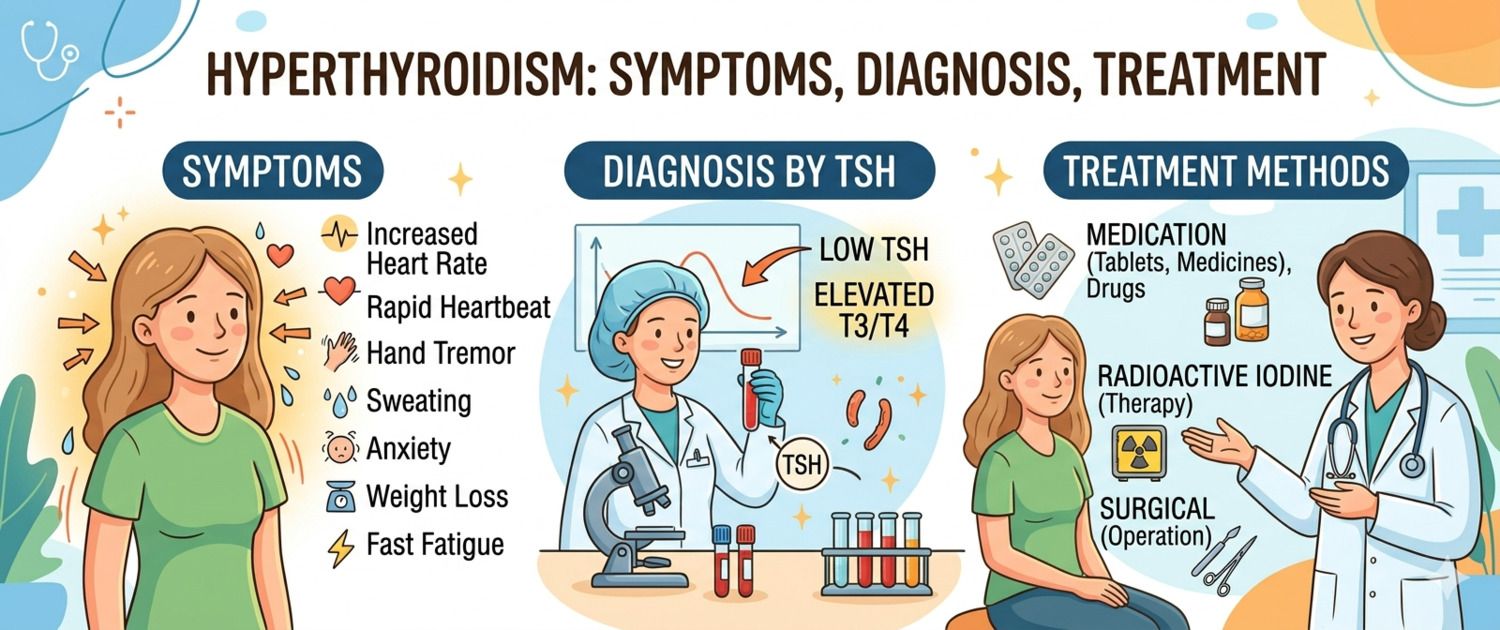
A heart racing even at rest, weight loss despite a good appetite, hand tremor, and irritability with no clear external cause — these can all be signs of thyrotoxicosis. Hyperthyroidism is a state in which the thyroid gland produces too many hormones and essentially "over-revs" the entire body. Let's break down how to recognize it, which tests confirm the diagnosis, and what treatment involves.
What Is Hyperthyroidism and Thyrotoxicosis
Hyperthyroidism means the thyroid produces excess T4 and T3. Thyrotoxicosis is the broader term for any state of excess thyroid hormone — including levothyroxine overdose. In practice both terms are often used interchangeably.
Where hypothyroidism slows everything down, hyperthyroidism speeds everything up. Thyroid hormones are the metabolic accelerator, and in excess they push the engine into overdrive.
Causes of Hyperthyroidism
Graves' disease (diffuse toxic goiter) — the most common cause, especially in young women. An autoimmune condition: antibodies mimic TSH and keep the gland switched on at full output. The hallmark sign is exophthalmos (protruding eyes).
Toxic multinodular goiter — more common in older adults. Individual nodules begin producing hormones autonomously, ignoring pituitary signals.
Toxic adenoma — a single autonomously functioning nodule.
Destructive thyroiditis — in De Quervain's or postpartum thyroiditis, hormones leak from damaged cells. The hyperthyroid phase is temporary and often transitions into hypothyroidism.
Levothyroxine overdose — iatrogenic thyrotoxicosis in patients being treated for hypothyroidism.
Symptoms of Hyperthyroidism
Cardiovascular: rapid heartbeat (resting heart rate above 90); atrial fibrillation — especially in older patients; elevated systolic blood pressure.
Metabolic: weight loss despite normal or increased appetite; excessive sweating; heat intolerance.
Neuromuscular: hand tremor; muscle weakness; insomnia; irritability, anxiety, emotional instability.
Gastrointestinal: frequent loose stools, diarrhea.
Specific to Graves' disease: exophthalmos, eye pressure and swelling, pretibial myxedema (skin thickening on the shins).
Diagnosis: Low TSH Is the Key Finding
Diagnosis uses a thyroid panel. The logic is the inverse of hypothyroidism: when T4 and T3 are excessive, the pituitary "brakes" — TSH drops toward zero.
| Marker | Normal | Subclinical hyperthyroidism | Overt hyperthyroidism |
|---|---|---|---|
| TSH | 0.4–4.0 mIU/L | < 0.4 mIU/L | < 0.1 mIU/L |
| Free T4 | 9–20 pmol/L | Normal | Elevated |
| Free T3 | 3.5–6.5 pmol/L | Normal | Elevated |
Subclinical hyperthyroidism — TSH is suppressed but T4 and T3 are normal. Symptoms may be absent, but atrial fibrillation and bone loss risk already exist.
Additional tests:
- TSH receptor antibodies (TRAb) — confirm Graves' disease
- Thyroid ultrasound with Doppler — assesses volume and blood flow
- Scintigraphy — when cause is unclear, to differentiate Graves', adenoma, and thyroiditis
Hyperthyroidism Treatment: Antithyroid Drugs, Radioiodine and Surgery
Choice depends on the cause, patient age, gland size, pregnancy plans, and patient preference.
Antithyroid drugs (conservative)
Methimazole and propylthiouracil block thyroid hormone synthesis. For Graves' disease, the course is 12–18 months. Remission after stopping is achieved in 30–50% of patients. Relapse leads to radioiodine or surgery.
Radioiodine therapy (¹³¹I)
Radioactive iodine selectively accumulates in the thyroid and destroys its tissue. Effect develops over 3–6 months. The usual outcome is hypothyroidism requiring lifelong levothyroxine. Contraindicated in pregnancy.
Surgery (thyroidectomy)
Indicated for large goiter compressing neck structures; antithyroid drug intolerance; suspected malignancy; or pregnancy planned in the near future. After total thyroidectomy — lifelong replacement therapy.
Complications: Heart Palpitations, Osteoporosis and Thyroid Storm
- Atrial fibrillation — chronic thyrotoxicosis raises the risk 3–5 fold; stroke risk rises accordingly
- Osteoporosis — excess thyroid hormones accelerate bone resorption; fracture risk increases
- Heart failure — in prolonged untreated thyrotoxicosis
- Thyroid storm — rare but life-threatening: abrupt worsening of all symptoms, high fever, confusion
When to See a Doctor Urgently
Immediately if: resting heart rate above 120, palpitations or irregular rhythm; sudden high fever and confusion in a known hyperthyroid patient (storm); eye swelling, protrusion, or vision disturbance; TSH below 0.01 mIU/L found on testing — urgent endocrinologist appointment.
Summary
Hyperthyroidism responds well to treatment when caught early. The key is TSH: its suppression is detectable before symptoms appear. Three treatment options allow an individualized approach. Untreated thyrotoxicosis hits the heart and bones hardest — two organs that are difficult to recover once damaged.
This article is for informational purposes only. Interpretation of test results and treatment decisions are the responsibility of a physician.
For informational purposes only
This article is for informational purposes only and does not constitute medical advice, diagnosis, or treatment. Please consult a healthcare professional for medical guidance.