Heart Attack (MI): Symptoms, First Aid and Treatment
Reviewed by the LabReadAI medical team
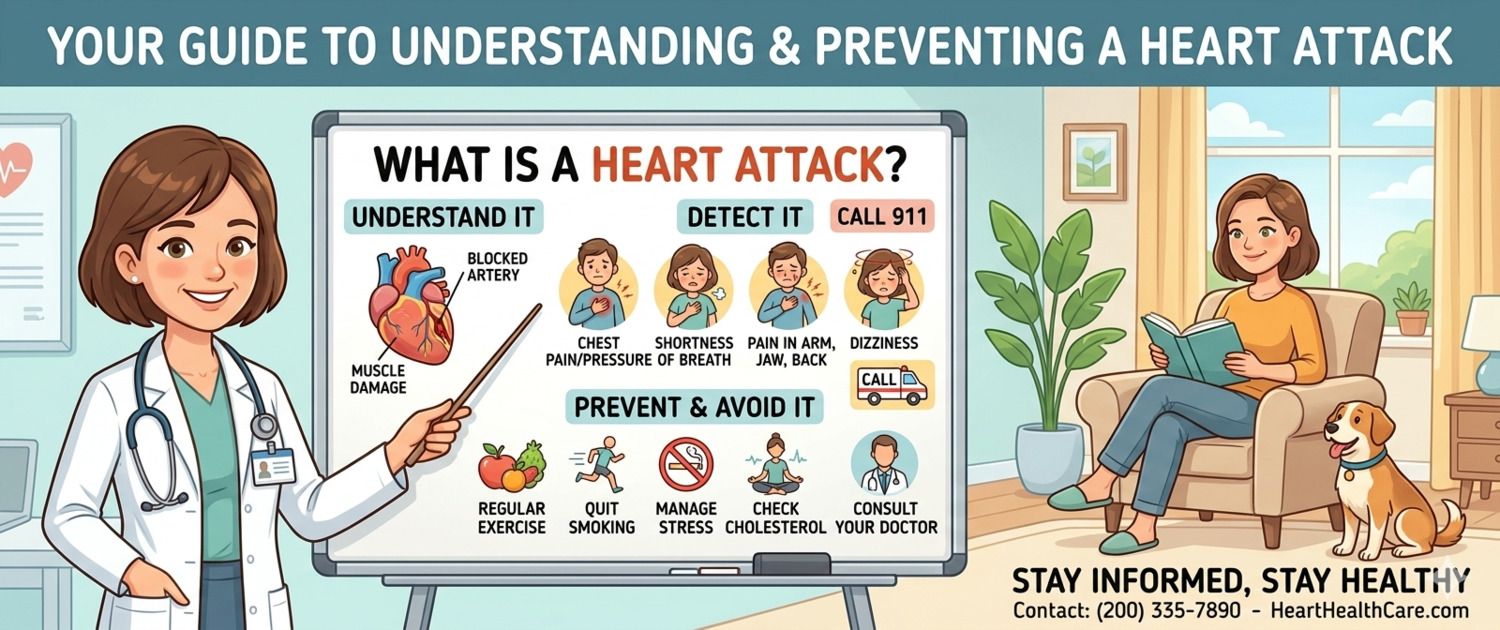
Crushing chest pain radiating to the left arm or jaw, accompanied by cold sweat — that is the textbook heart attack. But in almost one-third of cases, especially in women, the presentation is completely different: breathlessness, nausea, inexplicable fatigue. Heart attacks kill not because they are unrecognizable — but because people wait too long. Every 10 minutes of delay costs roughly another one percent of viable heart muscle. Let's break down how a heart attack works, how to recognize it, and what protects against it.
What a Heart Attack Is and How It Develops
A myocardial infarction is the death of heart muscle tissue caused by sudden loss of blood supply. In the vast majority of cases, the mechanism is the same: an atherosclerotic plaque in a coronary artery ruptures, a thrombus forms instantly at the rupture site, and it completely or nearly completely occludes the vessel.
Heart muscle is acutely sensitive to ischemia. Within 20–40 minutes of blood flow cessation, irreversible necrosis of cardiomyocytes begins — cells that do not regenerate. The necrotic zone is eventually replaced by scar tissue, which cannot contract. The larger the area of damage and the longer the artery stays closed, the more severe the consequences.
This is the precise connection between atherosclerosis and heart attack: a plaque growing silently for years can produce no symptoms until the moment of rupture — and then a chronic asymptomatic disease becomes an acute catastrophe within minutes.
Heart attacks are classified by depth of damage (transmural — through the full wall thickness; non-transmural), by location (anterior, inferior, lateral, posterior), and by ECG changes (ST-elevation MI — STEMI; and non-ST-elevation MI — NSTEMI). STEMI is the most dangerous variant, requiring emergency reperfusion within the first 90–120 minutes.
Symptoms of a Heart Attack: Classic and Atypical
Knowing the symptoms matters not for self-treatment but to call for help without hesitation. Delayed response is the primary killer in heart attack.
Classic symptoms (more common in men):
- Pressure, squeezing, or burning chest pain — intense, lasting more than 15–20 minutes
- Radiation to the left arm, shoulder, neck, lower jaw, or back
- Cold clammy sweat, pallor
- Rapidly progressing weakness, a sense of impending doom
- Pain not relieved by nitroglycerin (unlike angina)
Atypical symptoms occur in about 30% of patients — significantly more often in women, older adults, and people with diabetes:
| Atypical presentation | Who is most affected |
|---|---|
| Breathlessness without chest pain | Women, elderly, diabetics |
| Nausea, vomiting, upper abdominal pain | Inferior MI (right ventricular involvement) |
| Unexplained sudden weakness and sweating | Postmenopausal women |
| Pain between the shoulder blades | Posterior MI |
| Dizziness or loss of consciousness | Arrhythmia complicating MI |
| Sensation of heartburn or indigestion | Inferior MI — frequently confused with GI symptoms |
The key rule: if any of these symptoms appears for the first time, lasts more than 10–15 minutes, and has no obvious explanation — call emergency services immediately. Do not wait to see if it passes.
First Aid for a Heart Attack: What to Do Before the Ambulance
The right actions in the first minutes genuinely save lives and preserve heart function.
Immediately:
- Call emergency services — do not drive the person yourself if an ambulance can reach you. The ambulance carries a defibrillator and can begin thrombolysis en route
- Place the person in a semi-reclined position — this reduces cardiac workload
- Loosen collar, belt, and ensure fresh air access
- Give aspirin 325 mg to chew (or 2–4 tablets of 100 mg) — if there is no allergy and no obvious bleeding. Aspirin blocks platelet aggregation and measurably reduces the size of the forming thrombus
- Nitroglycerin — 1 tablet under the tongue; may be repeated after 5 minutes if pain persists. Contraindicated if systolic pressure is below 90 mmHg or if the person has taken a PDE-5 inhibitor (sildenafil and equivalents) within 24–48 hours
If the person loses consciousness and stops breathing — begin cardiopulmonary resuscitation immediately: 30 chest compressions (5–6 cm depth, 100–120 per minute) + 2 rescue breaths. Do not stop until the ambulance arrives or signs of life return.
Do not give the person anything to eat or drink. Do not let them walk around. Do not leave them alone.
Diagnosis: Tests and Imaging
Diagnosis in hospital runs in parallel with treatment — blood samples are drawn while the patient is already being wheeled to the catheterization lab.
ECG — the first and most critical tool. ST-segment elevation in the relevant leads is the sign of acute transmural infarction and the indication for emergency reperfusion. ECG must be obtained within 10 minutes of arrival.
Troponin — the gold standard of biochemical diagnosis. Troponin I and T are proteins specific to cardiomyocytes. When cells die, they release these proteins into the bloodstream: levels begin rising 2–4 hours after onset, peak at 12–24 hours, and remain elevated for 7–14 days. High-sensitivity troponin (hsTnI, hsTnT) allows MI to be excluded within 1–3 hours of symptom onset.
CK-MB (MB isoenzyme of creatine kinase) — an earlier but less specific marker. It normalizes faster than troponin (within 48–72 hours), which makes it useful for diagnosing reinfarction when baseline troponin is already elevated.
LDH — rises 12–24 hours after onset, peaks on days 2–4 and remains elevated for up to 14 days. Used in late-presenting patients — when troponin has already normalized but retrospective confirmation of infarction is still needed.
BNP / NT-proBNP — natriuretic peptides are measured on admission to assess haemodynamic stress on the left ventricle. An elevated level at presentation predicts the risk of acute heart failure as a complication of MI and guides the intensity of supportive therapy.
Coronary angiography — visualizes the occluded coronary artery and is the mandatory precursor to percutaneous coronary intervention (PCI, stenting).
Echocardiography — assesses the zone of wall motion abnormality, valve function, and left ventricular ejection fraction — the key measure of damage severity.
Treatment of Myocardial Infarction
The goal of STEMI treatment is to restore blood flow in the occluded artery as quickly as possible. Every minute of delay destroys approximately two million cardiomyocytes.
Reperfusion therapy — the cornerstone:
- Primary PCI (balloon angioplasty with stenting) — the standard for STEMI: a balloon is inflated at the occlusion site and a stent is deployed. Target "door-to-balloon" time: no more than 90 minutes
- Thrombolysis — intravenous thrombolytic agent (alteplase, tenecteplase) when PCI is not available within 120 minutes. Less effective than PCI but life-saving when a catheterization lab is not accessible
Pharmacological therapy:
- Dual antiplatelet therapy: aspirin + ticagrelor or clopidogrel — sustained suppression of platelet aggregation
- Anticoagulants (heparin, enoxaparin) — in the acute phase
- Beta-blockers — reduce myocardial oxygen demand and heart rate
- ACE inhibitors or ARBs — prevent adverse left ventricular remodeling
- High-intensity statins — stabilize plaques, lower cholesterol, and reduce the risk of recurrent events; prescribed to all post-MI patients without exception
Thrombosis as a systemic problem. The clot-forming mechanism in MI shares key features with the mechanism underlying deep vein thrombosis: in both conditions, platelet activation and the coagulation cascade play a central role. The difference lies in location and trigger — not in biology.
Rehabilitation After a Heart Attack
Rehabilitation begins in hospital — literally the day after the patient stabilizes. Its goals: restore physical function, prevent a second event, and improve quality of life.
Physical rehabilitation. Early mobilization (corridor walking on day 2–3) reduces immobilization complications: thrombosis and hypostatic pneumonia. A structured cardiac rehabilitation program — supervised aerobic exercise three to five times per week — measurably reduces five-year mortality by 20–30%.
Psychological rehabilitation. Depression develops in 20–30% of post-MI patients and is an independent predictor of another cardiac event. Treating it is part of rehabilitation — not optional.
Lifelong medication therapy. After a heart attack, patients take a minimum of four drug classes — aspirin, statin, beta-blocker, ACE inhibitor — and discontinuing any of them sharply raises the risk of reinfarction. Stopping the statin after a year "because cholesterol is now normal" is one of the most common and dangerous post-MI errors.
Follow-up monitoring: ECG, echocardiography, and lipid profile at 4–6 weeks, then annually; unscheduled workup at any new symptom.
Risk Factors and Prevention of Myocardial Infarction
A heart attack is not random. In most patients presenting with acute coronary syndrome, a careful history reveals several modifiable risk factors that had been ignored for years.
Non-modifiable factors: age (men > 45, women > 55 years), male sex, family history (MI in a first-degree relative before age 55 in men, before 65 in women).
Modifiable factors — this is where prevention is concentrated:
- Arterial hypertension — blood pressure control reduces MI risk by 20–25%
- Smoking — doubles or triples risk; cessation delivers benefit within one year
- Dyslipidemia — elevated LDL, reduced HDL; statins reduce risk by 25–35%
- Diabetes and insulin resistance — accelerate atherosclerosis
- Obesity, especially abdominal
- Physical inactivity
- Chronic stress and depression
The principle of prevention is simple in theory and demanding in practice: control blood pressure, cholesterol, and blood sugar; don't smoke; stay active. Annual lipid profile monitoring from age 40 (from 35 with risk factors) is the minimum monitoring standard.
This article is for informational purposes only and does not replace professional medical advice. If you experience symptoms of a heart attack, call emergency services immediately.
For informational purposes only
This article is for informational purposes only and does not constitute medical advice, diagnosis, or treatment. Please consult a healthcare professional for medical guidance.