Lipid Panel: Cholesterol, LDL, HDL and Triglyceride Norms
Reviewed by the LabReadAI medical team
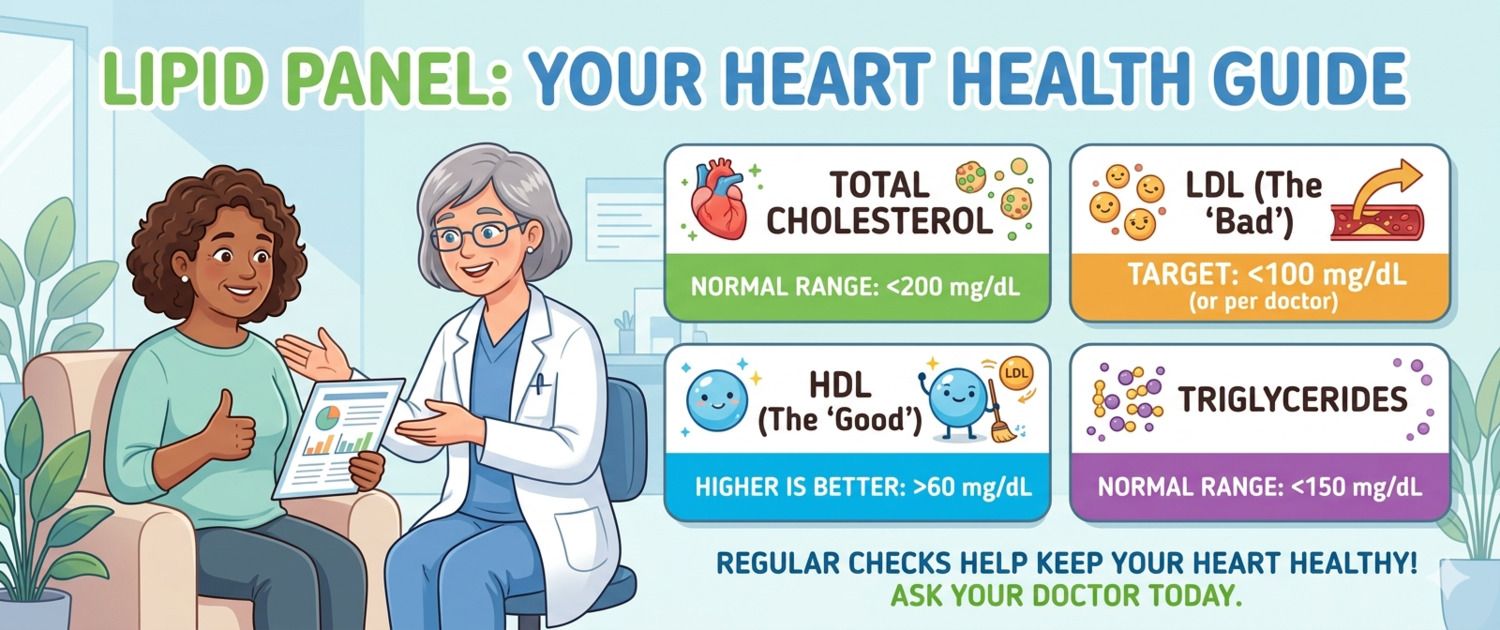
A cholesterol test gets ordered for almost every patient over forty — and most people look at the single "total cholesterol" figure without realising it tells them very little on its own. The real picture of cardiovascular risk comes from four values together: total cholesterol, LDL, HDL, and triglycerides. This is the lipid panel, or lipid profile. Here's what each marker measures, what the numbers mean, and why the same result can be safe for one person and dangerous for another.
What Is a Lipid Panel and Why Is It Done
Lipids are fat-like substances essential to cell life: they form cell membranes, serve as raw material for hormones and bile acids, and transport fat-soluble vitamins. The problem isn't that lipids exist — it's when they accumulate in excess or their balance shifts.
Too much of certain lipids in the blood triggers atherosclerosis — cholesterol depositing in arterial walls. Plaques narrow the vessels, reduce blood flow to the heart and brain, and when they rupture, they cause thrombosis — the mechanism behind myocardial infarction and stroke. The process unfolds silently over years and decades before any symptom appears. This is precisely why the lipid panel is a preventive tool: it quantifies atherosclerotic risk before a clinical event occurs and creates an opportunity to intervene.
Indications: routine screening starting at age 20 (every four to six years if results are normal), annual monitoring with diabetes, hypertension, obesity, or smoking, follow-up on statin therapy, and known family history of hypercholesterolaemia. After age 40 for men and after age 50 or menopause for women — annually.
What the Panel Includes: Four Key Markers
A standard lipid panel reports four values. Each carries distinct diagnostic weight, and none can be dismissed in isolation.
Total cholesterol is the combined content of all cholesterol forms in the blood. It's the starting point — not the treatment target. It includes both "bad" and "good" cholesterol together. A high total cholesterol alone does not indicate high risk; what matters is its composition.
LDL — low-density lipoprotein ("bad" cholesterol) is the primary treatment target and the principal driver of atherosclerosis. LDL particles penetrate the arterial wall, oxidise, and form plaque. Lowering LDL is the single most evidence-based intervention for reducing heart attack and stroke risk.
HDL — high-density lipoprotein ("good" cholesterol) works in the opposite direction: it collects cholesterol from vessel walls and transports it to the liver for disposal. Higher HDL is better. Low HDL is an independent cardiovascular risk factor.
Triglycerides are the body's primary fat storage form. Their level reflects dietary caloric intake, alcohol consumption, and the state of fat metabolism. Elevated triglycerides frequently accompany low HDL and raised blood glucose — the classic triad of metabolic syndrome.
From these primary values, the atherogenic index is calculated: (Total cholesterol − HDL) / HDL. A value above 3.0–3.5 in adults indicates elevated risk.
Normal Lipid Panel Values
An important feature of the lipid panel: LDL target values depend not on a single universal norm but on each patient's cardiovascular risk category. The table below shows general reference values; for patients with established heart disease or diabetes, targets are considerably lower.
| Marker | Optimal | Acceptable | Elevated |
|---|---|---|---|
| Total cholesterol | < 5.0 mmol/L | 5.0–6.1 mmol/L | > 6.2 mmol/L |
| LDL | < 3.0 mmol/L | 3.0–4.1 mmol/L | > 4.1 mmol/L |
| HDL (men) | > 1.0 mmol/L | 0.9–1.0 mmol/L | < 0.9 mmol/L |
| HDL (women) | > 1.2 mmol/L | 1.0–1.2 mmol/L | < 1.0 mmol/L |
| Triglycerides | < 1.7 mmol/L | 1.7–2.2 mmol/L | > 2.3 mmol/L |
| Atherogenic index | < 3.0 | 3.0–4.0 | > 4.0 |
In children and adolescents, norms are lower. In pregnancy, cholesterol physiologically rises in the second and third trimester — results during this period must be interpreted with gestational age in mind.
How to Read Results: Does Total Cholesterol or LDL Matter More
This is a question that trips up many patients. A total cholesterol of 6.5 mmol/L sounds alarming — but if HDL is 2.2 and LDL is only 3.8, the atherogenic index is low and actual risk is modest. Conversely, a total cholesterol of 5.0 mmol/L with LDL of 3.9 and HDL of 0.8 is a significantly more dangerous picture.
Current cardiology guidelines are clear: LDL is the primary target. Its value determines the need for therapy, and reducing it is what statins are designed to achieve.
LDL treatment targets vary by cardiovascular risk category:
- Low risk (young, no risk factors): LDL < 3.0 mmol/L
- Moderate risk (hypertension, smoking, obesity): LDL < 2.6 mmol/L
- High risk (diabetes, chronic kidney disease): LDL < 1.8 mmol/L
- Very high risk (previous MI, stroke, unstable angina): LDL < 1.4 mmol/L
This is why a doctor cannot give a meaningful interpretation of a lipid panel without knowing the patient's full history. The same numbers will require completely different responses depending on context.
Why Lipid Values Are Elevated: Causes of Dyslipidaemia
Dyslipidaemia — abnormal lipid balance in the blood — arises from two categories of causes.
Primary (genetic): Familial hypercholesterolaemia is an inherited disorder of LDL receptors in which cholesterol cannot be cleared from the blood normally. LDL can reach 6–10 mmol/L from childhood. Diet alone does not control this — pharmacological therapy is needed from an early age.
Secondary (acquired): far more common. The main drivers:
- Diet high in saturated fats and trans fats (fast food, pastries, fatty meat).
- Physical inactivity: regular aerobic exercise raises HDL.
- Excess body weight and abdominal obesity.
- Alcohol: even moderate regular intake markedly raises triglycerides.
- Type 2 diabetes and insulin resistance disrupt the entire fat metabolism cycle.
- Hypothyroidism: reduced thyroid function raises cholesterol — which is why TSH is checked when cholesterol is high without an obvious cause.
- Chronic kidney disease and nephrotic syndrome.
- Certain medications: beta-blockers, thiazide diuretics, retinoids, antiretrovirals.
For a complete metabolic assessment, a lipid panel is frequently ordered alongside liver function tests and blood glucose — all three reflect different dimensions of metabolic health.
How to Prepare for a Lipid Panel
Preparation for a lipid panel is stricter than for most blood chemistry tests — and errors here produce the largest distortions.
Blood must be drawn fasting for 12–14 hours (most other tests require only 8–10 hours). This is critical: even a glass of milk or a piece of bread two hours before the test will raise triglycerides by 20–50% and distort the entire profile.
Avoid alcohol for 48 hours — it raises triglycerides rapidly and the effect persists. Limit fatty food for 24 hours before. Restrict intense physical activity the day before: strenuous exercise transiently shifts HDL and triglyceride levels.
Do not test during an acute illness: any active infection or inflammation temporarily changes the lipid profile — LDL falls and triglycerides rise. The best time is six to eight weeks after recovery from a significant illness.
Tell your doctor about all medications. Statins, fibrates, oral contraceptives, thyroid hormones — all of these affect results. If testing to monitor therapy, keep the same time of day and don't change the medication schedule before the draw.
When to See a Doctor Urgently
Call emergency services immediately for any sign of an acute coronary or cerebrovascular event — regardless of what the lipid panel showed:
- Chest pain or pressure, especially radiating to the arm, jaw, or back.
- Sudden shortness of breath, cold sweat, or air hunger.
- Facial asymmetry, slurred speech, limb weakness — signs of stroke.
Schedule a routine appointment with a GP or cardiologist if:
- LDL exceeds 4.1 mmol/L on a first-time result.
- Triglycerides exceed 5.6 mmol/L — high risk of acute pancreatitis.
- Values have worsened on repeat testing despite lifestyle changes — for guidance on next steps, see high cholesterol.
- Results are being interpreted for the first time and you're unsure which risk category you fall into.
Conclusion
A lipid panel is not just a "cholesterol test." It is a risk stratification tool: it shows how actively atherosclerosis is progressing right now and creates a window to intervene before a cardiovascular event. Looking at total cholesterol alone means seeing only part of the picture. What matters is LDL, its ratio to HDL, and context — age, risk factors, and co-existing conditions. Interpreting a lipid profile is a physician's task, because the same numbers demand different responses from different patients.
The lipid panel is a key marker of vascular biological age — for how it connects with longevity and other indicators, see the article biological age by blood tests. For the extended lipid profile with ApoB, longevity target levels and cardiovascular risk assessment, see the article extended lipid profile and longevity.
If the panel shows raised triglycerides, omega-3 often comes up in the conversation with the doctor. Only products with enough EPA and DHA can lower them, and which omega-3 to choose helps tell such a product from token fish oil.
This article is for informational purposes only. Interpreting test results and prescribing treatment is exclusively the responsibility of a physician.
For informational purposes only
This article is for informational purposes only and does not constitute medical advice, diagnosis, or treatment. Please consult a healthcare professional for medical guidance.