LDL Cholesterol: Normal Levels, Causes and How to Lower It
Reviewed by the LabReadAI medical team
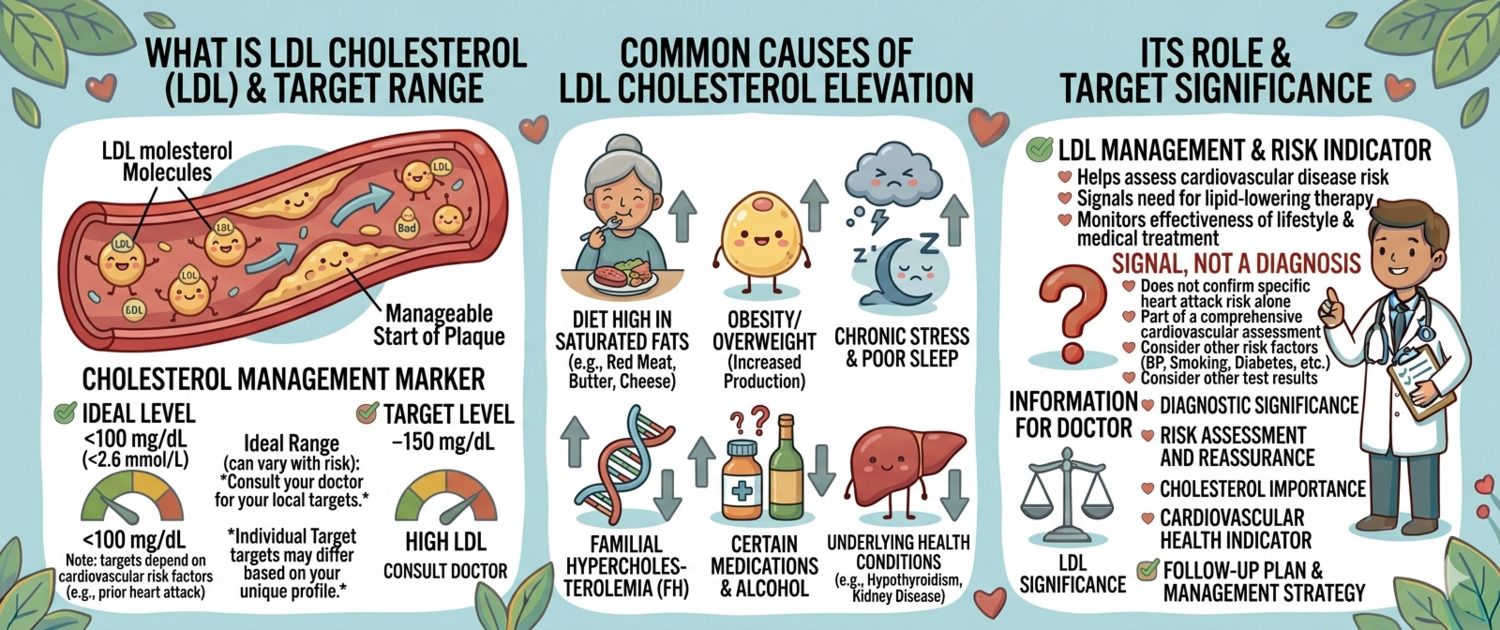
LDL is called "bad cholesterol" — and while that is an oversimplification, it captures the essential reality: low-density lipoproteins are the primary builders of atherosclerotic plaques in artery walls. Every 1.0 mmol/L reduction in LDL measurably reduces the risk of heart attack by approximately 22% — one of the most robustly demonstrated effects in cardiology. Let's break down what LDL is, why its level matters more than most people realize, and how to bring it down.
What LDL Is and How It Drives Atherosclerosis
LDL (low-density lipoproteins) are the primary transport carriers of cholesterol in the body. They form from VLDL (very-low-density lipoproteins) as triglycerides are hydrolyzed, and they carry cholesterol from the liver to peripheral tissues — muscles, adrenal glands, and cell membranes.
Under normal conditions, cells capture LDL through receptors (LDL-R) and use the cholesterol for membrane synthesis and hormone production. The problem begins when LDL is in excess: uncaptured particles penetrate the subendothelial space of arteries, become oxidized, and are engulfed by macrophages, which transform into foam cells. An atherosclerotic plaque gradually develops — initially soft and lipid-rich, later fibrotic with calcification.
Rupture of an unstable plaque triggers thrombosis — this is how the majority of heart attacks and strokes occur suddenly in people who had "no complaints."
Particularly dangerous are small dense LDL particles (sdLDL): they penetrate the vessel wall more easily, are more susceptible to oxidation, and circulate longer. Their proportion increases with high triglycerides and insulin resistance — which is why a "normal" LDL in the setting of metabolic syndrome can carry significantly greater risk than the same value in a healthy individual.
A lipid panel is the only way to objectively assess LDL and the full spectrum of lipid risk in a single test.
LDL Normal Ranges: Not One Number for Everyone
The key feature of LDL interpretation is that target values are determined not by the absolute figure on the lab report, but by the patient's overall cardiovascular risk. The same value of 3.0 mmol/L may be entirely normal for a young healthy individual and unacceptably high for a patient who has survived a heart attack.
Population reference categories:
| LDL level (mmol/L) | Category |
|---|---|
| < 1.8 | Optimal |
| 1.8–2.5 | Desirable |
| 2.5–3.0 | Borderline |
| 3.0–4.9 | High |
| ≥ 5.0 | Very high |
Risk-based LDL targets (ESC 2019 guidelines):
| Risk category | LDL target |
|---|---|
| Very high (MI, stroke, diabetes with organ damage, CKD 3–5) | < 1.4 mmol/L |
| High (diabetes without organ damage, hypertension with organ damage, CKD 1–2) | < 1.8 mmol/L |
| Moderate | < 2.6 mmol/L |
| Low | < 3.0 mmol/L |
Patients who have experienced a heart attack or stroke have the strictest targets — even when their LDL appears "normal" on the standard reference range. High-intensity statin therapy in these patients is a guideline standard, not an option.
In women before menopause, LDL is on average lower than in men of the same age — estrogens upregulate hepatic LDL receptor activity. After menopause this protection disappears and LDL rises.
How to Prepare for an LDL Blood Test
LDL is measured in serum as part of a lipid panel. Preparation requirements are standard across the full lipid profile.
- Strictly fasting: at least 12 hours without food — eating raises triglycerides, which enter the Friedewald LDL calculation
- No alcohol for 72 hours: alcohol transiently lowers LDL and substantially raises triglycerides
- Stable diet for 2–3 weeks: a drastic dietary change before the test produces an unrepresentative result
- Acute illness reduces LDL by 10–40% — best to postpone testing 6–8 weeks after recovery; after a heart attack, only a blood draw within the first 24 hours or after 6–8 weeks gives a reliable result
- Pregnancy substantially alters LDL — interpret with caution
Most laboratories calculate LDL by the Friedewald equation: LDL = Total cholesterol − HDL − TG/2.2. When triglycerides exceed 4.5 mmol/L, this formula is unreliable — direct LDL measurement is required.
Causes of High LDL
Elevated LDL — hypercholesterolemia — results from a combination of genetic factors, lifestyle, and comorbid conditions.
| Cause | Mechanism | Characteristic features |
|---|---|---|
| Familial hypercholesterolemia (FH) | LDL receptor or apoB gene mutation | LDL > 5.0–6.0; family history; xanthomas |
| Diet high in saturated fats | Reduced hepatic LDL receptor activity | Responds to dietary change |
| Hypothyroidism | Reduced LDL receptor synthesis and activity | Combined with elevated TSH |
| Type 2 diabetes | Insulin resistance → increased VLDL synthesis | High TG + high LDL |
| Nephrotic syndrome | Compensatory lipoprotein synthesis for protein losses | Proteinuria; edema |
| Chronic kidney disease | Impaired VLDL→LDL catabolism | Rising creatinine |
| Gallstones / cholestasis | Impaired biliary cholesterol excretion | Elevated ALP, GGT |
| Certain medications | Reduced LDL receptor activity | Progestins, corticosteroids, retinoids |
| Obesity | Insulin resistance → VLDL synthesis | Abdominal pattern |
| Menopause | Reduced estrogen-driven LDL receptor stimulation | LDL rises after age 50 |
Familial hypercholesterolemia (FH) — a genetic condition with LDL > 5.0 mmol/L in heterozygotes (> 13–15 mmol/L in homozygotes). Affects 1 in 250–500 people. Without treatment — myocardial infarction in the 30s–40s. Diagnostic criteria include LDL level, family history, and physical signs (tendon xanthomas, xanthelasmas, premature corneal arcus before age 45).
Causes of Low LDL
Low LDL (< 1.0 mmol/L) is usually good news from a cardiovascular perspective. But in some situations it is a marker of systemic disease.
Main causes of low LDL:
- Hyperthyroidism — accelerated LDL particle catabolism
- Severe liver disease (cirrhosis, acute hepatic failure) — reduced synthesis of apoB-containing lipoproteins
- Malabsorption syndrome, severe starvation, cachexia — substrate deficiency
- Hypobetalipoproteinemia — a rare genetic condition
- Intensive statin therapy — expected and targeted reduction; LDL 0.5–1.0 mmol/L on therapy is safe
- Malignancies (acute leukemias, some solid tumors) — tumor cell cholesterol consumption
Very low LDL (< 0.5 mmol/L) without an explained cause — warrants excluding severe liver disease and malignancy.
LDL in the Context of the Full Lipid Profile
LDL is central but not the only marker of atherogenic risk. Its clinical significance is fully revealed only alongside the complete lipid panel.
LDL and HDL: atherogenicity ratio. At equal LDL levels, high HDL substantially reduces risk — it transports excess cholesterol back to the liver. The atherogenicity index = (Total cholesterol − HDL) / HDL, or more simply LDL/HDL. Optimal LDL/HDL ratio: < 3.0.
LDL and triglycerides: metabolic syndrome. High triglycerides, high LDL, and low HDL form the classic "atherogenic triad" of insulin resistance. Additionally: elevated triglycerides drive formation of small dense LDL (sdLDL) — the most atherogenic subfraction, not captured by standard LDL calculation.
LDL and atherosclerosis: the causal relationship between LDL and atherosclerosis is one of the most established facts in medicine. Mendelian randomization data show: the lower the LDL maintained throughout life, the lower the risk of myocardial infarction — regardless of how the reduction is achieved (statins, ezetimibe, PCSK9 inhibitors, or diet).
Non-HDL cholesterol = Total cholesterol − HDL. Captures LDL + VLDL + IDL. When triglycerides exceed 4.5 mmol/L and formula-calculated LDL is unreliable — non-HDL cholesterol becomes the preferred therapeutic target.
How to Lower LDL and When Medication Is Needed
LDL is one of the most manageable cardiovascular risk factors: both lifestyle changes and medications deliver measurable results.
Lifestyle changes (reduce LDL by 5–20%):
- Limit saturated fats (red meat, butter, palm oil, full-fat cheese) and trans fats (margarine, industrial baked goods) — to < 7% of daily calories
- Increase soluble fiber: oat bran, legumes, apples, psyllium — reduces LDL by 5–10%
- Plant sterols and stanols (phytosterol-enriched margarines, functional foods) — reduce LDL by 8–15%
- Regular aerobic activity — modestly lowers LDL and raises HDL
- Weight loss in obesity — every 10 kg lost reduces LDL by approximately 5–8%
Pharmacological treatment:
Statins — first-line when LDL reduction beyond lifestyle is needed. Mechanism: inhibition of HMG-CoA reductase → reduced hepatic cholesterol synthesis → compensatory increase in LDL receptor number → enhanced LDL clearance from blood. Reduce LDL by 30–55% depending on agent and dose.
Ezetimibe — blocks intestinal cholesterol absorption. In monotherapy reduces LDL by 15–20%; in combination with statins — an additional 15–25%.
PCSK9 inhibitors (evolocumab, alirocumab) — monoclonal antibodies blocking LDL receptor degradation. Reduce LDL by 50–65%. Used in familial hypercholesterolemia and statin-intolerant patients at very high cardiovascular risk.
Statin initiation should be discussed with a physician. Self-discontinuing statins after LDL normalizes is one of the most common and dangerous errors: statins are prescribed lifelong in high-risk patients and only continue working with uninterrupted use.
For the extended lipid profile with ApoB, LDL's role in longevity medicine and target levels, see the article extended lipid profile and longevity.
This article is for informational purposes only and does not replace professional medical advice. If you have high cholesterol or elevated LDL, consult a cardiologist or GP.
For informational purposes only
This article is for informational purposes only and does not constitute medical advice, diagnosis, or treatment. Please consult a healthcare professional for medical guidance.