Extended Lipid Panel: Normal Ranges, Interpretation and Heart Risk
Reviewed by the LabReadAI medical team
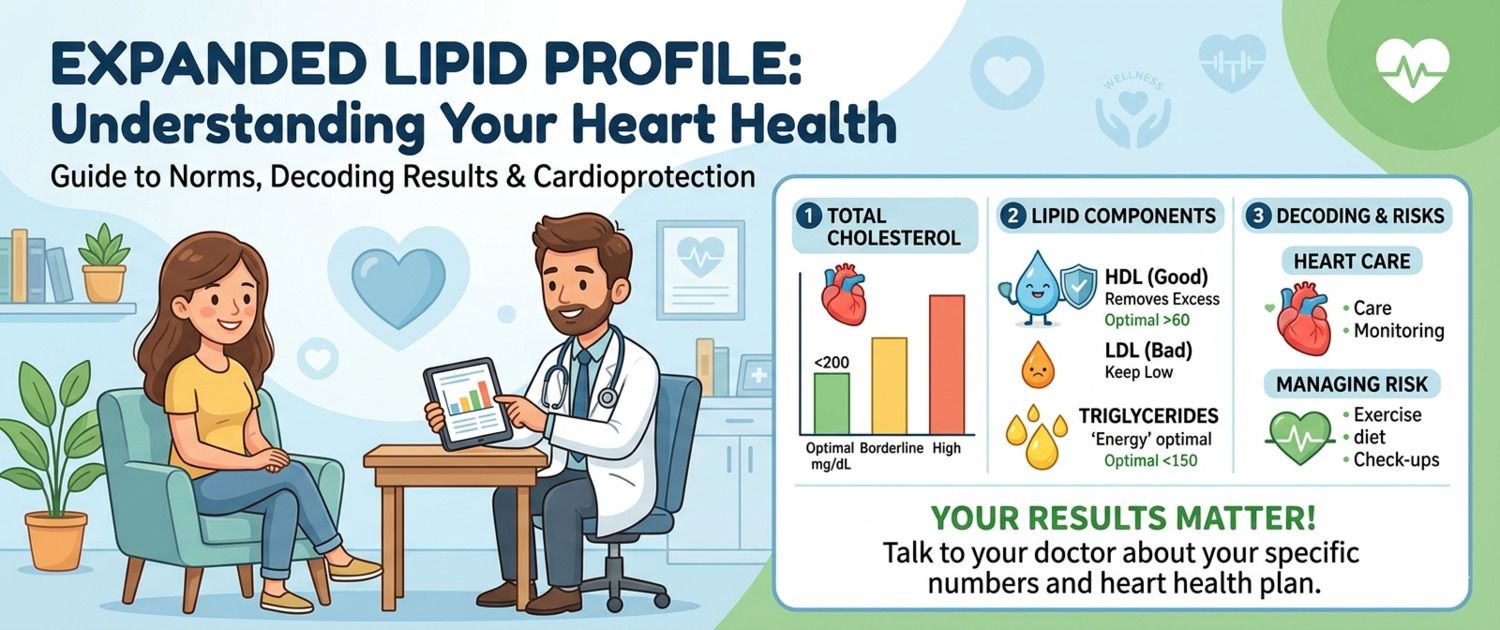
A standard cholesterol test is one of the most frequently ordered — and one of the least informative — blood tests. "Cholesterol is normal" says nothing about actual cardiovascular risk. An extended lipid panel is a different conversation: it shows not only how much fat is in the blood but how atherogenic the packaging is.
What the Extended Lipid Panel Includes
A basic (standard) lipid panel has four components: total cholesterol, LDL, HDL and triglycerides. The extended version adds several critically important positions.
Basic panel: Total cholesterol, LDL cholesterol, HDL cholesterol, Triglycerides.
Extended additions:
- ApoB (apolipoprotein B) — the number of atherogenic particles
- Lipoprotein(a) — an independent genetic risk factor
- Non-HDL cholesterol — all atherogenic cholesterol combined
- Atherogenicity index — total cholesterol to HDL ratio
Interpreting a lipid panel correctly requires viewing the full picture — no single value is meaningful in isolation.
Lipid Panel Normal Ranges
| Marker | Optimal | Moderate risk | High risk |
|---|---|---|---|
| Total cholesterol | < 5.0 mmol/L | 5.0–6.2 | > 6.2 |
| LDL | < 2.6 mmol/L | 2.6–4.1 | > 4.1 |
| HDL (men) | > 1.0 mmol/L | 0.8–1.0 | < 0.8 |
| HDL (women) | > 1.2 mmol/L | 1.0–1.2 | < 1.0 |
| Triglycerides | < 1.7 mmol/L | 1.7–5.6 | > 5.6 |
| ApoB | < 90 mg/dL | 90–120 | > 120 |
| Atherogenicity index | < 3 | 3–4 | > 4 |
With established cardiovascular disease or diabetes, targets are stricter: LDL < 1.8 mmol/L, ApoB < 70 mg/dL.
Total Cholesterol — Why It Is a Poor Marker
Total cholesterol is the sum of LDL, HDL and VLDL. A high HDL raises the "total" figure without increasing risk. An athlete with total cholesterol of 6.5 mmol/L and HDL of 2.5 mmol/L is cardiovascularly healthier than someone with total cholesterol 5.5 and HDL 0.9 mmol/L.
Better markers:
- Non-HDL cholesterol = Total − HDL (target < 3.4 mmol/L)
- TG/HDL ratio (target < 1.3; above 1.8 suggests insulin resistance)
- Atherogenicity index = Total/HDL (target < 3)
ApoB: Why It Outperforms LDL
ApoB is the protein on the surface of every atherogenic particle. One ApoB = one dangerous particle. This makes it a direct particle counter.
At identical LDL values, two people can differ twofold in particle count — and particle count, not the lipid load, drives cholesterol deposition in arterial walls. This occurs in insulin resistance: triglycerides rise, VLDL is overproduced, each VLDL carries one ApoB molecule, and LDL remains deceptively "normal". The 2023 ESC guidelines name ApoB the strongest lipid risk predictor overall. For a detailed breakdown, see ApoB: why this test beats standard cholesterol.
Triglycerides and HDL: The Insulin Resistance Ratio
The TG/HDL ratio is one of the most sensitive accessible insulin resistance markers.
| TG/HDL (mmol/L) | Interpretation |
|---|---|
| < 1.3 | Optimal, low insulin resistance |
| 1.3–1.8 | Borderline |
| > 1.8 | Probable insulin resistance |
| > 3.5 | High probability of small dense LDL pattern |
An elevated TG/HDL ratio predicts cardiovascular events even with a "normal" LDL. This is the main signal to extend testing to ApoB and fasting insulin.
How to Improve Your Lipid Panel Without Medication
Replace high-GI carbohydrates with unrefined alternatives: lowers triglycerides 20–30%, raises HDL, reduces small dense LDL pattern.
Monounsaturated fats (olive oil, avocado): lower LDL 8–12%, ApoB 8–10%, leave HDL unchanged.
Soluble fibre (psyllium, oats, legumes): lower LDL 5–10% through reduced cholesterol reabsorption.
Aerobic exercise: lower triglycerides 20–25%, raise HDL 5–10%.
5–10% weight loss: triglycerides fall 15–20%, HDL rises.
Berberine 500 mg twice daily: lowers LDL 20–25%, triglycerides 25–35%.
When lifestyle measures are insufficient, statins reduce LDL and ApoB by 35–55%. For the broader longevity context, see how to live long and healthy and biological age by blood tests.
How to Prepare for a Lipid Panel
Strict 12-hour fast before blood draw — a fatty meal the night before inflates triglycerides two to threefold, distorting the entire profile. No alcohol for 24 hours. Do not radically change your diet in the three days before testing — results should reflect your usual pattern.
For informational purposes only
This article is for informational purposes only and does not constitute medical advice, diagnosis, or treatment. Please consult a healthcare professional for medical guidance.