ApoB Blood Test: Normal Levels, Interpretation and Cardiovascular Risk
Reviewed by the LabReadAI medical team
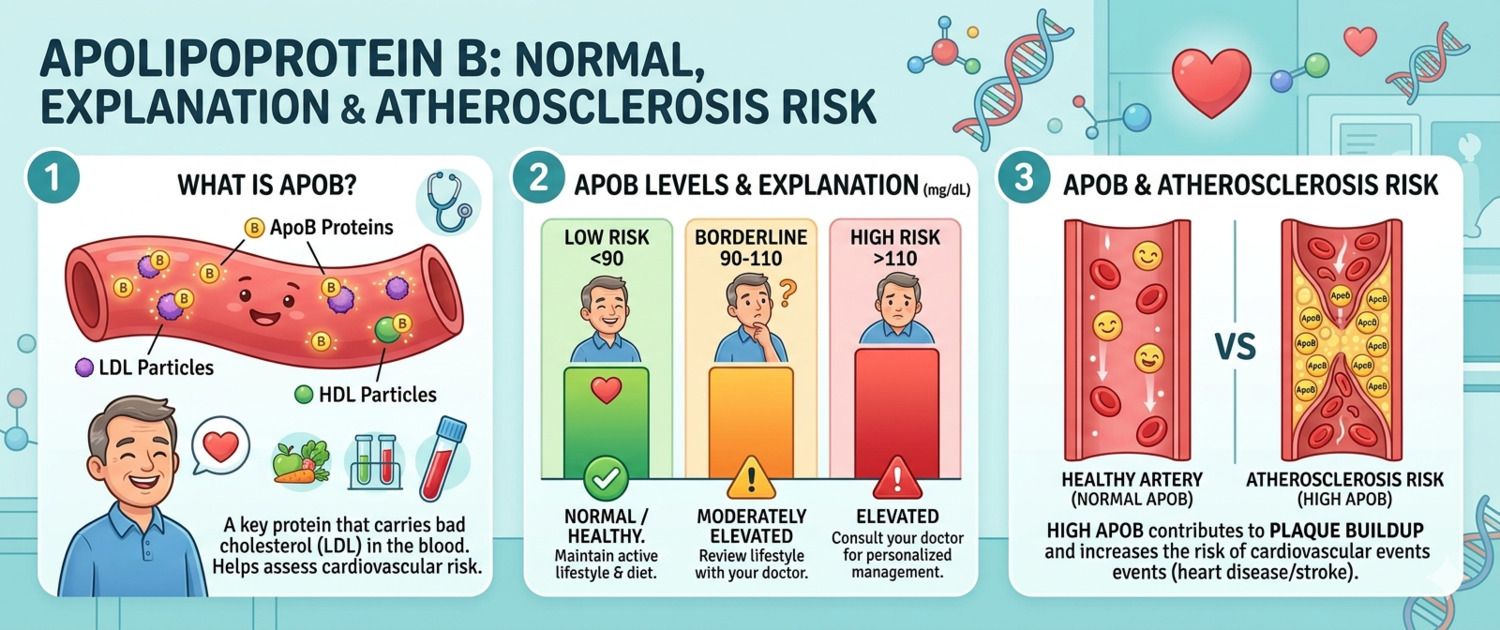
A standard cholesterol test measures the amount of lipid in the blood. Apolipoprotein B (ApoB) measures something different: the number of atherogenic particles. It is that number — not the cholesterol load — that determines how many lipid-carrying projectiles are bombarding arterial walls every minute, and it predicts cardiovascular risk more accurately than conventional LDL cholesterol.
What Is ApoB and How Does It Work?
ApoB is a protein located on the surface of every atherogenic particle: LDL (bad cholesterol), VLDL and lipoprotein(a). There is exactly one ApoB molecule per particle. This makes ApoB a direct count of atherogenic particles in the blood, regardless of how much cholesterol each particle carries.
This is where the standard lipid test has a fundamental limitation. LDL cholesterol measures the total lipid cargo, not the number of vehicles. Two individuals can have identical LDL of 3.0 mmol/L, yet one may have 800 small dense particles (high risk) and the other 400 large buoyant particles (low risk). ApoB resolves this: it simply counts the vehicles.
ApoB Normal Ranges for Adults
| Risk category | ApoB (mg/dL) |
|---|---|
| Optimal | < 70 |
| Normal (no risk factors) | < 100 |
| Borderline high | 100–129 |
| High | ≥ 130 |
For patients with established cardiovascular disease or diabetes, the target is ApoB below 70 mg/dL. In familial hypercholesterolaemia, the target is below 60 mg/dL. Reference ranges printed on laboratory reports often do not reflect current ESC 2023 recommendations.
Why ApoB Is More Accurate Than LDL Cholesterol
Discordance — normal LDL but elevated ApoB — occurs in approximately one in four patients who experience a cardiovascular event. It arises in:
- Small dense LDL particles (pattern B): each particle carries less cholesterol, so LDL is normal while particle count, and therefore ApoB, is high.
- Insulin resistance and metabolic syndrome: the liver overproduces VLDL, each carrying one ApoB molecule, raising total atherogenic particle burden without a proportional LDL rise.
- Elevated HDL cholesterol: high HDL inflates the total cholesterol figure, masking the real atherogenic pool.
Large prospective studies — INTERHEART, AMORIS, UK Biobank — show ApoB predicts first myocardial infarction 20–25% more accurately than LDL. Each 10 mg/dL reduction in ApoB corresponds to a 6% reduction in ischaemic heart disease risk, per a 2021 Lancet meta-analysis.
Causes of Elevated ApoB
Diet high in saturated and trans fats directly stimulates hepatic LDL particle synthesis. About 25% of the population are genetic hyper-responders who show a pronounced ApoB rise to dietary fat.
Insulin resistance drives excess VLDL production. After VLDL conversion to LDL, the particle count remains elevated even when LDL cholesterol appears modest.
Familial hypercholesterolaemia (FH): LDL receptor mutations impair particle clearance from the bloodstream. A lipid panel without ApoB in FH is incomplete.
Hypothyroidism: slowed lipid metabolism raises ApoB in parallel with TSH elevation.
Familial Hypercholesterolaemia: Why ApoB Is Critical
In FH, the calculated LDL (Friedewald formula) can underestimate actual particle burden, because the formula assumes average particle cholesterol content — which differs markedly in FH. ApoB provides objective therapy monitoring: if ApoB falls below 70 mg/dL, the target is genuinely met.
Family screening using ApoB is recommended when a first-degree relative has had a heart attack before age 55 (men) or 65 (women), as inherited FH can raise ApoB in children from age five, while other markers remain normal.
How to Lower ApoB
Diet: replacing saturated fats with monounsaturated fats (olive oil, avocado) reduces ApoB by 8–12%. Soluble fibre (psyllium, oats, legumes) adds a further 4–6% by reducing cholesterol absorption.
Statins are the most powerful tool, reducing ApoB by 30–50% by upregulating hepatic LDL receptors.
Berberine — a plant alkaloid — lowers ApoB by 15–20% through a statin-like mechanism (LDL receptor upregulation, suppression of fatty acid synthesis).
Ezetimibe blocks intestinal cholesterol absorption, adding 15–20% ApoB reduction on top of statin therapy.
Exercise: regular aerobic activity lowers triglycerides and VLDL, reducing total atherogenic particle count by 7–10%.
For the longevity context and a practical monitoring strategy, see ApoB and longevity: why this test beats standard cholesterol.
Who Should Get an ApoB Test?
ApoB is most valuable when:
- LDL appears normal but cardiovascular risk factors are present (diabetes, obesity, smoking);
- There is a family history of early heart attack;
- Monitoring the response to lipid-lowering therapy;
- Metabolic syndrome is present.
Blood is drawn fasting (12-hour fast). The result is relatively stable — unlike triglycerides, ApoB is not substantially affected by a single fatty meal.
For informational purposes only
This article is for informational purposes only and does not constitute medical advice, diagnosis, or treatment. Please consult a healthcare professional for medical guidance.