ApoB: What It Measures, Normal Levels and Atherosclerosis Risk
Reviewed by the LabReadAI medical team
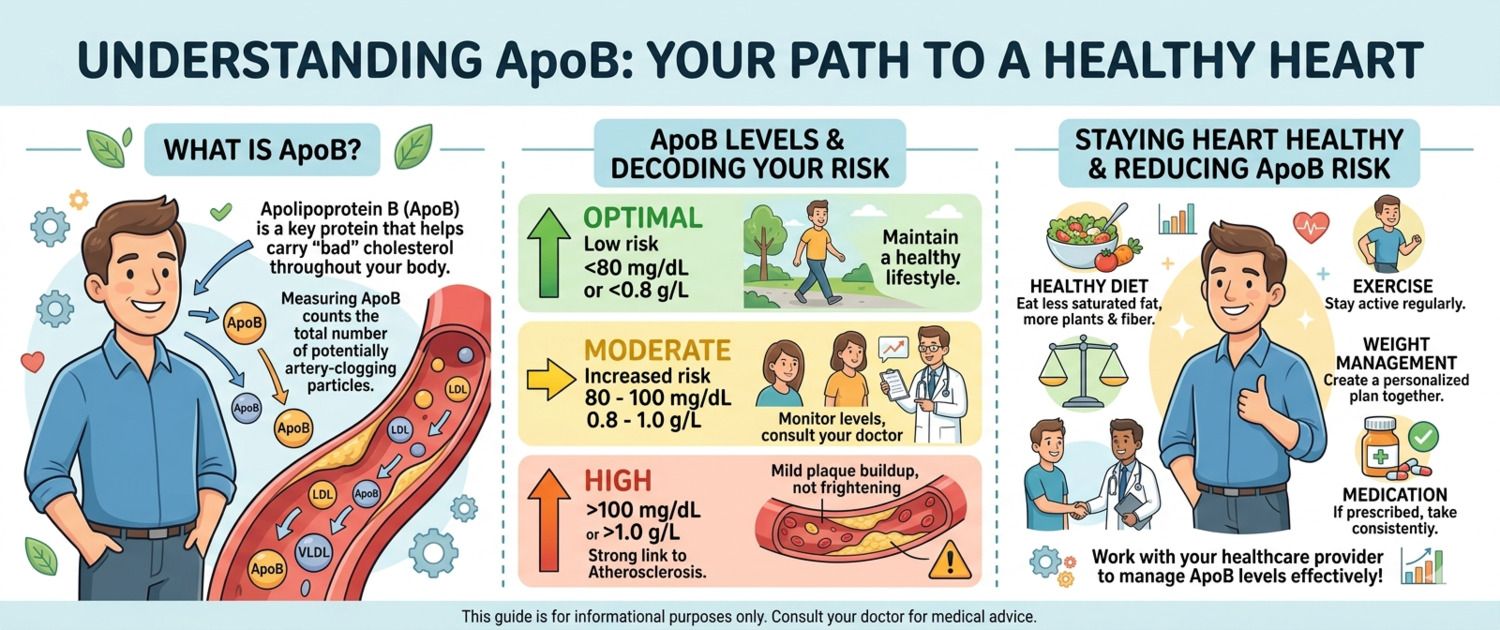
Standard LDL cholesterol testing measures the total mass of cholesterol carried in low-density lipoprotein particles. But cardiovascular risk is determined not by cholesterol mass, but by the number of atherogenic particles — and that is precisely what ApoB measures.
ApoB (apolipoprotein B) is the structural protein on every atherogenic lipoprotein particle: VLDL, IDL, LDL, remnants, and Lp(a). Each such particle carries exactly one ApoB molecule. Therefore, ApoB = an exact count of atherogenic particles.
What ApoB Measures and Why Interpretation Matters
Atherosclerotic plaque forms when atherogenic particles penetrate the arterial wall and become trapped there. The probability of penetration depends on particle count, not on the cholesterol volume inside each particle.
Interpreting an ApoB result directly answers: how many atherogenic particles are circulating? This makes ApoB a more accurate predictor of cardiovascular risk than LDL-C.
ApoB is included in most extended cardiology panels. An extended lipid profile with ApoB is the standard cardiovascular risk assessment in modern preventive medicine clinics.
ApoB Normal Levels: Interpretation and Longevity Optimal Values
| ApoB level | Interpretation |
|---|---|
| < 60 mg/dL | Very low risk (aggressive statin therapy target) |
| 60–79 mg/dL | Longevity optimum |
| 80–99 mg/dL | Moderate risk; standard treatment target |
| 100–129 mg/dL | Elevated risk |
| ≥ 130 mg/dL | High risk; interventions indicated |
The lab reference range is typically < 120–130 mg/dL. But the longevity optimum is substantially lower: < 80 mg/dL. Meta-analyses show a linear relationship between ApoB and cardiovascular events with no apparent lower "safe" threshold — lower is better.
An equivalent surrogate marker is non-HDL cholesterol (total minus HDL): optimal < 2.6 mmol/L when ApoB < 80 mg/dL, useful when ApoB is unavailable.
Why ApoB Outperforms LDL: Discordance Explained
ApoB and LDL normally correlate. But in a subset of patients they diverge — this is called discordance:
LDL normal, ApoB elevated — the most dangerous scenario. It indicates many small dense LDL particles (sdLDL): each carries less cholesterol (so LDL-C looks normal), but there are many more particles. Small dense LDL are 3–5 times more atherogenic than large LDL.
LDL elevated, ApoB normal — lower risk: few large particles with high cholesterol content per particle.
Discordance commonly arises with insulin resistance: hyperinsulinemia shifts the LDL spectrum toward small dense particles. Elevated triglycerides and low HDL are indirect markers of this shift.
Apolipoprotein B and Atherosclerosis: The Risk Mechanism
ApoB-containing particles penetrate the endothelium and are captured by macrophages → foam cells form → plaque grows. The more particles, the faster atherosclerosis progresses.
Chronic inflammation amplifies this: elevated hs-CRP increases particle adhesion to the endothelium. The combination of high ApoB and high hs-CRP multiplies cardiovascular event risk compared with either factor alone.
Lp(a) is a distinct lipoprotein carrying its own ApoB molecule plus an additional apolipoprotein(a) protein. Its level is 80–90% genetically determined and is largely unresponsive to diet or exercise. Normal ApoB with elevated Lp(a) still carries significant cardiovascular risk.
Elevated ApoB: Causes and Next Steps
ApoB rises with:
- Insulin resistance and metabolic syndrome (most common cause)
- Diets high in saturated fats and trans fats
- Hypothyroidism (reduces LDL receptor clearance)
- Chronic inflammation
- Genetic disorders (familial hypercholesterolemia)
When elevated ApoB is found, evaluate homocysteine (methylation marker), hs-CRP, fasting insulin, and thyroid function.
How to Lower ApoB Without Medication
Diet:
- Replace saturated fats with unsaturated fats (olive oil, avocado, nuts)
- Increase omega-3 from fatty fish or supplements — lowers VLDL and triglycerides
- Soluble fiber (oat bran, psyllium, legumes) reduces LDL and ApoB by 5–10%
- Limit refined carbohydrates and sugar — lowers triglycerides → fewer sdLDL particles
Lifestyle:
- Aerobic exercise 150+ min/week at moderate intensity lowers ApoB by 5–8%
- Weight loss in obesity: −10% body weight → −15–20% ApoB
- Improving insulin sensitivity reduces sdLDL particle shift
When ApoB exceeds 100 mg/dL with additional risk factors, consult a cardiologist regarding statin or PCSK9-inhibitor therapy.
Who Should Test ApoB and How Often
ApoB is recommended for:
- Everyone after age 40 — annually as part of the annual lab checklist
- Anyone with insulin resistance, obesity, or metabolic syndrome
- Those with "normal" LDL but other risk factors present (smoking, hypertension, elevated BMI)
- Anyone with family history of early cardiovascular events (< 55 in men, < 65 in women)
Draw fasting (12 hours). ApoB is stable — no need to retest more than once per year at stable values.
Complete longevity risk picture — in how to live long.
For informational purposes only
This article is for informational purposes only and does not constitute medical advice, diagnosis, or treatment. Please consult a healthcare professional for medical guidance.