Annual Lab Tests Checklist: Key Biomarkers for Longevity
Reviewed by the LabReadAI medical team
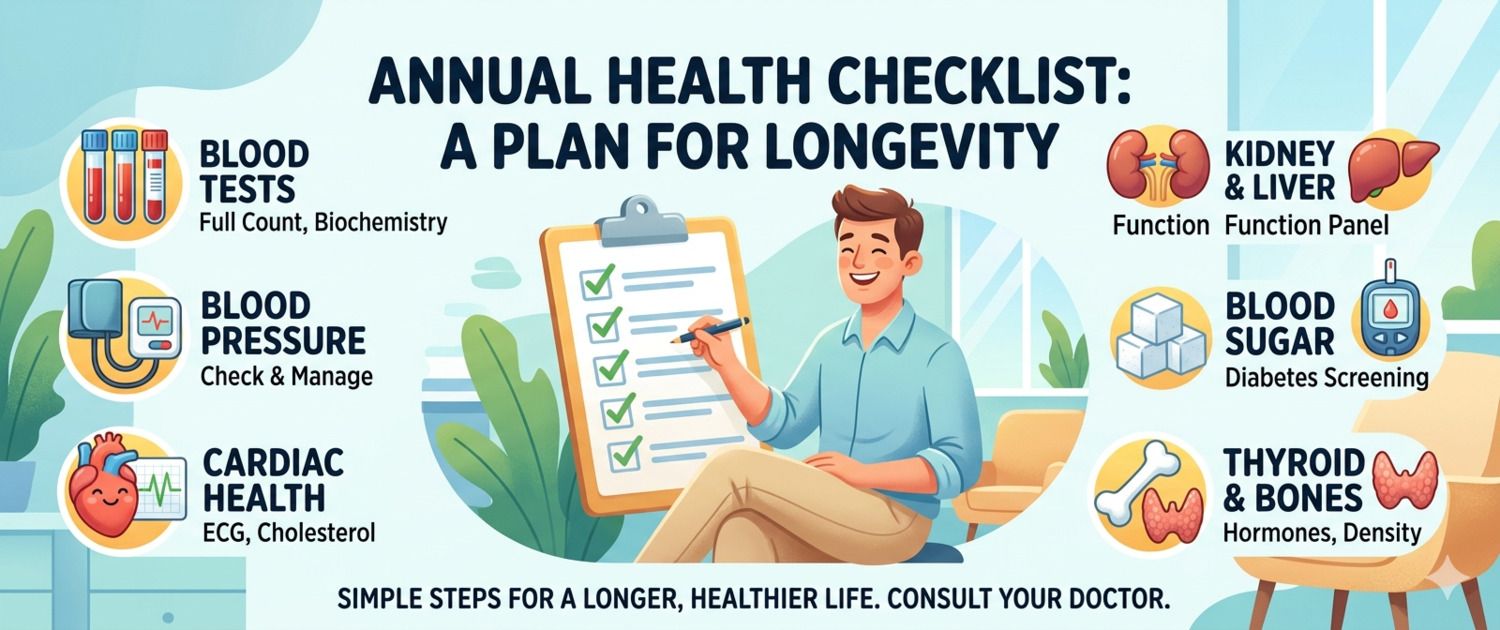
Most people only get lab tests when something hurts. But chronic inflammation, insulin resistance, and key nutrient deficiencies accumulate silently for years — until they're too advanced for easy correction.
An annual lab checklist is not medical bureaucracy. It's an early-warning system that catches deviations while they're still fixable.
Why Annual Monitoring Beats Symptomatic Testing
Most chronic diseases — type 2 diabetes, coronary artery disease, osteoporosis — develop for 10–15 years before the first symptom. Annual testing lets you intercept the trend early.
Biological age is defined precisely by the combination of laboratory markers. When annual checklist results consistently fall in optimal ranges, biological age tends to be lower than chronological age.
The EPIC study of 25,000 participants found that people with optimal values on four key biomarkers live an average of 14 years longer than those outside normal range.
Metabolic Core Panel: Non-Negotiables
The metabolic core is the foundation of every annual checklist:
| Test | Optimal | Lab normal |
|---|---|---|
| Fasting glucose | 4.0–5.0 mmol/L | < 6.1 |
| Fasting insulin | 3–8 µU/mL | < 25 |
| HbA1c | < 5.5% | < 6.0% |
| HOMA-IR | < 1.5 | < 2.7 |
HOMA-IR = (insulin × glucose) / 22.5. If HOMA-IR exceeds 2, insulin resistance is already present — even when glucose looks "normal." More detail in fasting insulin and HOMA-IR.
Glycated hemoglobin reflects average glucose over three months and reveals hidden sugar spikes invisible in a single fasting test.
Lipid Panel: Beyond Total Cholesterol
The standard lipid panel covers cholesterol, LDL, HDL, and triglycerides. The extended version provides substantially more predictive value.
| Test | Longevity optimal |
|---|---|
| LDL | < 2.6 mmol/L |
| HDL | > 1.6 mmol/L (women), > 1.3 (men) |
| Triglycerides | < 1.1 mmol/L |
| ApoB | < 80 mg/dL |
ApoB reflects atherogenic risk more accurately than LDL because it counts atherogenic particles rather than summing their mass. More in extended lipid profile.
Inflammation and Oxidative Stress Markers
Chronic inflammation is the main driver of aging. Two markers belong in every annual checklist:
High-sensitivity CRP — the best-validated marker of systemic inflammation. Optimal < 1 mg/L. At > 3 mg/L, cardiovascular event risk triples. Full interpretation in hs-CRP and inflammation.
Homocysteine — marker of methylation capacity and risk of atherosclerosis and dementia. Optimal < 9 µmol/L. Correctable with B vitamins. Full protocol in homocysteine and longevity.
Hormonal Panel: Minimum Annual Set
Hormonal status governs quality of life, body composition, and aging rate.
| Hormone | Who | Frequency |
|---|---|---|
| TSH | Everyone | Annual |
| Free testosterone | Men 35+ | Annual |
| Estradiol | Women | Annual |
| DHEA-S | 40+ | Annual |
| IGF-1 | 40+ | Every 2 years |
DHEA-S is a biological age marker: it declines 1–2% per year from age 30. Full analysis in DHEA-S and aging.
Nutrient Status: The Silent Deficiencies
| Test | Optimal range |
|---|---|
| Vitamin D (25-OH) | 60–80 ng/mL |
| Ferritin | 70–150 µg/L (men), 50–100 (women) |
| Omega-3 index | 8–12% |
| Vitamin B12 | > 400 pmol/L |
| RBC magnesium | > 2.0 mmol/L |
Vitamin D deficiency affects 70–80% of Russians in autumn and winter. On vitamin D and longevity: vitamin D and longevity. Omega-3 index in Russia averages 4–5% against an optimal 8–12%. More: omega-3 index.
Kidney and Liver Function: Early Markers
| Test | Purpose |
|---|---|
| Creatinine + eGFR | Kidney function |
| ALT, AST | Liver, inflammation |
| Uric acid | Metabolic syndrome, NAFLD |
| Total protein, albumin | Nutritional status |
Uric acid above 350 µmol/L (women) or 415 (men) is an early sign of metabolic syndrome. ALT > 30 U/L (men) or > 20 (women) signals fatty liver disease.
How to Run an Annual Checklist in Practice
The best approach: one fasting morning visit per year, testing everything at once. Many labs offer bundled health check panels at lower cost than the sum of individual tests.
Full list with intervals and priorities — in health monitoring. For those starting with a minimal but high-impact set — analysis checklist.
After age 40, expand the annual checklist with aging biomarkers: telomere length, epigenetic clocks, and inflammaging-specific markers.
The full longevity program incorporating all these markers is in how to live long.
For informational purposes only
This article is for informational purposes only and does not constitute medical advice, diagnosis, or treatment. Please consult a healthcare professional for medical guidance.