Blood Test Monitoring for Health: How Often to Test and Track
Reviewed by the LabReadAI medical team
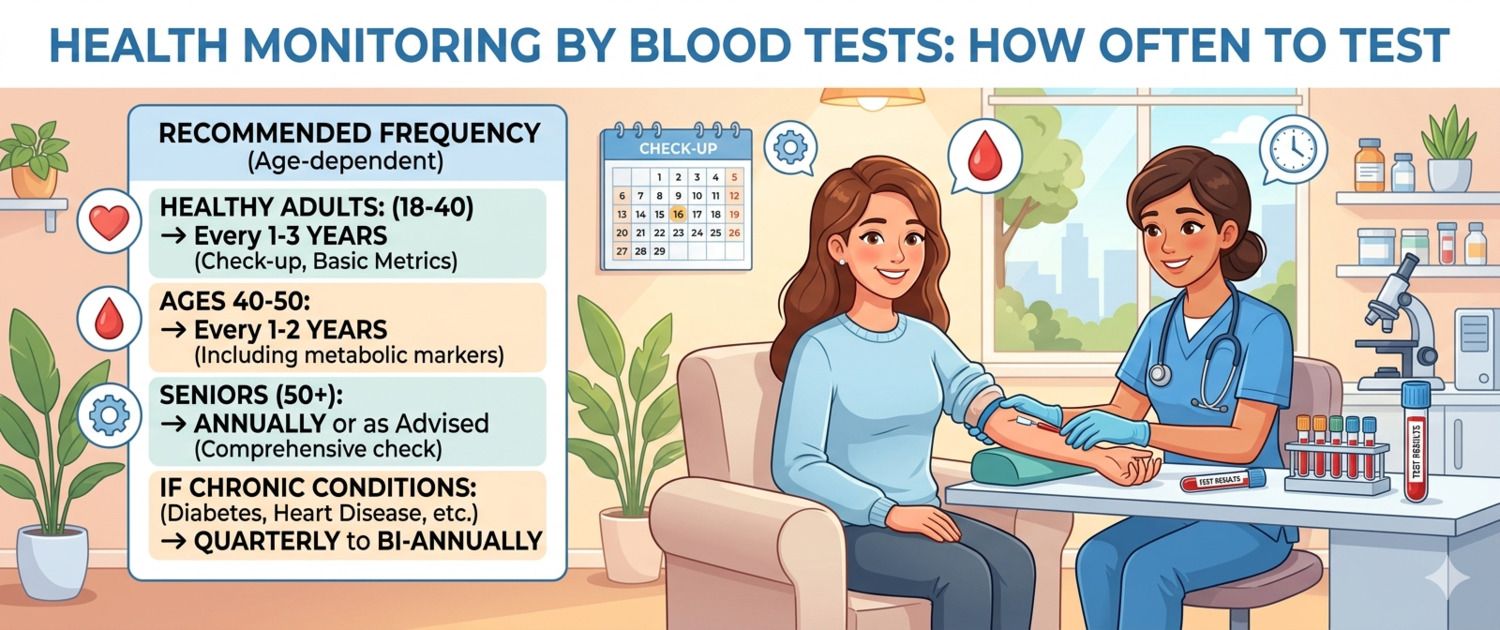
A single blood test is a snapshot of one moment. Without previous results it tells you very little: you cannot see whether a value is rising or falling, fast or slow, stable or fluctuating. Real health monitoring is a series of measurements over time that builds a personal trend. It is the trend — not an isolated number — that lets you act before symptoms appear.
Why One Test Is Not Information: The Logic of Trends
A lab result has three dimensions: the absolute value, its position within the reference range, and the trend relative to previous measurements. The third dimension is the most important — and the one routinely ignored with one-off checkups.
Example: testosterone of 14 nmol/L in a 45-year-old man is "within range". But if the value was 20 nmol/L a year ago — that is a 30% decline in 12 months. A fundamentally different clinical picture requiring action. Without the previous result it is impossible to see.
The same applies to ferritin, CRP, vitamin D, HbA1c: knowing your personal baseline at age 30–35 provides a reference for all subsequent decades. This is what a health monitoring system actually means.
Health Monitoring: Core Markers for Regular Tracking
A systematic monitoring programme does not require dozens of tests. Ten to twelve markers cover the key physiological systems:
Inflammation and immune status: high-sensitivity C-reactive protein — the primary chronic inflammation marker. Optimum: below 1 mg/L. A rising trend without acute illness signals chronic inflammation.
Iron stores and metabolism: ferritin + complete blood count. Ferritin is relevant both as an iron marker and as an indirect inflammation indicator — which is why it is always read alongside CRP.
Glucose metabolism: HbA1c — the 2–3 month average of glucose levels. A rising trend even within the normal range (from 5.2% to 5.6%) is an early sign of worsening insulin sensitivity.
Nutritional status: vitamin D — the one nutrient where deficiency affects most people in temperate climates. In trend terms, the goal is not just "reaching normal" but holding the 75–150 nmol/L optimum.
How Often to Take Blood Tests: Frequency by Marker
Different markers require different monitoring intervals, based on how fast they change and their clinical relevance:
| Marker | Minimum frequency | Optimal frequency |
|---|---|---|
| Complete blood count | Once a year | 1–2 times a year |
| hs-CRP | Once a year | Twice a year |
| Ferritin | Once a year | 1–2 times a year |
| HbA1c | Once a year | Twice a year (if pre-diabetic) |
| Vitamin D | Once a year | Twice a year (autumn and spring) |
| Testosterone + SHBG | Once a year (from age 40) | Once a year |
| Lipid panel | Once per 2–3 years (normal) | Annually (elevated risk) |
| TSH | Once a year | Once a year |
Vitamin D is an exception to "once a year": in temperate climates it reliably drops through winter. Testing in September–October (before the deficit season) and March–April (after winter) gives a complete seasonal picture.
What "Normal" Means in Trends: Reference vs Personal Baseline
A laboratory reference range is a statistical interval derived from a population of broadly healthy people. It does not account for individual variation and does not protect against "normal deterioration".
A personal baseline is the movement of your own value over time. Two scenarios with the same number lead to opposite conclusions:
- Testosterone of 15 nmol/L in a 42-year-old man who has always run at 16–17 nmol/L — a stable level, no cause for concern
- Testosterone of 15 nmol/L in the same man who was at 21 nmol/L a year ago — a 29% decline in 12 months, warranting further investigation
This is why a first checkup at age 30–35 is a reference point, not a standalone measurement. The earlier your personal optimum is recorded, the earlier a meaningful decline will become visible.
Red Flags in Trends: When to Increase Monitoring Frequency
Standard annual monitoring applies to a stable trend. When deviations are found, increase frequency:
Test every 3–4 months: CRP above 3 mg/L without explanation; HbA1c in the pre-diabetic zone (5.7–6.4%); ferritin above 300 µg/L or below 20 µg/L; testosterone down more than 20% in a year.
Test every 6 months: a marker is consistently in the lower or upper third of its reference range; a new diet or training programme has started; nutritional supplements have been added — confirm the effect.
Return to annual monitoring: a marker shows three consecutive readings in the optimal range under stable lifestyle conditions.
How to Compare Tests Accurately: Same Lab and Same Time of Day
Trends are only meaningful under comparable measurement conditions. Three rules for valid comparison:
1. Same laboratory. Reference ranges and methods differ between labs. Ferritin of 150 µg/L at lab A and 150 µg/L at lab B are not necessarily the same real value.
2. Same time of day. Testosterone, cortisol, ferritin and several biochemical markers follow circadian rhythms. Testosterone at 8 am vs 3 pm differs by 20–30%. Compare morning draws with morning draws.
3. Similar pre-test conditions. Two to three days before the draw: consistent routine — no intense exercise, no alcohol, no dietary changes. Acute exercise raises CRP, cortisol and white cells — this is a temporary effect, not a real trend.
Building a Health Archive: How to Store and Read Your Tests
Keeping paper forms is reliable but impractical for comparison. A simple spreadsheet (Google Sheets or equivalent) with date, laboratory name and each marker's value works well. Ten to fifteen rows of markers and one row per test date is enough.
What becomes immediately visible:
- Which markers are consistently in the optimum range
- Which are slowly drifting toward a reference boundary
- Seasonal patterns (vitamin D, testosterone)
- Effect of lifestyle changes on specific markers
When switching laboratories, do a "crossover draw" — test at both labs on the same day to establish a correction factor.
Health Monitoring System: Step-by-Step Plan
Step 1. Baseline draw (age 30–35): complete a full checkup — this is the reference point for all subsequent trends. The full panel is covered in the men's health checkup guide.
Step 2. Annual monitoring (from age 35): CBC, basic metabolic panel, CRP, ferritin, HbA1c, vitamin D, lipid panel, testosterone + SHBG, TSH. Morning draw, same laboratory.
Step 3. Interpret trends: compare to your own previous values first, then to the reference range. The trend matters more than the absolute number.
Step 4. React early: if a marker is drifting, increase frequency and find the cause before it exits the reference range. How biomarkers relate to biological age and the pace of ageing is covered in the biological age blood test guide. The cellular mechanisms ageing each marker reflects are explained in the article ageing of the body: causes and mechanisms. A full longevity programme is in the article how to live long and healthy. Optimal annual monitoring intervals and target values — in the guide annual lab tests: longevity checklist. Extended lipid profile with ApoB — extended lipid profile and longevity.
This article is for informational purposes. Interpreting test results and prescribing treatment is the responsibility of a qualified doctor.
For informational purposes only
This article is for informational purposes only and does not constitute medical advice, diagnosis, or treatment. Please consult a healthcare professional for medical guidance.