Ageing of the Body: Causes, Mechanisms and How to Slow It
Reviewed by the LabReadAI medical team
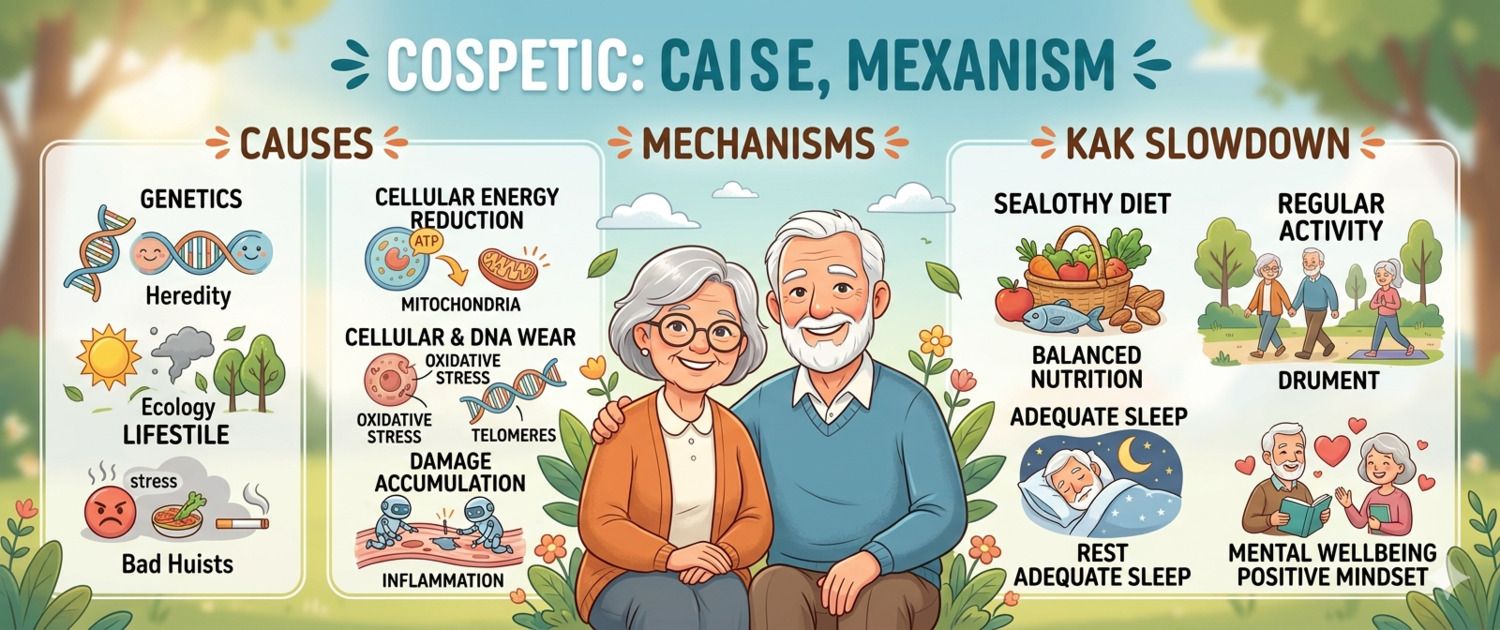
Ageing is not simply the accumulation of years. It is a set of concrete molecular and cellular processes that unfold at different rates in different people and are measurable long before symptoms appear. The gap in how two people of the same age are ageing can span 10–15 years of biological time — and most of that gap is driven by modifiable factors. Understanding the mechanisms of ageing is the first step toward influencing its pace.
Causes of Ageing: Molecular Mechanisms
Modern science describes ageing through several fundamental mechanisms that mutually amplify each other. These are not competing theories — they operate in parallel and are interconnected.
DNA damage accumulation. Every cell accumulates thousands of genomic lesions daily from oxidative stress, ultraviolet radiation and replication errors. DNA repair systems gradually lose efficiency, damage accumulates, mutations become fixed. Cells with critically damaged DNA either undergo apoptosis or enter a state of "senescence."
Telomere shortening. Telomeres are protective "caps" on chromosome ends. With each cell division they shorten slightly. When telomere length reaches a critical minimum, the cell stops dividing. The rate of telomere shortening is a biological marker of ageing pace; it is accelerated by chronic inflammation, oxidative stress, and insulin resistance.
Mitochondrial dysfunction. Mitochondria — the cell's power plants — become less efficient with age and generate more reactive oxygen species (ROS). This creates a vicious cycle: more ROS → more mitochondrial DNA damage → less efficient mitochondria → still more ROS.
Impaired autophagy. Autophagy is the cellular "waste management system" that clears damaged organelles and proteins. Its activity declines with age; cellular debris accumulates and the cell's capacity to respond to stress and self-renew diminishes.
Senescent cells. Cells entering senescence do not die — they remain active and secrete pro-inflammatory compounds (the SASP phenotype). Accumulating in tissues, they generate background chronic inflammation that accelerates ageing in neighbouring cells.
Chronic Inflammation as the Engine of Ageing
The term "inflammageing" (inflamm-ageing) describes a specific phenomenon: as the body ages, baseline inflammation chronically rises — even without overt infection or autoimmune disease. This background inflammatory tone is one of the key predictors of accelerated ageing, cardiovascular events and cognitive decline.
Sources of chronic inflammation in ageing: senescent cells (SASP), visceral fat (produces pro-inflammatory cytokines), gut dysbiosis, accumulation of damaged mitochondria and glycation products.
C-reactive protein in the high-sensitivity format (hs-CRP) is the most accessible marker of chronic inflammation. A value above 1 mg/L in the absence of acute illness signals a smouldering inflammatory process that is accelerating ageing. The longevity optimum is below 1 mg/L.
Homocysteine is a marker of vascular inflammation and "vascular age." Its chronic elevation above 10 µmol/L damages the arterial endothelium and accelerates atherosclerosis independently of cholesterol. Its strong link to B12, B6 and folate metabolism makes it one of the most readily correctable markers.
Insulin Resistance and Metabolic Ageing
Impaired insulin signalling is one of the central mechanisms of accelerated ageing. Chronically elevated insulin suppresses autophagy, activates mTOR (a signalling pathway that inhibits cellular repair), accelerates protein glycation, and sustains chronic inflammation through visceral fat.
Insulin resistance is not just a diabetes risk. It is an accelerator of ageing in every system:
| System | Mechanism of accelerated ageing in insulin resistance |
|---|---|
| Blood vessels | Hyperinsulinaemia → endothelial dysfunction → atherosclerosis |
| Brain | Impaired neuronal insulin signalling → reduced BDNF → cognitive decline |
| Liver | Fat accumulation → inflammation → accelerated fibrosis |
| Immune system | Chronic inflammation → exhaustion of immune reserve |
| Telomeres | Oxidative stress in IR → accelerated telomere shortening |
Glycated haemoglobin (HbA1c) in the 5.5–5.9% range is technically normal but functionally already a zone of accelerated glycation damage across all body tissues. The sum of glycation damage accumulates over years and directly correlates with biological age. The longevity optimum is HbA1c 4.8–5.4%.
Telomeres: The Cell's Molecular Clock
Telomeres shorten at a rate of approximately 25–200 base pairs per year — depending on lifestyle, stress level and inflammation. Shortening below the critical threshold triggers cellular senescence or apoptosis. In chronic inflammation and oxidative stress, the rate of shortening significantly increases.
Telomere length testing (qPCR or FISH methods) is available in specialist laboratories but is not part of standard clinical practice: its clinical value for individual diagnostics is currently limited by high biological variability. More practical are indirect markers of telomere status: hs-CRP, homocysteine and fasting insulin — factors that accelerate telomere shortening are well measurable and correctable.
Importantly: telomerase — the enzyme that rebuilds telomeres — does not disappear entirely with age. Regular aerobic exercise, stress reduction and sleep normalization reliably increase its activity.
Oxidative Stress and Antioxidant Defence
Oxidative stress is a mismatch between ROS production and the antioxidant system's capacity to neutralise it. At moderate levels, ROS are important signalling molecules; in chronic excess, they damage DNA, proteins and cell membrane lipids.
Main sources of excess oxidative stress: dysfunctional mitochondria, chronic inflammation, hyperglycaemia, ultraviolet radiation, tobacco smoke, alcohol, and micronutrient deficiencies (vitamin C, E, zinc, selenium).
The body's antioxidant systems (glutathione peroxidase, superoxide dismutase, catalase) depend on nutrient status. Zinc, selenium and vitamin C deficiencies directly impair their activity. External antioxidants (supplements, "superfoods") do not replace endogenous defence systems — those are supported by regular physical exercise, normal sleep and adequate nutrition.
Mitochondria and the Energy Economy of Ageing
Declining mitochondrial function with age is one of the most significant drivers of systemic ageing. It manifests as reduced energy, loss of muscle strength and endurance, and deteriorating metabolic flexibility (the ability to switch between glucose and fatty acids as fuel).
Mitochondrial dysfunction markers in routine tests: lactate, pyruvate, coenzyme Q10 levels. Indirectly — reduced aerobic capacity, muscle weakness, disproportionate fatigue.
The main stimuli for mitochondrial biogenesis (formation of new mitochondria): high-intensity interval training, caloric restriction, fasting, and cold exposure. Mitochondria are one of the few cellular components that respond to lifestyle changes almost immediately: after just 2–4 weeks of regular exercise, mitochondrial function measurably improves.
Hormones in Ageing
Hormonal ageing (endocrinopause) is not a single event — it is a gradual process unfolding at different rates in different people.
Cortisol tends to have a chronically elevated baseline level with age — through weakening of HPA axis negative feedback. Chronically elevated cortisol accelerates hippocampal atrophy, insulin resistance and muscle wasting.
Testosterone declines in both sexes after 30–35 years. In men, approximately 1–2% per year. Declining testosterone accelerates loss of muscle mass, visceral fat gain, cognitive decline and osteoporosis.
Vitamin D — a steroid hormone whose levels fall with age due to reduced skin synthesis and absorption. Its deficiency accelerates inflammation, reduces testosterone synthesis and impairs immune response — a triple blow to the pace of ageing.
Biomarkers and Tests for Assessing Ageing Pace
A detailed breakdown of biological age assessment from blood tests is in the article biological age: ageing markers. Key markers with clinical interpretation:
| Marker | Accelerated ageing signal | Optimum |
|---|---|---|
| Hs-CRP | > 1 mg/L chronically | < 1 mg/L |
| Homocysteine | > 10 µmol/L | < 10 µmol/L |
| HbA1c | > 5.5% | 4.8–5.4% |
| Fasting insulin | > 10 µIU/mL | 3–8 µIU/mL |
| Vitamin D | < 30 ng/mL | 40–80 ng/mL |
| Ferritin (men) | > 300 or < 30 µg/L | 80–200 µg/L |
| Free testosterone | Below age-appropriate optimum | Age-dependent |
| Morning cortisol | > 690 nmol/L chronically | 138–450 nmol/L |
For a comprehensive health monitoring programme — health monitoring.
How to Slow Ageing: What Is Proven
No pill slows ageing as effectively as evidence-based lifestyle changes. The hierarchy of interventions by strength of evidence:
Level 1 — maximum evidence:
- Regular physical activity (aerobic + resistance training) — the only intervention that reliably improves all key ageing markers simultaneously
- Normalising sleep to 7–8 hours — critical for autophagy, cortisol reduction and hormonal recovery
- Reducing fast carbohydrate and sugar intake — directly lowers glycation, insulin and inflammation
Level 2 — good evidence:
- Correcting vitamin D deficiency to the optimal 40–80 ng/mL level
- Normalising homocysteine through B12 + B6 + folate
- Mediterranean or MIND diet — inflammation reduction and neuroprotection
- Chronic stress management (cortisol reduction)
Level 3 — promising but inconclusive:
- Intermittent fasting (autophagy activation via mTOR suppression)
- Metformin (TAME longevity trial, ongoing)
- Spermidine, resveratrol, NMN/NAD+ — evidence accumulating; recommendations premature
A practical starting programme is in the article how to live long and healthy. A detailed review of hs-CRP as an inflammaging marker and reduction protocol — hs-CRP and longevity. Homocysteine as a vascular ageing biomarker — homocysteine and longevity. Telomere length analysis and ways to slow shortening — telomeres and ageing. DHEA-S as a marker of adrenal function and biological age — DHEA-S and ageing.
This article is for informational purposes only. Interpretation of test results and building an individual programme is a task for a physician.
For informational purposes only
This article is for informational purposes only and does not constitute medical advice, diagnosis, or treatment. Please consult a healthcare professional for medical guidance.