Telomere Length: What the Test Shows and How to Slow Aging
Reviewed by the LabReadAI medical team
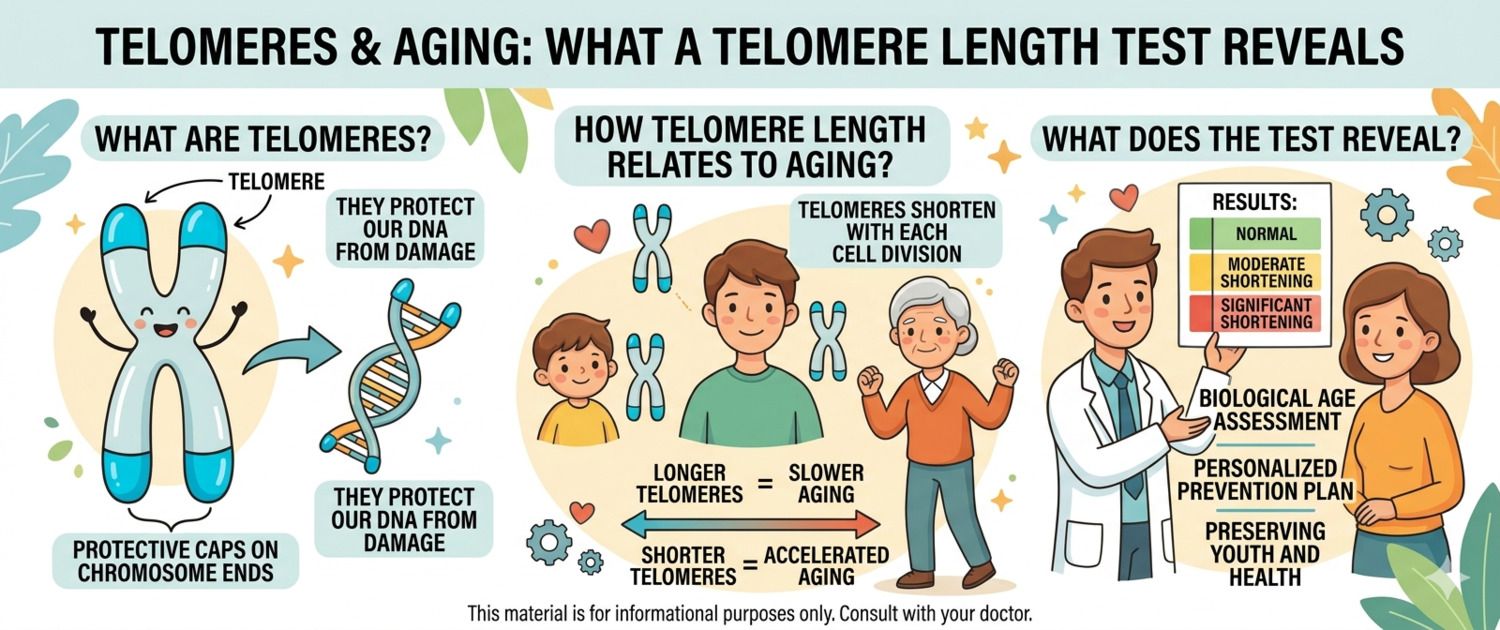
Telomeres are repetitive DNA sequences (TTAGGG) at the ends of chromosomes. They protect genetic information from degradation, functioning like the plastic tips on shoelaces. With each cell division, telomeres shorten by roughly 50–100 base pairs.
When telomeres reach a critical length (~5,000 base pairs), the cell enters senescence or triggers apoptosis. The accumulation of senescent cells is one of the central mechanisms of aging — and that is what a telomere length test measures.
What Telomeres Are and How They Connect to Aging
The link between telomeres and aging was experimentally established in the 1990s. In 2009, Blackburn, Greider, and Szostak received the Nobel Prize for discovering telomeres and telomerase.
Telomere length correlates with biological age — sometimes more closely than chronological age. People with longer telomeres get sick less often, live longer, and maintain cognitive function later in life.
Telomeres, however, are not the only marker of organismal aging. Modern epigenetic clocks (Horvath, GrimAge) often predict biological age more accurately than telomere length alone.
Telomere Length: Reference Values and Test Interpretation
Telomere length declines on average by 20–30 base pairs per year in peripheral blood leukocytes. Norms vary substantially between laboratories and measurement methods.
| Age | Average length (T/S ratio, PCR method) | Interpretation |
|---|---|---|
| 20–30 years | > 1.20 | Above average |
| 40–50 years | 1.00–1.15 | Age-average |
| 60–70 years | 0.85–1.00 | Below average |
| 70+ years | < 0.85 | Accelerated aging |
Interpretation of the test result is relative to the age-specific percentile — the absolute value matters less than where it falls in the distribution for your age group. Telomere length at or below the 25th percentile is a predictor of accelerated biological aging.
What a telomere length test shows beyond age: the rate of cellular wear driven by chronic inflammation, oxidative stress, and lifestyle.
Telomerase: Why the "Youth Enzyme" Is Not Immortality
Telomerase (hTERT) is the enzyme that restores telomere length by adding TTAGGG repeats. In most somatic cells it is nearly inactive. It is active in stem cells, germ cells — and cancer cells.
This paradox is the core limitation of "telomerase activation" as a longevity strategy: the same pathways that lengthen telomeres potentially raise cancer risk. This is why telomerase-activating supplements (e.g., TA-65) lack convincing evidence for broad use.
Moderate, lifestyle-driven telomerase activation through aerobic exercise and reducing chronic inflammation is the safe, evidence-based approach.
What Shortens Telomeres: Seven Key Factors
- Chronic inflammation (inflammaging) — hs-CRP > 3 mg/L is associated with 15–20% shorter telomeres
- Psychological stress — people with chronic stress have telomeres averaging 10 years shorter
- Insulin resistance — via hyperinsulinemia and oxidative stress; assess with fasting insulin
- Obesity — every +5 BMI units is associated with accelerated telomere shortening
- Smoking — ~5 years of accelerated telomere aging over a smoker's lifetime
- Sleep deprivation — < 6 hours of sleep doubles the shortening rate
- Nutrient deficiencies — vitamin D, omega-3, folate, and vitamin B12 are protective
Chronic Stress and Inflammation: The Main Enemies of Telomeres
Stress activates the HPA (hypothalamic-pituitary-adrenal) axis, raising cortisol. Chronically elevated cortisol suppresses telomerase activity and amplifies oxidative DNA damage. The stress-telomere link is among the best-studied: caregivers of chronically ill family members have telomeres shorter by the equivalent of 9–17 years.
Chronic inflammation — assessed via homocysteine and hs-CRP — accelerates telomere shortening through reactive oxygen species-mediated DNA damage.
Declining DHEA-S is also linked to shorter telomeres: DHEA-S exerts antioxidant and anti-inflammatory effects that protect telomeric DNA.
How to Slow Telomere Shortening: Longevity Protocol
Evidence-based interventions:
- Aerobic exercise 150+ min/week — the only intervention with direct evidence for telomerase activation (Blackburn/Epel studies): running, swimming, cycling
- Mindfulness meditation (MBSR): an 8-week program showed significant increases in telomerase activity in lymphocytes
- Mediterranean diet: high polyphenols and omega-3 slow shortening
- Quality sleep 7–9 hours: telomerase activity peaks at night
- Psychological stress reduction: CBT lowers telomere shortening biomarkers
Nutraceuticals with moderate evidence: Omega-3 (2–3 g EPA+DHA/day), vitamin D (target 60–80 ng/mL), NAD+ precursors, resveratrol.
Telomere Test: Types, Accuracy and How to Order
Main methods:
- qPCR (T/S ratio) — most accessible and affordable, measures average telomere length across all blood cells. Coefficient of variation ~10–15%. Suitable for longitudinal monitoring
- Flow-FISH — gold standard for accuracy, measures telomeres in specific cell types. Expensive; available at specialized labs
- Real-time PCR + single-cell analysis — newer methods with improved precision
A telomere test is appropriate as part of an extended annual longevity checklist. Retesting more than once per year is not meaningful.
Key caveat: qPCR variability (~10–15%) means small changes between tests are not significant. Interpret trends over 2–3 measurements, not a single result.
Full aging biomarker program — in how to live long.
For informational purposes only
This article is for informational purposes only and does not constitute medical advice, diagnosis, or treatment. Please consult a healthcare professional for medical guidance.