Omega-3 Index and Longevity: How to Raise It with Diet and Fish Oil
Reviewed by the LabReadAI medical team
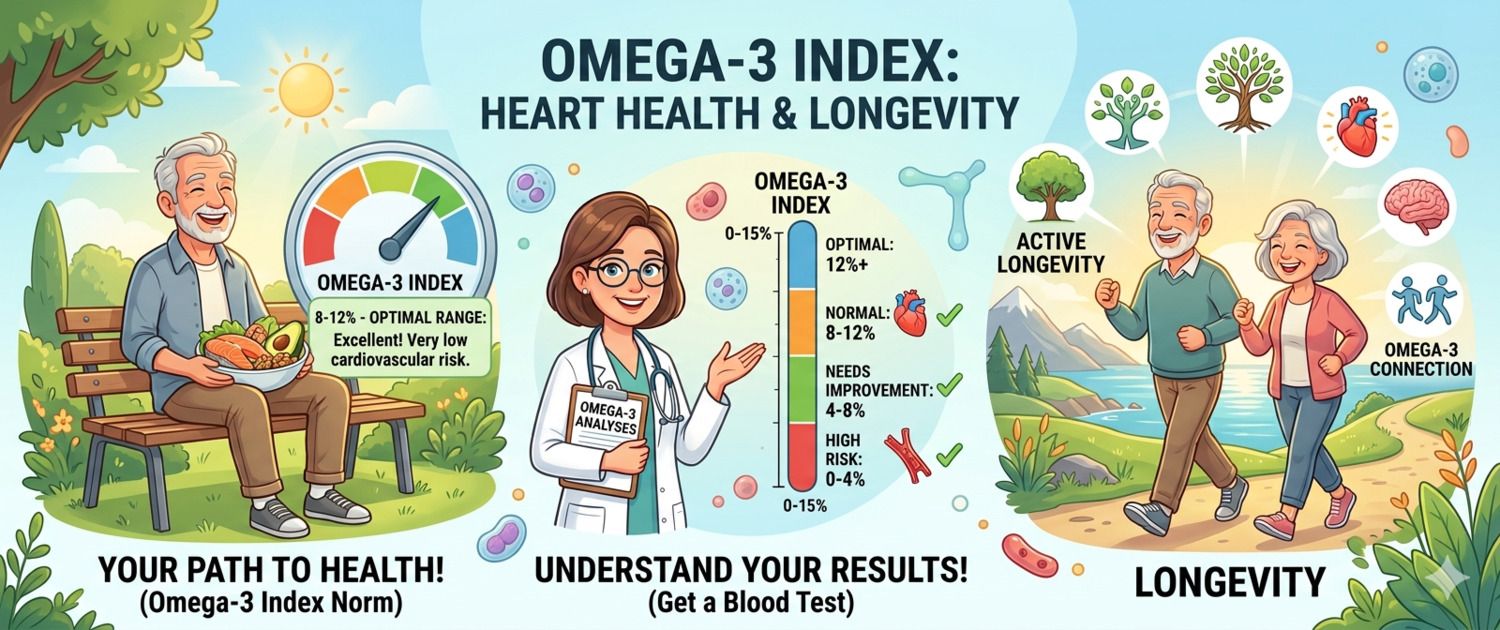
Most people taking fish oil do not know whether it is working. The capsule is bought, the supplement is taken, but the question "is my level actually normal?" goes unanswered. The omega-3 index is the only way to find out: it directly measures the percentage of EPA and DHA in red blood cell membranes. Interpretation of the result answers a question that standard blood tests never ask.
The link between the omega-3 index and longevity is among the most studied in preventive medicine.
Omega-3 Index Normal Ranges: Interpretation and Optimal Values
The omega-3 index is expressed as the percentage of EPA (eicosapentaenoic acid) + DHA (docosahexaenoic acid) of all fatty acids in red blood cell membranes. Interpretation of levels:
| Omega-3 Index | Interpretation |
|---|---|
| < 4% | Deficiency; high cardiovascular risk |
| 4–6% | Below optimal — typical for most Europeans |
| 6–8% | Acceptable |
| 8–12% | Longevity and cardioprotection optimum |
| > 12% | Seen in populations with high oily fish intake |
The average level in Russia and most European countries is 4–5% — roughly half the optimal range. In Japan the average omega-3 index is 8–10%, contributing to the lower cardiovascular mortality observed there.
What Is the Omega-3 Index and Why Measure It
The omega-3 index reflects integration of fatty acids into cell membranes over the past 2–3 months — the lifespan of a red blood cell. This is not a plasma concentration: plasma EPA/DHA levels fluctuate with recent meals and are not clinically interpretable.
Erythrocyte measurement is the gold standard used in all major clinical trials. It shows true tissue saturation, not what was eaten yesterday.
Biological significance: EPA and DHA incorporate into phospholipids of cell membranes, making them more fluid, improving signal transmission and reducing inflammation — the cellular mechanism behind omega-3 benefits.
Omega-3 and Cardiovascular Risk
The ASCEND (2019) and VITAL (2018) trials showed modest effects in primary prevention — benefits appeared primarily in those with a baseline omega-3 index below 4%. The landmark REDUCE-IT trial (high-dose icosapentaenoic acid — pure EPA, 4 g/day) demonstrated a 25% reduction in cardiovascular events in people with elevated triglycerides.
Key mechanisms: a high omega-3 index reduces triglycerides by 20–30%, lowers hs-CRP and improves endothelial function. Combined with C-reactive protein normalisation, omega-3 consistently reduces the inflammatory component of cardiovascular risk — the part that a standard lipid panel does not capture.
Omega-3 and the Brain: Memory, Mood and Neurodegeneration
DHA is the primary structural lipid of the brain — 30% of neuronal phospholipids. DHA deficiency is associated with accelerated cognitive decline, depression and increased Alzheimer's risk.
For brain longevity: the MIDAS trial (900 participants, 6 months) showed that 900 mg DHA/day improved memory and processing speed in people with subjective cognitive complaints. The effect correlated with the achieved omega-3 index rather than simply taking the supplement — reinforcing the importance of measuring rather than assuming.
Biological age of the brain progresses more slowly at an omega-3 index above 8%, based on longitudinal cohort data.
Why Fish Oil Capsules Can Fail: The Bioavailability Problem
Fish oil in ethyl ester form (EE — the cheapest formulation) is absorbed significantly less efficiently than triglyceride form (TG) — the natural form found in fish. Dyerberg et al. showed EE bioavailability is 73% lower than TG.
A second factor: individual metabolic variation. Some people convert EPA to DHA inefficiently and need a direct DHA source (algae oil, wild-caught fish) rather than standard fish oil.
A third factor: insufficient dosage. Reaching an omega-3 index of 8% typically requires about 2–3 g EPA+DHA daily — more than most standard capsules deliver.
How to Raise the Omega-3 Index: Protocol
Food: fatty wild-caught fish (mackerel, herring, wild salmon, sardines) — two to three 150 g portions per week provide about 1–2 g EPA+DHA. Sufficient for maintaining a 6–8% index.
Supplements (to reach 8–12%): 2–3 g EPA+DHA daily in TG form, taken with food. Look for "triglyceride form" or "natural fish oil" — not "ethyl ester." Krill oil has good bioavailability but reaching high doses is impractical.
Vitamin D status: vitamin D and omega-3 are synergistic. Correcting vitamin D deficiency improves DHA utilisation in the brain.
Timeline: after 3 months of consistent supplementation, the index stabilises — retest and adjust dose accordingly.
Who Should Test and How Often
The omega-3 index is not included in standard blood panels — it must be ordered specifically. Available through specialised labs and functional medicine panels.
Priority groups: anyone taking fish oil (to verify efficacy), people with cardiovascular disease or risk factors, cognitive complaints, and vegans or vegetarians.
Frequency: once yearly as part of the annual blood test checklist. For those supplementing, retest after 3 months. If the index is low and you plan to raise it with a supplement, the product itself matters a lot — how much EPA and DHA a capsule holds, in what form and how fresh it is; see which omega-3 to choose.
Combined with hs-CRP, fasting insulin and vitamin D, the omega-3 index forms a multi-marker inflammatory profile for assessing biological ageing and building the how to live longer strategy.
For informational purposes only
This article is for informational purposes only and does not constitute medical advice, diagnosis, or treatment. Please consult a healthcare professional for medical guidance.