High-Sensitivity CRP: Norms, Interpretation and Longevity
Reviewed by the LabReadAI medical team
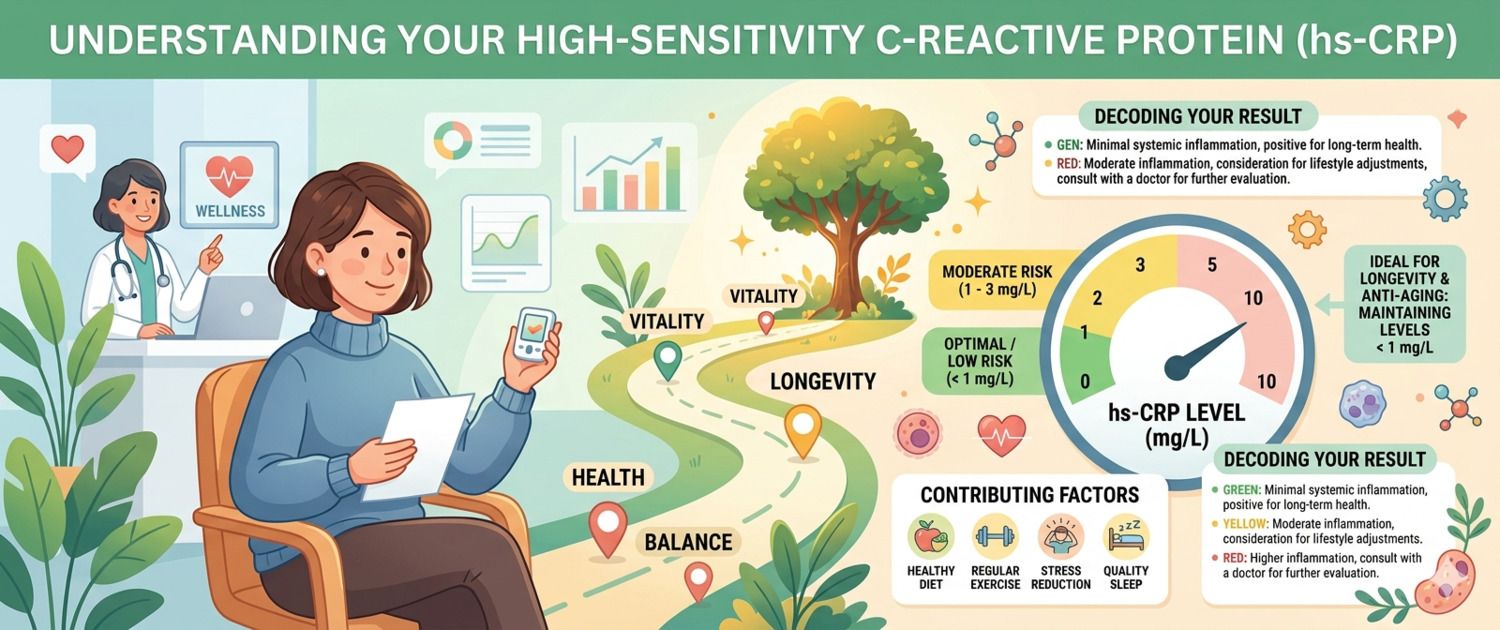
Standard CRP returns "normal" whenever inflammation stays below 5 mg/L. For a healthy 45-year-old with hs-CRP at 2.5 mg/L, that answer is dangerously misleading: chronic low-grade inflammation silently damages vessels and accelerates ageing for decades. High-sensitivity CRP measures precisely this "quiet" inflammatory background — and it is the test you need for cardiovascular risk assessment and biological age evaluation.
What Is hs-CRP and How It Differs from Standard CRP
CRP is synthesised in the liver in response to interleukin-6 (IL-6). During acute infection it climbs from 0.5 to 100–500 mg/L within 24–48 hours. Standard CRP works well in this range and is blind to chronic low-grade inflammation.
High-sensitivity CRP uses immunonephelometry with an amplified reagent. Detection range: 0.1–10 mg/L. This allows detection of the inflammatory background that standard CRP labels "normal".
Key point: hs-CRP and standard CRP measure the same protein with different sensitivity. If a lab report does not specify "high-sensitivity", it is likely not the right test for longevity or cardiovascular risk screening.
hs-CRP Normal Ranges: Clinical vs Longevity Optimal
Most labs list the upper limit as 5 mg/L — a threshold borrowed from standard CRP. International cardiology societies use different cut-offs for hs-CRP:
| hs-CRP Level | Interpretation |
|---|---|
| < 1 mg/L | Longevity optimum, low inflammatory background |
| 1–2 mg/L | Moderate inflammation; worth investigating |
| 2–3 mg/L | Elevated cardiovascular risk |
| > 3 mg/L | High risk; source of inflammation must be found |
| > 10 mg/L | Acute inflammation; retest after recovery |
For optimal biological age, aim for under 1 mg/L. The NHANES study (12,000 Americans) found that adults 65+ with hs-CRP < 1 mg/L had 38% lower all-cause mortality compared to those with 1–3 mg/L.
Inflammaging: How Chronic Inflammation Drives Ageing
In 2000, Italian gerontologist Claudio Franceschi described the phenomenon of inflammaging (inflammation + ageing). As we age, the immune system loses its ability to fully switch off inflammatory signals. Each trigger — gut dysbiosis, visceral fat, stress, nocturnal hypoxia — adds a few molecules of IL-6 to the bloodstream. Over decades these microwaves accumulate into a permanent background.
The average 70-year-old has hs-CRP 2–3× higher than a 30-year-old. Yet centenarians from Blue Zones — Sardinia, Okinawa, Ikaria — maintain hs-CRP in their 70s comparable to that of 40-year-olds. Inflammaging is linked to all four leading causes of death: atherosclerosis, cancer, neurodegeneration and metabolic disease. See ageing: mechanisms and markers for more.
What Raises hs-CRP: Nine Common Causes
Visceral fat — the primary IL-6 source. Fat tissue around organs actively secretes pro-inflammatory cytokines. Waist circumference above 88 cm in women and 102 cm in men almost always correlates with hs-CRP above 2 mg/L.
Insulin resistance — a key inflammatory driver. Fasting insulin above 8–10 µU/mL and hs-CRP above 2 mg/L reinforce each other and commonly co-occur.
Gut dysbiosis — disrupted microbiota increases intestinal permeability. Bacterial lipopolysaccharides (LPS) enter the bloodstream and trigger systemic inflammation.
Poor sleep — fewer than 6 hours per night raises IL-6 by 40% and hs-CRP by 0.5–1 mg/L. Sleep deprivation is one of the fastest routes to elevated inflammation without an obvious cause.
Chronic stress — cortisol normally suppresses inflammation, but prolonged stress desensitises cortisol receptors and the anti-inflammatory effect disappears.
Western diet — trans fats, ultra-processed food and excess linoleic acid activate NF-κB, the primary pro-inflammatory transcription factor.
Hidden infections — chronic H. pylori, Epstein-Barr virus and periodontitis can keep hs-CRP at 2–4 mg/L for years with no obvious symptoms.
Sleep apnoea — intermittent nocturnal hypoxia generates powerful oxidative stress and systemic inflammation.
Vitamin D deficiency — several randomised trials show that correcting vitamin D deficiency reduces hs-CRP by 10–20%.
hs-CRP and Cardiovascular Risk: Research Evidence
The landmark JUPITER trial (2008): 17,800 people with normal LDL but hs-CRP ≥ 2 mg/L were randomised to rosuvastatin or placebo. After two years, statin therapy reduced hs-CRP by 37% and cardiovascular events fell by 54%. Conclusion: inflammation is an independent risk factor even when the lipid panel is normal.
The CRP CHD Genetics Collaboration meta-analysis (160,000 participants): each doubling of hs-CRP is associated with a 37% increase in coronary heart disease risk. Critically, hs-CRP > 3 mg/L with normal LDL doubles the heart attack risk compared to elevated LDL alone with normal hs-CRP.
How to Lower hs-CRP Without Medication
Omega-3 fatty acids: 1–3 g EPA+DHA daily reduces hs-CRP by 20–30% over 3 months. An omega-3 index above 8% consistently correlates with hs-CRP below 1 mg/L.
Visceral fat loss: each 5 kg of body weight lost reduces hs-CRP by approximately 15–20%. The key metric is waist circumference, not total body weight.
Physical activity: 150 minutes of moderate exercise per week lowers hs-CRP by 20–35%. Adding two weekly strength sessions provides further benefit.
Homocysteine normalisation: elevated homocysteine amplifies endothelial inflammation. Correcting it with B12, folate and B6 reduces both markers simultaneously.
Ferritin management: excess iron (ferritin > 200 ng/mL in men) amplifies oxidative stress and inflammation. Therapeutic blood donation or dietary adjustment improves both markers.
Mediterranean diet: clinically proven 20% reduction in hs-CRP over 3 months with strict adherence — extra-virgin olive oil, fatty fish, legumes, nuts and vegetables.
Who Should Test hs-CRP and How Often
First-time screening: all adults over 35 — at minimum once. Priority cases: overweight (BMI > 25), family history of cardiovascular disease, hypertension, prediabetes, or unexplained fatigue.
When not to test: during acute illness, a flare of chronic disease, or shortly after injury — the result will be misleading. Wait at least 2–3 weeks after recovery.
Testing frequency: with results below 1 mg/L — once yearly as part of the annual blood test checklist. With values 1–3 mg/L — every 3–6 months until normalised.
In children this marker is usually ordered to separate viral from bacterial fever — see fever in children.
Panel context: hs-CRP is most valuable alongside homocysteine, fasting insulin and ferritin. These four markers form the "inflammatory cluster" for biological age assessment — the foundation of the longevity monitoring system described in how to live longer: the evidence base.
For informational purposes only
This article is for informational purposes only and does not constitute medical advice, diagnosis, or treatment. Please consult a healthcare professional for medical guidance.