Fibrinogen Blood Test: Normal Levels, Results and Causes
Reviewed by the LabReadAI medical team
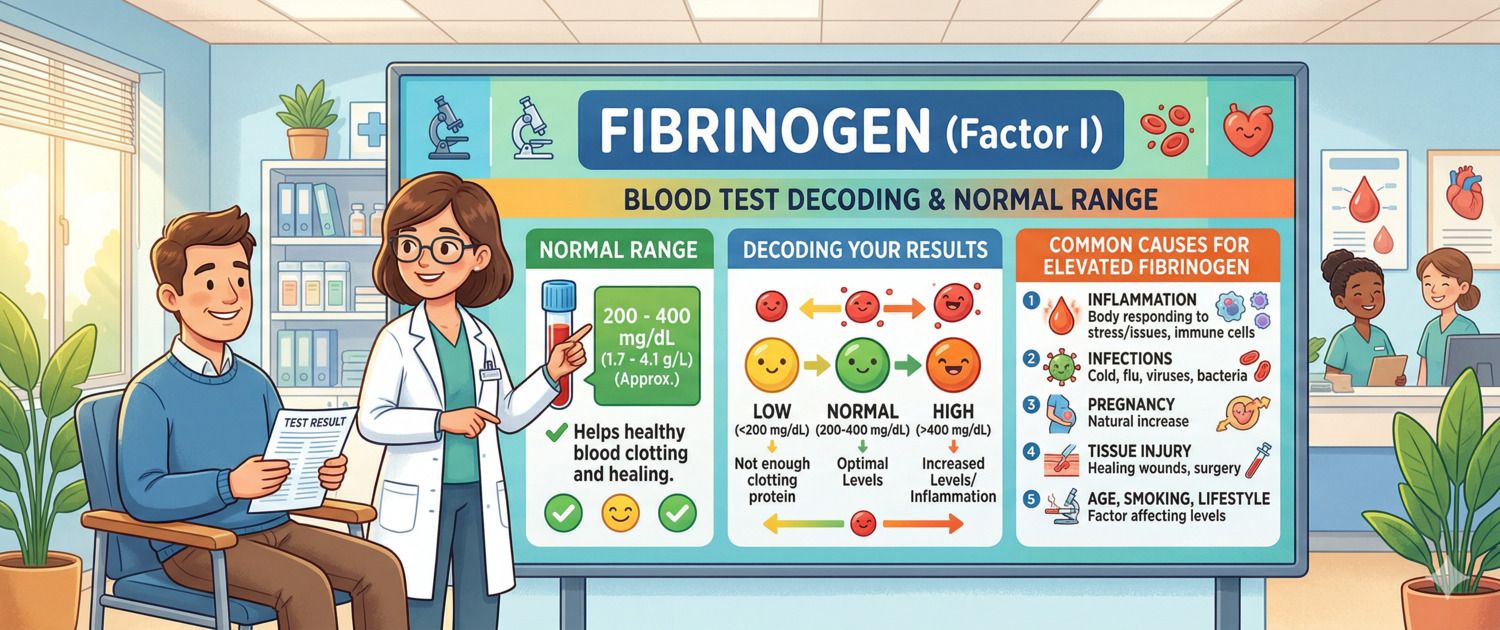
You had a clotting screen done — and fibrinogen comes back above the reference range. Or, unexpectedly, it is too low. This protein sits at the very centre of the coagulation system: without it, even a minor cut would not stop bleeding. Yet when fibrinogen is too high, it becomes a threat itself — raising the risk of thrombosis and cardiovascular events. This article explains what the test measures, what the reference ranges mean, and when an abnormal result genuinely demands attention.
What Is Fibrinogen and Its Role in Haemostasis
Think of the coagulation system as an emergency repair crew: when a blood vessel is damaged, the crew rushes to the site, stops the leak, and patches the wall. Fibrinogen is the building material for the final patch. Under the action of the enzyme thrombin it converts into fibrin — insoluble protein strands that form the scaffold of the clot and seal the damage firmly.
Fibrinogen is synthesised exclusively in the liver and circulates continuously in dissolved form in blood plasma. Beyond its clotting role, it is an acute-phase protein: any infection, trauma, surgery, or tissue necrosis sharply raises its production — a protective mechanism that prepares the body for possible blood loss.
The fibrinogen test is part of the standard coagulation panel and is ordered for: surgical or obstetric pre-assessment; suspected clotting disorder; thrombotic risk evaluation; diagnosis and monitoring of disseminated intravascular coagulation (DIC); and chronic inflammatory or autoimmune disease.
How to Prepare for a Fibrinogen Test
Blood is drawn from a vein, preferably in the morning, and the test is typically part of a full coagulation screen. Failing to follow preparation steps can meaningfully distort results in either direction.
Fasting: strictly required — no food for at least 12 hours. Fatty food directly affects plasma rheology and can falsely elevate fibrinogen.
Physical activity and stress: avoid intense exercise for 24 hours beforehand. Acute physical stress activates the coagulation system as an adaptive response, producing a transient rise in fibrinogen.
Medications: anticoagulants (warfarin, heparin, rivaroxaban), oral contraceptives, and hormone therapy directly influence coagulation parameters. Do not stop any medication without medical advice — always inform the laboratory about any drug that affects clotting.
Tourniquet: the phlebotomist should apply the tourniquet for the minimum time necessary. Prolonged venous compression activates local fibrinolysis and can falsely lower the result.
Method: the assay uses the Clauss method (kinetic coagulometric) — the gold standard for measuring functional fibrinogen. Results are available within hours as part of the full coagulation panel.
Fibrinogen Normal Range: Reference Values
The reference interval for adults is essentially the same in men and women outside of pregnancy. Substantial physiological changes occur only during pregnancy — covered in a dedicated section below.
| Group | Fibrinogen Normal Range | Notes |
|---|---|---|
| Adults 18–60 years | 2.0–4.0 g/L | Same for both sexes |
| Adults over 60 | 2.0–4.5 g/L | Mild physiological rise |
| Newborns | 1.25–3.0 g/L | Lower than adult range |
Threshold values that require attention:
- < 1.0 g/L — critically low: high risk of non-coagulable haemorrhage; urgent assessment needed.
- > 5.0 g/L — significantly elevated: acute-phase response or thrombotic risk.
- > 8.0 g/L — marked hyperfibrinogenaemia: typically severe inflammation or malignancy.
Fibrinogen is never interpreted in isolation. It forms part of the broader coagulation picture — together with prothrombin time, APTT, and thrombin time — and only the composite result yields a clinically meaningful conclusion.
Causes of Elevated Fibrinogen
High fibrinogen is one of the most common incidental findings in routine blood work. Causes fall into physiological and pathological categories.
Acute-phase response. Any infection, trauma, surgical procedure, or tissue necrosis triggers hepatic synthesis of acute-phase proteins — primarily fibrinogen and C-reactive protein. In severe sepsis or major surgery fibrinogen may reach 8–10 g/L; this is a protective reaction, not a haemostatic disorder.
Chronic inflammatory diseases. In rheumatoid arthritis, inflammatory bowel disease, and autoimmune hepatitis, fibrinogen remains persistently elevated alongside ESR and C-reactive protein.
Thrombotic conditions. In thrombophilia — hereditary or acquired tendency to clotting — elevated fibrinogen acts simultaneously as a marker and a risk factor. Patients with established deep vein thrombosis almost invariably show levels well above the reference range.
Cardiovascular disease. Large epidemiological studies show that a fibrinogen level above 3.5 g/L independently raises the risk of myocardial infarction and stroke. In chest pain assessment, fibrinogen forms part of the acute coronary syndrome panel alongside troponin and D-dimer.
Metabolic disorders. Obesity, type 2 diabetes, and metabolic syndrome are accompanied by chronically elevated fibrinogen as part of the systemic pro-inflammatory state these conditions produce.
Smoking. Nicotine stimulates hepatic fibrinogen synthesis. Smokers' fibrinogen levels average 0.5–1.0 g/L higher than non-smokers', even without other risk factors.
Malignancies. Many cancers produce pro-inflammatory cytokines that drive hepatic fibrinogen production. Persistently elevated fibrinogen without an obvious cause warrants oncological screening.
Causes of Low Fibrinogen: Hypofibrinogenaemia
Low fibrinogen is far less common than elevation, but it carries a more immediately dangerous implication — the risk of uncontrolled haemorrhage.
Disseminated intravascular coagulation (DIC) is the most dangerous cause. In severe sepsis, obstetric emergencies (placental abruption, amniotic fluid embolism), or massive trauma, the coagulation system activates throughout the circulation and consumes all available fibrinogen. Levels fall below 1 g/L, producing a paradox: clots form in small vessels simultaneously with uncontrollable bleeding from large ones.
Severe liver disease. Fibrinogen is synthesised only by hepatocytes. In end-stage liver cirrhosis, synthesis falls sharply. Low fibrinogen is one of the markers of hepatic failure.
Primary fibrinolysis. In certain conditions (prostate cancer, acute promyelocytic leukaemia) the fibrinolytic system activates pathologically and destroys fibrinogen faster than the liver can produce it.
Hereditary afibrinogenaemia and hypofibrinogenaemia are rare genetic defects causing absent or critically low fibrinogen synthesis. They present with severe bleeding from early childhood.
Thrombolytic therapy. Administration of streptokinase, alteplase, or other thrombolytics in myocardial infarction or thromboembolism deliberately lowers fibrinogen — an expected and monitored treatment effect.
Fibrinogen in Pregnancy: Trimester Reference Ranges
Pregnancy is the only physiological state in which fibrinogen levels routinely exceed the standard adult range. This is not pathology: the body deliberately raises coagulation readiness in preparation for possible blood loss during delivery.
| Trimester | Fibrinogen Normal Range | Notes |
|---|---|---|
| First trimester | 2.4–5.1 g/L | Rise begins |
| Second trimester | 2.9–5.4 g/L | Moderate elevation |
| Third trimester | 3.7–6.2 g/L | Peak before delivery |
| Post-partum | 2.0–4.0 g/L | Returns to baseline within 3–5 days |
A fall below 2.0 g/L at any stage of pregnancy is an alarm signal: it may indicate early DIC, placental abruption, or severe pre-eclampsia — all obstetric emergencies requiring immediate hospitalisation.
A rise above 7.0 g/L in any trimester also warrants investigation: such levels are associated with thromboembolic complications, which remain a leading cause of maternal mortality in high-income countries.
When to See a Doctor
Prompt medical evaluation — or emergency care — is warranted when:
- Fibrinogen is below 1.0 g/L — critical risk of uncontrollable haemorrhage, especially before surgery or in the third trimester.
- Fibrinogen is falling on serial measurements during severe infection or after surgery — possible early DIC.
- Fibrinogen is markedly elevated (> 6 g/L) combined with breathlessness, leg pain, or chest discomfort — a clinical picture consistent with pulmonary embolism, a life-threatening condition.
- During pregnancy, fibrinogen falls below 2.0 g/L or exceeds 7.0 g/L — immediate obstetric assessment is needed.
- Fibrinogen remains persistently above 5.0 g/L for months without a clear inflammatory cause — indication for comprehensive workup including cancer screening.
This article is for informational purposes only and does not replace medical consultation. Result interpretation and diagnosis are made by a qualified physician.
For informational purposes only
This article is for informational purposes only and does not constitute medical advice, diagnosis, or treatment. Please consult a healthcare professional for medical guidance.