Thrombophilia: Causes, Symptoms, Diagnosis and Treatment
Reviewed by the LabReadAI medical team
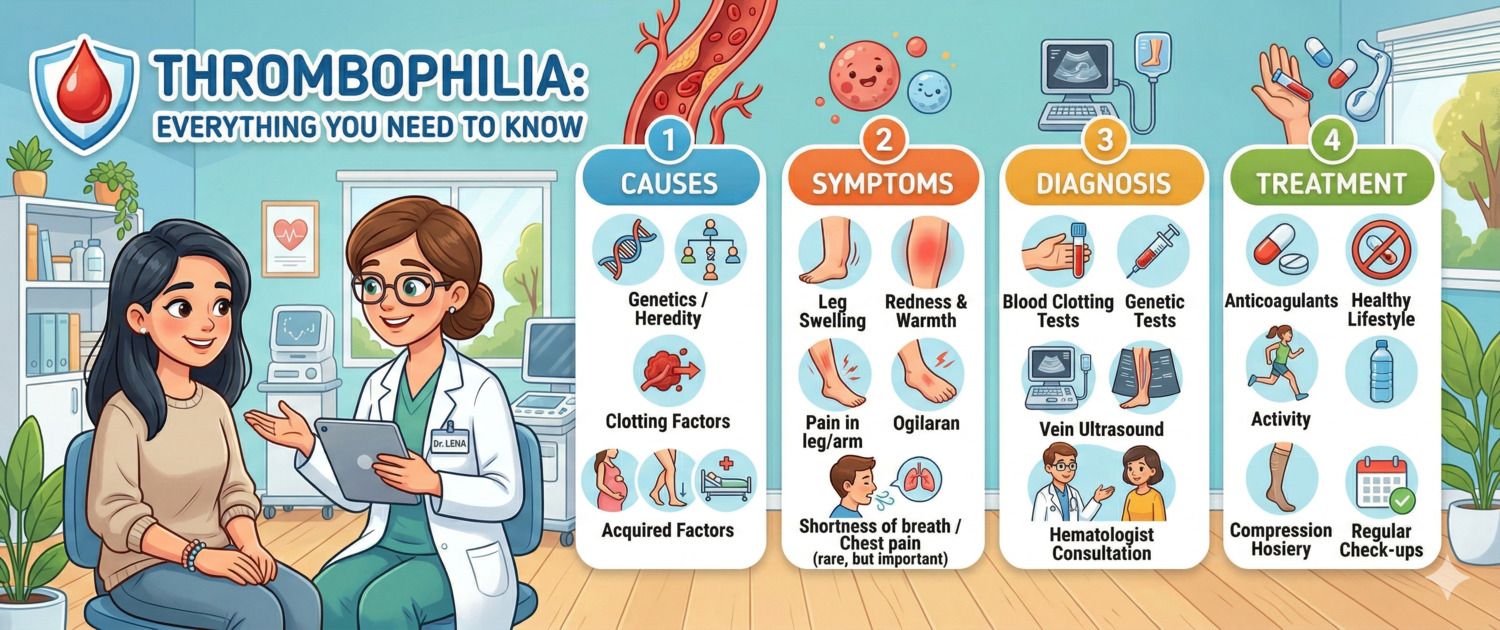
Deep vein thrombosis in a young person without an obvious trigger, recurrent miscarriages in a woman with otherwise normal gynaecological findings, a stroke at age 30 — each of these scenarios demands that thrombophilia be excluded. This is not a single disease but a group of conditions united by an increased readiness of the clotting system to form thrombi. Here is what forms exist, how they are identified, and when treatment cannot be avoided.
What Thrombophilia Is
Thrombophilia is a disorder of haemostasis in which the balance between procoagulant and anticoagulant mechanisms is shifted towards clot formation. Normally, blood clots only where it should — at a site of vessel injury — and the clot dissolves at the right time. In thrombophilia, this process loses its regulation: clots form without apparent cause, in inappropriate locations, or fail to resolve as they should.
Thrombophilia may be inherited (a genetically determined defect in clotting factors or their inhibitors) or acquired (develops during life under the influence of disease or external factors). In practice, several defects often coexist in a single patient — this dramatically amplifies the overall thrombotic risk.
Thrombophilia alone does not guarantee that a thrombosis will occur. It is a risk factor that becomes manifest in combination with circumstances: pregnancy, surgery, immobility, oral contraceptives. This is precisely why a first thrombotic episode so often coincides with one of these moments.
Hereditary Thrombophilia: Factor V Leiden and Other Inherited Forms
Factor V Leiden mutation (FV Leiden, R506Q) — the most common inherited thrombophilia in European populations (3–8% of carriers). Factor V becomes resistant to inactivation by protein C. Heterozygotes have a 3–8-fold increased thrombotic risk; homozygotes, 50–80-fold. In heterozygotes using oral contraceptives, the risk of venous thromboembolism rises 35-fold.
Prothrombin G20210A mutation — the second most common inherited thrombophilia (2–4% of the population). Leads to elevated prothrombin levels and hypercoagulability. Thrombotic risk is 2–4-fold higher; substantially greater in homozygotes.
Protein C deficiency — protein C inactivates factors Va and VIIIa. Its deficiency reduces anticoagulant protection. Prevalence approximately 0.2–0.4%. First thrombosis typically occurs between ages 10 and 40.
Protein S deficiency — protein S is a cofactor for protein C. Clinically indistinguishable from protein C deficiency.
Antithrombin III deficiency — antithrombin is the primary inhibitor of thrombin and factors Xa and IXa. Deficiency (prevalence 0.02–0.04%) is one of the most thrombogenic inherited thrombophilias: thrombotic risk is elevated 5–50-fold.
Acquired Thrombophilia: Antiphospholipid Syndrome and Other Causes
Antiphospholipid syndrome (APS) — an autoimmune condition in which antibodies (lupus anticoagulant, anticardiolipin, anti-β2-glycoprotein-I) target phospholipids and related proteins. The result is a prothrombotic state affecting both the venous and arterial circulation. APS is the leading acquired cause of thrombosis in young people and recurrent miscarriage in women.
Hyperhomocysteinaemia — elevated homocysteine damages vascular endothelium and activates coagulation. May be genetic (MTHFR polymorphism) or nutritional (B12, folate, B6 deficiency). Moderately increases the risk of both venous and arterial thrombosis.
Nephrotic syndrome — urinary loss of antithrombin III, proteins C and S creates a significant prothrombotic state. Renal vein thrombosis is a characteristic complication of severe nephrotic syndrome.
Other acquired factors: malignancy (tumours secrete procoagulants), polycythaemia and thrombocytosis, paroxysmal nocturnal haemoglobinuria, heart failure, obesity.
Symptoms and Clinical Presentations
Thrombophilia manifests clinically through thrombotic events — the condition itself is asymptomatic. Key signals suggesting possible thrombophilia:
- Deep vein thrombosis or pulmonary embolism before age 45 without an obvious provoking factor
- Recurrent thromboses — two or more episodes in the history
- Thrombosis at atypical sites — mesenteric veins, portal system, cerebral venous sinuses
- Arterial thrombosis in the young — stroke or myocardial infarction before age 45 without classical risk factors (characteristic of APS)
- Recurrent miscarriage — three or more losses before 10 weeks or one loss after 10 weeks (APS criterion)
- Thrombosis during pregnancy or on oral contraceptives
- Positive family history — thrombosis in first-degree relatives before age 45
Thrombophilia Diagnosis: Blood Tests, What to Test and When
Thrombophilia testing is not routine for everyone — it is indicated only when clinical criteria are met.
D-dimer — a marker of active clot formation and fibrinolysis. In thrombophilia as such, D-dimer is not elevated — it rises only during an active thrombotic event. A normal D-dimer with low clinical probability reliably excludes acute thrombosis.
Coagulation panel — baseline assessment of the clotting system: INR, aPTT, thrombin time, fibrinogen. A prolonged aPTT without clinical bleeding is a characteristic feature of the lupus anticoagulant in APS.
Homocysteine — identifies hyperhomocysteinaemia as an acquired prothrombotic factor. Must be drawn fasting after a strict 12-hour fast — otherwise the result is unreliable.
Genetic tests for inherited thrombophilia:
- FV Leiden mutation (R506Q) — by PCR
- Prothrombin G20210A mutation — PCR
- MTHFR C677T and A1298C polymorphisms (in hyperhomocysteinaemia)
APS testing (when suspected):
- Lupus anticoagulant (LA) — screening and confirmatory tests
- Anticardiolipin antibodies (aCL) IgG and IgM
- Anti-β2-glycoprotein-I antibodies (aβ2GPI) IgG and IgM APS diagnosis requires two positive results at least 12 weeks apart.
Functional tests:
- Protein C and protein S activity
- Antithrombin III activity
Timing rule: most thrombophilia tests cannot be reliably performed during the acute thrombotic event or while on anticoagulants — they distort results. The optimal window is 3–6 months after the thrombotic episode and after anticoagulation has been completed. Genetic tests (FV Leiden, prothrombin mutation) are unaffected by timing and can be done at any time.
Thrombophilia Treatment: Anticoagulants, Pregnancy and Prevention
Acute thrombosis in thrombophilia is treated identically to standard thrombosis — anticoagulants (direct oral anticoagulants, warfarin, low-molecular-weight heparins). Thrombophilia does not change the approach to acute treatment; it influences the decision about duration of therapy.
Duration of anticoagulant therapy is determined by the balance between recurrence risk and bleeding risk:
| Situation | Recommended duration |
|---|---|
| First thrombosis + provoking factor + low-risk thrombophilia | 3 months |
| First thrombosis without provoking factor | 6 months |
| Recurrent thrombosis | Indefinite |
| High-risk thrombophilia (AT III deficiency, homozygous FV Leiden, APS) | Indefinite |
| APS with thrombosis | Indefinite (warfarin, target INR 2.0–3.0) |
Prophylaxis during high-risk periods (pregnancy, surgery, immobility) in thrombophilia carriers — prophylactic-dose low-molecular-weight heparins. In pregnant women with inherited thrombophilia or APS, mandatory thromboprophylaxis throughout pregnancy and the postpartum period is standard care.
Correcting hyperhomocysteinaemia — folic acid + vitamin B12 + vitamin B6 lower homocysteine and theoretically reduce prothrombotic risk; however, evidence for their impact on thrombosis frequency is less robust than for stroke reduction.
When to See a Doctor
Planned thrombophilia workup is indicated for: first thrombosis before age 45 without a clear provoking factor; recurrent thromboses; thrombosis at atypical sites; recurrent miscarriage; planning pregnancy in a woman with a personal or strong family history of thrombosis.
Urgently: a first episode of deep vein thrombosis or suspected pulmonary embolism — immediate hospitalisation and anticoagulation cannot wait for genetic test results.
This article is for informational purposes only. Thrombophilia workup and treatment are carried out by a haematologist or vascular specialist.
For informational purposes only
This article is for informational purposes only and does not constitute medical advice, diagnosis, or treatment. Please consult a healthcare professional for medical guidance.