Insomnia: Causes and Which Lab Tests Find the Real Source
Reviewed by the LabReadAI medical team
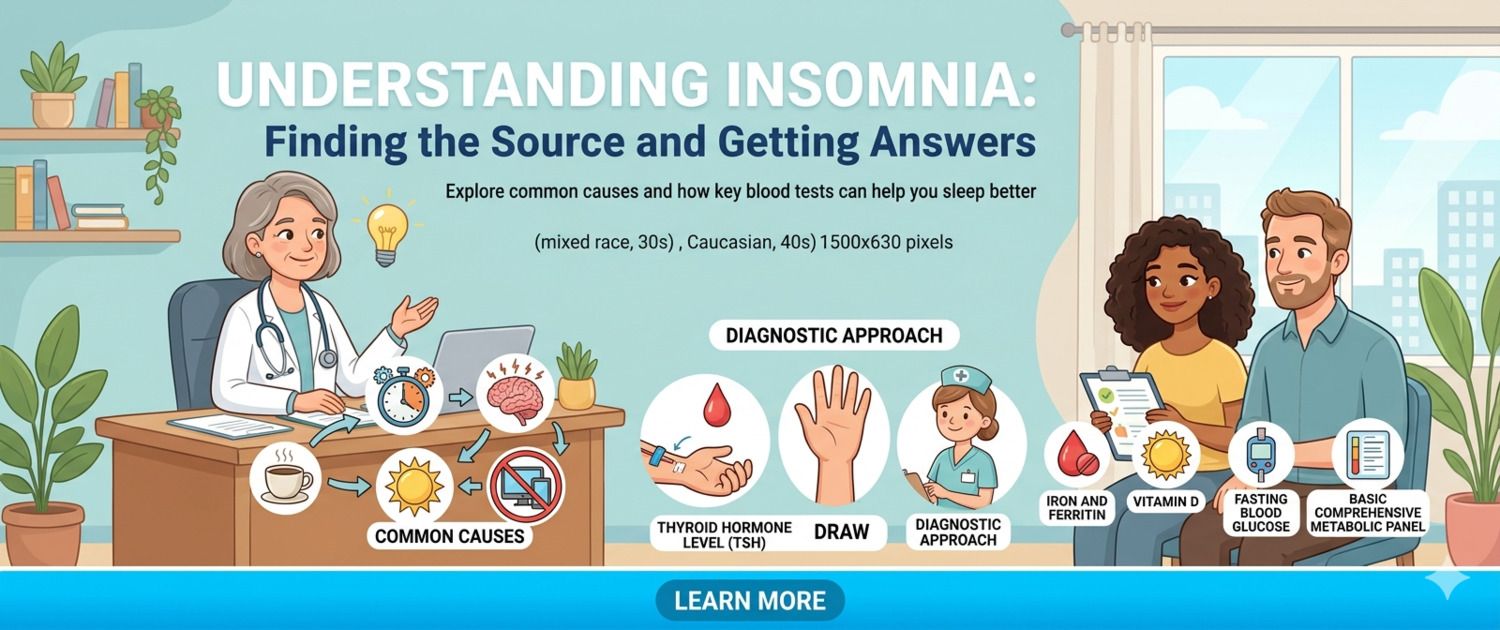
Insomnia is the most common complaint that brings patients in to ask "for something to help me sleep." In reality, "insomnia" is a symptom with a long list of possible causes: from subclinical hypothyroidism to iron deficiency, from high evening cortisol to low vitamin D. Each cause has its own solution — and a sleeping pill is rarely the central one. Finding the source needs not generic tests but a properly chosen marker set.
What Insomnia Is: Types and Forms
Clinically, insomnia is divided into three forms:
- Sleep-onset insomnia — difficulty falling asleep (more than 30 minutes after going to bed)
- Sleep-maintenance insomnia — frequent night awakenings, especially around 3–4 AM
- Early-morning awakening — waking at 4–5 AM with no return to sleep
By duration:
- Acute — less than 3 months, usually stress-, illness-, or schedule-related
- Chronic — more than 3 months, often with a biochemical component
Each type has characteristic biochemical correlates that are easier to spot if you know what to look for.
Biochemical Causes of Insomnia
Hormonal:
- Hypo- and hyperthyroidism
- Hypercortisolism (chronic stress, Cushing's syndrome)
- Melatonin deficiency (including age-related)
- Estradiol fluctuations and falling progesterone (perimenopause)
- Hyperprolactinemia
Nutritional:
- Low ferritin (< 50 ng/mL) — restless legs syndrome, fragmented sleep
- Vitamin D deficiency — disrupted sleep architecture
- Magnesium deficiency — impaired GABA function, light sleep
- B12 and folate deficiency — linked to insomnia and anxiety
Metabolic:
- Nocturnal hypoglycemias (awakenings at 2–4 AM)
- Insulin resistance and unstable blood sugar
- Chronic inflammation (elevated CRP)
Psychogenic / behavioral:
- Anticipatory anxiety about sleep
- Depression
- Poor sleep hygiene (screens, caffeine, irregular schedule)
- Sleep apnea
Many cases combine several factors: for example, low ferritin + subclinical hypothyroidism + high evening cortisol.
Hypothyroidism and Insomnia
Subclinical hypothyroidism is a top-3 missed cause of "unexplained" insomnia. TSH in the formal-normal range (3.5–4.5) is already a zone where some people develop sleep complaints. The target TSH for well-being is < 2.5 mIU/L.
Hyperthyroidism produces the opposite picture: hard to fall asleep, frequent awakenings, light sleep, often with palpitations and sweating. TSH is low (< 0.4) and T4 at the upper bound or above.
Tests: TSH + free T4; for abnormalities — anti-TPO antibodies, free T3.
Iron Deficiency and Restless Sleep
Low ferritin is the most common and most missed cause of insomnia in women of reproductive age. Mechanism: iron is needed for dopamine synthesis; deficiency manifests as restless legs syndrome (a "creeping" sensation, irresistible urge to move) and fragmented sleep.
The target ferritin for sleep is > 50 ng/mL, optimally 70–100. A level of 25–30 is formally "normal" but clinically often associated with sleep disturbance. Hemoglobin is usually normal — so a complete blood count is not enough; direct ferritin is needed.
Iron repletion (under medical supervision, oral or IV) improves sleep typically in 6–10 weeks.
Hypercortisolism: The "Mind That Won't Switch Off"
If a patient says "I can't fall asleep, my mind won't switch off" — high probability of elevated evening cortisol. Chronic HPA-axis activation prevents the brain from entering sleep mode: the mind keeps "solving issues" even on the verge of sleep. The daytime price of such sleep is scattered attention and brain fog — the very thing that most often leads people to suspect an attention deficit: see what steals your attention and how to check it.
Lab signature:
- Morning cortisol upper-normal or elevated
- Evening cortisol elevated (flattened circadian rhythm)
- DHEA-S reduced in those with prolonged stress
Strategies for lowering cortisol are detailed in how to lower cortisol. Lab-wise, an adrenal stress panel gives a full diurnal picture.
Melatonin and Magnesium Deficiency
Age-related decline in melatonin is natural: by age 60 nighttime synthesis drops 50–70% from young-adult levels — explaining why elderly patients often complain of "short sleep." A melatonin test is meaningful only with nighttime or salivary sampling — morning blood is uninformative.
Magnesium deficiency disrupts GABA-receptor function — the main inhibitory brake of the brain. Symptoms: difficulty falling asleep, hypnic jerks, night awakenings, muscle hyperexcitability. Red-cell magnesium is more informative than serum.
The full marker set — melatonin, evening cortisol, TSH, ferritin, vitamin D, magnesium — is described in the section below.
Which Tests to Take for Insomnia
Minimum set:
- Complete blood count
- Ferritin (not just hemoglobin)
- TSH + free T4
- Vitamin D (25-OH)
- Vitamin B12 + folate
- Fasting glucose
Extended set (with persistent complaint or clear clinical suspicion):
- Morning and evening cortisol
- DHEA-S
- Red-cell magnesium
- Melatonin (nighttime or salivary)
- Sex hormones in perimenopausal insomnia
These are conveniently combined into ready panels: thyroid — thyroid panel, stress — adrenal stress panel, specific sleep block — sleep disorders panel.
When to See a Sleep Specialist
Most insomnia is solved by primary care + endocrinology + (where needed) psychotherapy. A sleep specialist is needed for:
- Suspected sleep apnea (loud snoring, witnessed apneas, morning headaches)
- Insomnia lasting more than 6 months and unresponsive to standard therapy
- Parasomnias (sleepwalking, night terrors, REM behavior disorder)
- Daytime sleepiness with adequate sleep duration
- Narcolepsy and other hypersomnias
Sleep specialists handle mainly instrumental tasks — polysomnography, respiratory monitoring, MSLT testing. Lab diagnostics and sleep medicine are not substitutes — they complement each other.
Sleep and exhaustion pull each other in a circle: more in the articles on constant tiredness and on why a holiday does not help.
This article is for informational purposes only and does not replace professional medical advice. Long-standing insomnia requires clinical evaluation of the cause.
For informational purposes only
This article is for informational purposes only and does not constitute medical advice, diagnosis, or treatment. Please consult a healthcare professional for medical guidance.