Vitamin D Blood Test: Normal Range, Deficiency and How to Correct It
Reviewed by the LabReadAI medical team
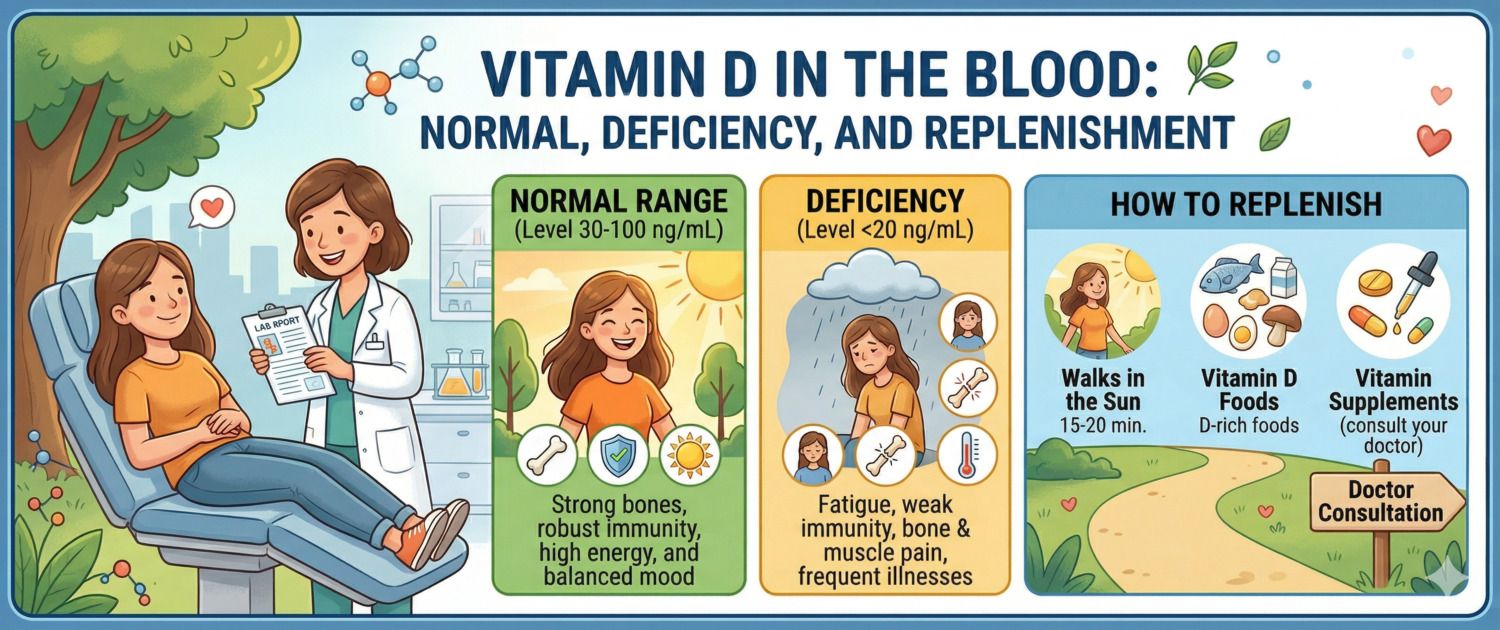
Vitamin D deficiency is one of the most widespread nutritional deficiencies in the world: estimates suggest that 40–70% of people in northern countries have insufficient levels. Yet vitamin D is not simply a vitamin in the conventional sense — by its mechanism of action it is closer to a hormone, its receptors are found in almost every cell of the body, and its deficiency is linked to impaired immunity, bone metabolism, reproductive function, and even mood. This article explains what to measure, how to interpret the result, and how to correct a deficiency correctly.
What Is Vitamin D and Why It Matters for Immunity and Calcium
Vitamin D is a fat-soluble vitamin more accurately described as a prohormone: in the body it is converted into the active hormone calcitriol. It reaches the body via two routes: synthesised in the skin under the action of ultraviolet B (UVB) radiation, and obtained from food (fatty fish, egg yolk, fortified foods).
Activation is two-step. In the liver, vitamin D is converted to 25-hydroxyvitamin D — the form measured in blood tests. Then in the kidneys (and partially in other tissues) it is converted to active calcitriol. This is why in chronic kidney disease the activation of vitamin D is impaired and functional deficiency develops even when 25-OH levels appear normal.
A critical and often overlooked factor: magnesium is required for both hepatic 25-hydroxylase and renal 1α-hydroxylase — the enzymes of both activation steps. When magnesium is deficient, vitamin D cannot be properly activated: 25-OH levels may normalise with supplementation while deficiency symptoms persist. This is one of the most common causes of apparent "resistance" to vitamin D therapy.
Key functions of vitamin D:
- Bone metabolism. The classic primary role: it regulates intestinal calcium absorption and renal reabsorption. Deficiency → falling calcium → compensatory rise in parathyroid hormone → calcium leached from bone. This is the mechanism of rickets in children and osteomalacia in adults.
- Immune regulation. Calcitriol activates innate immunity — stimulating the production of antimicrobial peptides (defensins, cathelicidin) and modulating the inflammatory response. Vitamin D deficiency is associated with higher rates of respiratory infections, tuberculosis, and autoimmune diseases.
- Neuromuscular function. Participates in nerve impulse transmission and muscle contraction. Deficiency causes muscle weakness and increased fall risk in older adults.
- Hormonal regulation. Vitamin D receptors are present in pituitary, adrenal, thyroid, ovarian, and testicular cells. Deficiency influences testosterone production, TSH regulation, and cortisol axis responsiveness.
- Neuropsychiatric effects. The link between vitamin D deficiency and depression, cognitive decline, and sleep quality via effects on melatonin is an active area of research.
Normal Vitamin D Levels: Table and Interpretation
The blood test measures 25-OH vitamin D (calcidiol) — the combined stores of D2 and D3. Units: ng/mL or nmol/L (1 ng/mL = 2.5 nmol/L).
| Level (ng/mL) | Level (nmol/L) | Interpretation |
|---|---|---|
| < 10 | < 25 | Severe deficiency |
| 10–20 | 25–50 | Deficiency |
| 20–30 | 50–75 | Insufficiency |
| 30–60 | 75–150 | Normal (optimal range) |
| 60–100 | 150–250 | High normal |
| > 100 | > 250 | Possible toxicity |
| > 150 | > 375 | Toxicity (hypercalcaemia) |
The target optimal range according to most clinical guidelines is 30–60 ng/mL (75–150 nmol/L). Some experts and medical societies recommend 40–60 ng/mL for maximum immune and bone-related benefit.
Interpretive categories are the same for children, but the minimum target for rickets prevention is at least 20 ng/mL, with an optimal range of 30–50 ng/mL.
Causes of Vitamin D Deficiency
Vitamin D deficiency is almost a pandemic of modern urban living. The main drivers:
Insufficient sun exposure — by far the most common cause. Skin synthesis requires direct UVB exposure on unprotected skin. At latitudes above 35–40° (all of Russia, Scandinavia, most of Europe) from October through April, the sun's angle is such that UVB rays barely reach ground level. In winter, cutaneous synthesis is essentially zero regardless of time spent outdoors.
Sunscreen use — SPF 15 reduces vitamin D synthesis by approximately 99%.
Dark skin — melanin absorbs UVB, reducing synthesis by three to six times compared to light skin.
Age — in adults over 65, the skin's capacity for vitamin D synthesis is reduced fourfold.
Obesity — vitamin D is fat-soluble and sequesters in adipose tissue, reducing bioavailability.
Malabsorption — coeliac disease, inflammatory bowel disease, intestinal resection impair absorption of fat-soluble vitamins.
Chronic kidney disease — impaired conversion of 25-OH to calcitriol.
Hypothyroidism — reduced thyroid function impairs vitamin D conversion through altered metabolic rate.
Certain medications — glucocorticoids, anticonvulsants, and rifampicin accelerate vitamin D catabolism.
Symptoms of Vitamin D Deficiency
Vitamin D deficiency is largely a "silent" condition: most people have no prominent symptoms even at levels of 10–15 ng/mL. But consequences accumulate over months and years.
Early and non-specific symptoms: chronic fatigue and general weakness, frequent upper respiratory infections and slow recovery, muscle aches and bone pain (particularly in the ribs, spine, and thighs), low mood and impaired concentration.
With severe and prolonged deficiency: pronounced muscle weakness with difficulty climbing stairs, tenderness on bone palpation (osteomalacia), skeletal deformities in children, and stress fractures. The long-term consequence in adults is osteoporosis.
For a detailed breakdown of clinical stages, diagnosis, and treatment — see Vitamin D Deficiency.
Indirect markers in other tests: compensatorily elevated parathyroid hormone (secondary hyperparathyroidism), low-normal or frankly low calcium, and reduced phosphorus.
How to Take a Vitamin D Blood Test Correctly
The form to measure: strictly 25-OH vitamin D (calcidiol) — total D2+D3. Not 1,25-dihydroxyvitamin D (calcitriol) — the active form, which can be normal or even elevated in deficiency due to compensatory hyperparathyroidism and therefore does not reflect body stores.
Preparation rules:
- Fasted, morning draw — as with most biochemical tests
- Stop vitamin D supplements 3–5 days before the test — otherwise the result reflects the supplement dose rather than true body status
- Inform the doctor about medications affecting vitamin D metabolism (glucocorticoids, anticonvulsants)
- For treatment monitoring — retest 3 months after starting supplementation
For a complete assessment of bone and mineral metabolism, vitamin D is tested alongside calcium and parathyroid hormone — their combination gives the diagnostically meaningful picture.
Vitamin D Deficiency Treatment: Doses, Forms and How to Raise Levels
Preventive doses for maintaining an adequate level (when already sufficient): 800–2000 IU/day for adults, 400–1000 IU/day for children.
Therapeutic doses for confirmed deficiency (< 20 ng/mL): 4000–10,000 IU/day for 8–12 week courses under medical supervision with blood monitoring. Doses above 4000 IU/day should be prescribed by a physician.
Form: vitamin D3 (cholecalciferol) is preferred over D2 (ergocalciferol) — better absorbed and maintains levels for longer. Oil-based preparations are slightly better absorbed than water-based ones when taken with a fatty meal.
Important: vitamin D is fat-soluble and accumulates in the body — overdose is possible with prolonged unsupervised use of high doses. Signs of hypervitaminosis D (typically at levels > 100–150 ng/mL): nausea, thirst, frequent urination, weakness, and cardiac arrhythmia from hypercalcaemia.
When to See a Doctor
A planned appointment is warranted when:
- Vitamin D is below 20 ng/mL — therapeutic dosing and monitoring are needed
- Deficiency persists despite standard-dose supplementation — check magnesium levels
- Parathyroid hormone is elevated with normal or borderline calcium — vitamin D deficiency may be the cause of secondary hyperparathyroidism
- Symptoms of osteomalacia or rickets in a child
Urgent consultation is needed for:
- Symptoms of hypercalcaemia (nausea, vomiting, polyuria, arrhythmia) during high-dose vitamin D supplementation — possible toxicity
- Vitamin D above 100 ng/mL on repeat measurement
Vitamin D is one of the few nutrients where proactive level monitoring is justified for virtually everyone living at northern latitudes, particularly through the autumn and winter months. An annual blood test and an appropriately dosed supplement represent a simple measure with real impact on immunity, bone health, and the hormonal environment.
For the role of vitamin D in longevity, optimal vs. lab reference levels, and the link with testosterone and cardiovascular risk, see the article what vitamin D does and longevity.
This article is for informational purposes only. Interpreting test results and prescribing treatment is exclusively the responsibility of a physician.
For informational purposes only
This article is for informational purposes only and does not constitute medical advice, diagnosis, or treatment. Please consult a healthcare professional for medical guidance.