Vitamin D Deficiency: Symptoms, Causes and Treatment
Reviewed by the LabReadAI medical team
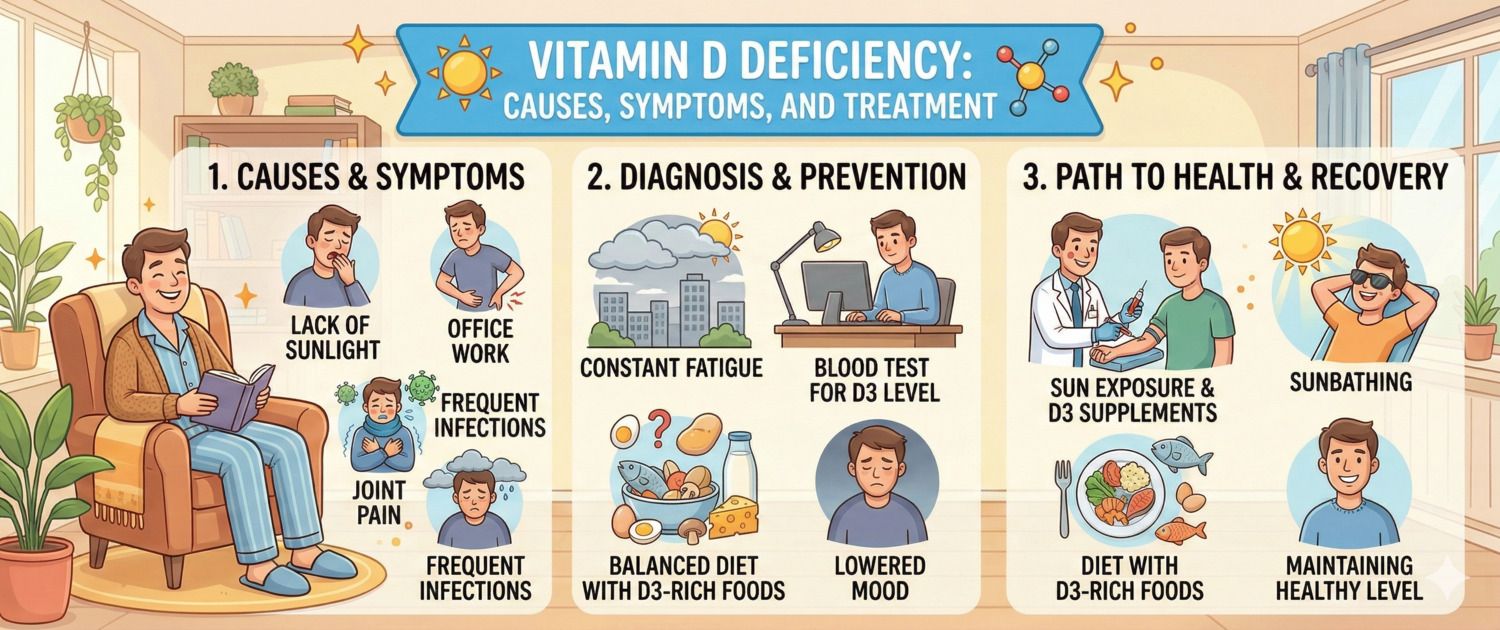
Fatigue, frequent colds, bone and muscle pain, low mood through the winter months — all of these can be manifestations of a single deficiency. Vitamin D insufficiency affects 40–70% of people in northern countries and most urban populations in temperate zones, yet it remains underdiagnosed: symptoms are non-specific and the clinical picture unfolds slowly — over months and years.
Why Vitamin D Deficiency Is So Common
Vitamin D is unique in that most of it is not obtained from food but synthesised in the skin under ultraviolet B (UVB) radiation. This dependence on sunlight makes deficiency almost inevitable for much of humanity under modern conditions.
People living at latitudes above 35–40° are essentially cut off from UVB synthesis between October and April: the sun's angle is such that UVB rays are absorbed by the atmosphere before reaching the ground. Even on sunny winter days, going outside provides no vitamin D synthesis — only tanning from UVA rays.
Beyond geography — lifestyle: most people spend their working day indoors. SPF-15 sunscreen blocks 99% of UVB synthesis. Darker skin requires 3–6 times more sun exposure to produce the same amount of vitamin D. In people over 65, skin synthesis efficiency is reduced fourfold.
Obtaining enough vitamin D from food is practically impossible: even fatty fish (salmon, mackerel, sardines) provides 400–600 IU per 100 g — against a minimum adult requirement of 800–1,000 IU per day and a therapeutic dose of 4,000–5,000 IU for deficiency correction.
Symptoms of Vitamin D Deficiency in Adults
The insidious nature of vitamin D deficiency is its silence. Most people with levels of 10–15 ng/mL have no prominent complaints. Symptoms accumulate gradually and are often attributed to stress, fatigue, or ageing.
Musculoskeletal symptoms: Diffuse bone pain — particularly in the ribs, spine, pelvis, and thighs — that is tender on pressure. This is osteomalacia: deficiency impairs bone mineralisation, leaving bones soft and painful. Proximal muscle weakness — difficulty rising from a chair or climbing stairs — is characteristic of severe deficiency.
In older adults, vitamin D deficiency increases fall risk (impaired neuromuscular function) and fracture risk (osteoporosis with prolonged deficiency).
Fatigue and low energy: Chronic fatigue is one of the most frequent but non-specific symptoms. The mechanism relates to vitamin D's role in mitochondrial metabolism and cellular energy processes.
Frequent infections: Vitamin D activates innate immunity — stimulating the synthesis of antimicrobial peptides (cathelicidin, defensins) and regulating the inflammatory response. Deficiency is associated with more frequent upper respiratory infections, influenza, and severe respiratory illness.
Low mood and depression: Vitamin D receptors are present in the hippocampus and other brain structures. Deficiency is associated with increased risk of depression and seasonal affective disorder (SAD). The relationship with melatonin and serotonin is actively studied.
Hair loss: Vitamin D participates in the hair follicle growth cycle. Deficiency is associated with diffuse hair loss — alopecia that often worsens in autumn and winter.
Sleep disturbances: Vitamin D receptors are involved in circadian rhythm regulation through interaction with melatonin. Deficiency may contribute to impaired sleep onset and quality.
High-Risk Groups
Children under 5: breast milk contains little vitamin D (50–80 IU/L). If the nursing mother is deficient, the infant receives almost none. Severe deficiency → rickets.
Pregnant women: vitamin D deficiency during pregnancy raises the risk of pre-eclampsia, gestational diabetes, preterm birth, and impaired fetal bone mineralisation. The target level during pregnancy is at least 40 ng/mL.
Older adults: reduced skin synthesis, less time outdoors, declining kidney function (impaired 25-OH → calcitriol conversion). Increased fracture and sarcopenia risk.
People with darker skin: melanin competes with provitamin D3 for UVB — 3–6 times more sun exposure is needed for equivalent synthesis.
Patients with obesity: vitamin D is fat-soluble and sequesters in adipose tissue — bioavailability is reduced; doses 2–3 times higher than standard are needed to reach target levels.
Malabsorption syndromes: coeliac disease, Crohn's disease, bariatric surgery — impaired absorption of fat-soluble vitamins.
Diagnosis: The 25-OH Vitamin D Blood Test
The only reliable way to detect deficiency is a blood test for 25-hydroxyvitamin D [25(OH)D]. For detailed normal ranges and interpretation, see Vitamin D.
Practical thresholds:
- < 10 ng/mL — severe deficiency; risk of osteomalacia and myopathy
- 10–20 ng/mL — deficiency; therapeutic doses required
- 20–30 ng/mL — insufficiency; correction needed
- 30–60 ng/mL — normal, target range
100 ng/mL — possible toxicity
Additional tests when deficiency is confirmed: parathyroid hormone (elevated in deficiency — secondary hyperparathyroidism), blood calcium, phosphorus, magnesium — when treatment resistance is suspected.
Treatment of Vitamin D Deficiency
Form selection: vitamin D3 (cholecalciferol) is preferred over D2 (ergocalciferol) — better absorbed and more effective at raising 25(OH)D levels. Oil-based preparations are slightly better absorbed than aqueous forms when taken with fatty food, though the clinical difference is minimal with correct administration.
Treatment regimens by severity:
| 25(OH)D level | Regimen |
|---|---|
| < 20 ng/mL | 4,000–5,000 IU/day × 8–12 weeks, then maintenance |
| 20–30 ng/mL | 2,000–3,000 IU/day × 8–12 weeks, then maintenance |
| Maintenance (after correction) | 1,500–2,000 IU/day year-round |
Alternatively, bolus regimens: 50,000 IU once weekly for 8–12 weeks — equally effective but requires closer monitoring.
Administration rules:
- Take with a fat-containing meal — this fat-soluble vitamin is absorbed with dietary fats
- Check blood levels 3 months after starting treatment
- If levels exceed 60 ng/mL after treatment — switch to a preventive dose
Treatment resistance — what to do: If levels do not normalise after 3 months of adequate dosing — check magnesium: deficiency blocks vitamin D activation enzymes. Also rule out malabsorption and chronic kidney disease (impaired 25-OH → calcitriol conversion).
When active vitamin D is needed (alfacalcidol, calcitriol): In chronic kidney disease with significantly reduced GFR, the kidneys cannot activate standard vitamin D. Pre-activated forms are used in these cases — strictly under nephrologist supervision.
Prevention
- Sun exposure: 15–30 minutes of direct sun (arms, legs) between 10 AM and 3 PM, 3–4 times a week — provided latitude and season allow UVB synthesis. Do not burn.
- Supplements: residents of northern latitudes (above 40–45°) are advised to take vitamin D year-round. Minimum preventive dose: 800–1,000 IU/day for adults; 400–600 IU/day for children.
- Level monitoring: 25(OH)D blood test once a year — at the end of winter (February–March), when levels are lowest.
- Diet: fatty fish, egg yolks, fortified foods — the contribution is modest but worth including.
When to See a Doctor
- Level < 10 ng/mL — severe deficiency with osteomalacia risk: endocrinology consultation within days
- Deficiency not correcting with standard doses after 3 months — investigate the cause of resistance
- Deficiency identified during pregnancy — urgent obstetric consultation
- Deficiency in a child with signs of skeletal deformity — paediatrician or paediatric endocrinologist immediately
If you are interested not just in treating deficiency but in vitamin D's role in longevity and optimal levels, see the article what vitamin D does: normal blood levels and longevity.
Night sweating in a child does not prove deficiency — see child sweating in sleep.
This article is for informational purposes only and does not replace consultation with a qualified physician.
For informational purposes only
This article is for informational purposes only and does not constitute medical advice, diagnosis, or treatment. Please consult a healthcare professional for medical guidance.