Osteoporosis: Symptoms, Diagnosis, Treatment and Prevention
Reviewed by the LabReadAI medical team
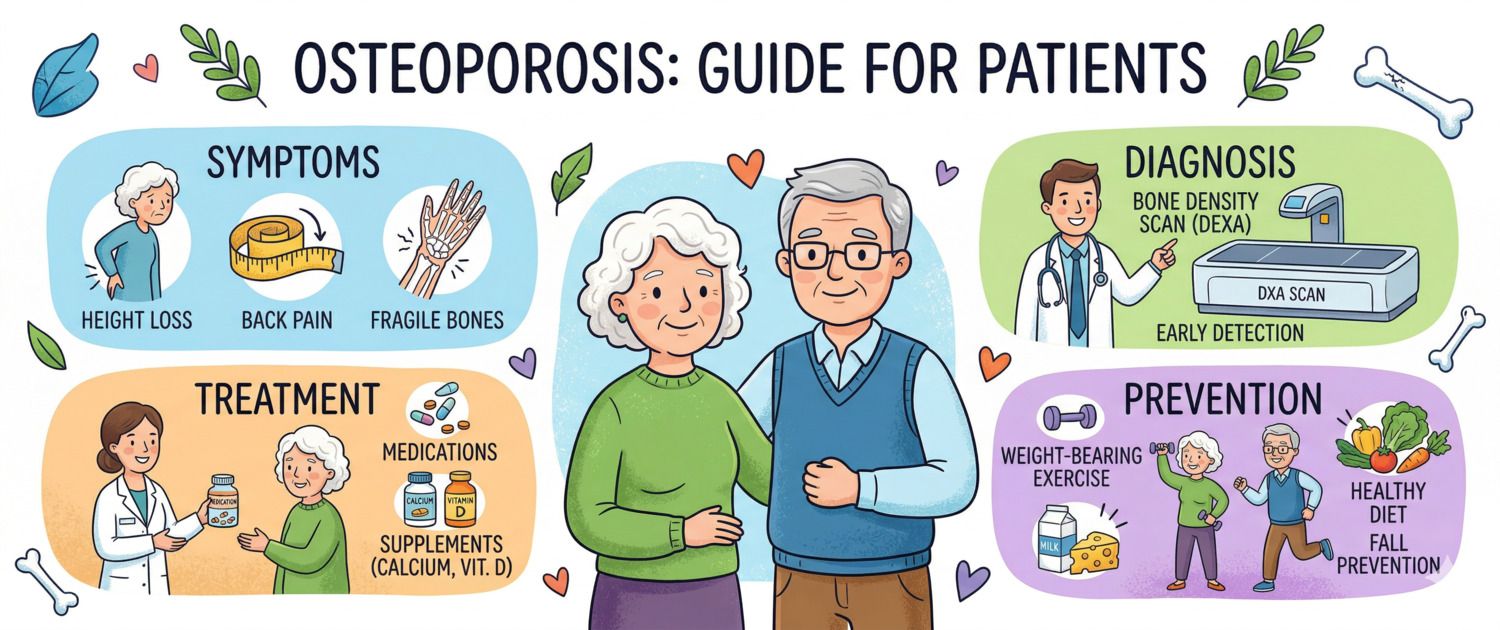
Osteoporosis is called a "silent epidemic" — and the name fits precisely. Bone deteriorates for years without a single symptom, and the first signal is a fracture: from a minor knock, an awkward twist, or even a forceful cough. One in three women over 50 and one in five men of the same age will sustain an osteoporotic fracture in their remaining lifetime. The good news: the disease can be detected long before that moment — and its progression significantly slowed.
What Is Osteoporosis and How Does It Develop
Bone is living tissue in a constant state of renewal. Specialised osteoclast cells break down old bone while osteoblasts build new tissue. Normally these processes are balanced and bone maintains its strength. Peak bone mass is reached around age 25–30 — this is a kind of "bone capital" for the rest of life. After age 30–35 the balance gradually shifts: breakdown begins to outpace formation and bone density slowly declines.
Osteoporosis is the point at which bone loss has progressed far enough that bone becomes brittle and fractures under loads that healthy bone would withstand with ease. Bone microarchitecture is disrupted: trabecular struts thin and perforate, and the bone begins to resemble moth-eaten sponge.
Two main types are recognised:
- Primary osteoporosis — postmenopausal (type I, in women in the early years after menopause when oestrogen falls) and senile (type II, in men and women over 70)
- Secondary osteoporosis — a consequence of another disease (e.g. rheumatoid arthritis) or drug treatment: glucocorticoids, antiepileptics, aluminium-containing antacids
Symptoms of Osteoporosis: Why the Disease Is Missed for Years
Osteoporosis itself does not hurt. This is precisely what makes it so dangerous — while bone density falls, the person feels entirely well. Early indirect signs worth noting:
- Loss of height — losing more than 2–3 cm compared to young adult height suggests vertebral compression fractures, which often occur silently
- Chronic back pain — especially in the thoracic and lumbar spine; may be the result of "quiet" vertebral fractures
- Posture changes — progressive thoracic kyphosis ("dowager's hump"): vertebrae gradually deform wedge-shaped under body weight
- Fractures from minimal trauma — wrist from a fall from standing height, hip during walking, ribs from a hug
Hip fracture is the most severe complication. In elderly patients it is associated with high mortality in the first year: up to 30% of patients die from complications (thromboembolism, pneumonia, heart failure) — not from the fracture itself, but from the prolonged immobilisation that follows.
Low Bone Density Causes and Risk Factors
Bone loss is a universal ageing process, but the rate and severity are shaped by a combination of factors.
| Risk factor | Mechanism |
|---|---|
| Female sex and menopause | Oestrogen brakes osteoclast activity; its fall at menopause accelerates resorption 3–5 fold |
| Age over 65 | Reduced cutaneous vitamin D synthesis, impaired calcium absorption, sarcopaenia |
| Family history | Genetics determines up to 60–80% of peak bone mass |
| Low oestradiol / testosterone | Sex hormones protect bone in both sexes |
| Low body weight (BMI < 18.5) | Less mechanical load on bone; less adipose tissue for oestrogen synthesis |
| Smoking | Accelerates oestrogen breakdown, impairs bone blood supply |
| Alcohol (> 2 units/day) | Direct toxicity to osteoblasts; impairs calcium absorption |
| Glucocorticoids (prednisolone > 3 months) | Suppress osteoblasts and intestinal calcium absorption |
| Sedentary lifestyle | Bone strengthens under mechanical load — without it, it atrophies |
| Calcium and vitamin D deficiency | Impaired mineralisation of newly formed bone |
Diagnosing Osteoporosis: Densitometry and Blood Tests
Densitometry (DXA — dual-energy X-ray absorptiometry) is the diagnostic gold standard. It measures bone mineral density (BMD) at the lumbar vertebrae and femoral neck. The result is expressed as a T-score — the deviation from peak bone mass in young adults:
| T-score | Interpretation |
|---|---|
| Above −1.0 | Normal |
| −1.0 to −2.5 | Osteopaenia (reduced density preceding osteoporosis) |
| −2.5 and below | Osteoporosis |
| −2.5 and below + prior fracture | Severe osteoporosis |
Densitometry is recommended for all women over 65, men over 70, and younger individuals with risk factors (menopause before 45, glucocorticoid use, prior fragility fracture).
Blood tests are needed to exclude secondary osteoporosis and assess calcium-phosphate metabolism before starting treatment:
- Calcium — total and ionised. Usually normal in primary osteoporosis; marked elevation points to hyperparathyroidism.
- Vitamin D (25-OH) — essential. Vitamin D deficiency is one of the most frequent correctable risk factors; at levels below 30 nmol/L, bone mineralisation is impaired.
- Parathyroid hormone (PTH) — elevated in secondary hyperparathyroidism (response to calcium/vitamin D deficiency) and in primary hyperparathyroidism as an independent cause.
- Phosphorus — reduced in osteomalacia and several forms of secondary osteoporosis.
- Oestradiol in women / testosterone in men — when hormonal deficiency is suspected as the cause of bone loss.
- Bone turnover markers — osteocalcin (formation) and β-CrossLaps/CTX (resorption) — used to monitor treatment response.
Treating Osteoporosis: Medications and Lifestyle Measures
Treatment is started at T-score −2.5 or below, and also in osteopaenia when the 10-year fracture risk calculated by the FRAX tool is high.
Baseline therapy — nothing else works effectively without it:
- Calcium 1000–1200 mg/day as elemental calcium — from food and supplements as needed
- Vitamin D3 800–2000 IU/day (dose guided by 25-OH vitamin D blood level)
Antiresorptive therapy — slows bone breakdown:
- Bisphosphonates (alendronate, zoledronate, ibandronate) — first line; reduce vertebral fracture risk by 40–70%, hip fracture by 40–50%
- Denosumab — monoclonal antibody blocking RANKL, the key activator of osteoclasts; used when bisphosphonates are not tolerated or in renal insufficiency
- Hormone replacement therapy (HRT) — in women in early postmenopause; effective bone protection, prescribed with careful consideration of cardiovascular and oncological risks
Anabolic therapy — stimulates new bone formation; reserved for severe osteoporosis:
- Teriparatide (PTH fragment) — the only agent that genuinely builds new bone
- Romosozumab — blocks sclerostin, simultaneously stimulating formation and inhibiting resorption
Note: bisphosphonates are taken in courses with "drug holidays" — after 3–5 years of treatment a break is taken under densitometry monitoring. Do not stop or switch therapy independently.
Osteoporosis Prevention: Diet and Lifestyle
No medication works effectively against a background of calcium and vitamin D deficiency — this is the foundation without which treatment cannot reach its target.
Calcium from food — the preferred source:
| Food | Calcium per 100 g |
|---|---|
| Hard cheese | 700–1200 mg |
| Milk, kefir, yoghurt | 110–120 mg |
| Canned sardines (with bones) | 380 mg |
| Tofu (calcium-set) | 350 mg |
| White cabbage | 48 mg |
| Broccoli | 47 mg |
Daily calcium requirement: 1000 mg for adults 18–50, 1200 mg for women over 50 and men over 70.
Exercise — one of the most underestimated treatment tools. Weight-bearing and resistance training stimulate osteoblasts through mechanical stress. Effective activities: walking, running, dancing, strength training, yoga, tai chi. The last two are particularly valuable for fall prevention: they improve balance and coordination.
Swimming and cycling, despite their cardiovascular benefits, create minimal mechanical load on bone.
Fall prevention — a separate strategy, especially in older adults: removing thresholds and slippery surfaces at home, good lighting, vision correction, discontinuing sedating medications where possible.
When to See a Doctor Urgently
Osteoporosis is not an emergency condition, but several situations call for prompt medical attention:
- Acute back pain after minimal or no trauma — possible vertebral compression fracture; X-ray or MRI of the spine needed
- A fall with pain in the hip, groin or thigh — suspected hip fracture; immediate hospitalisation required
- Newly discovered T-score of −2.5 or below — planned but prompt assessment by a rheumatologist or endocrinologist to initiate therapy
- Height loss of 4 cm or more — indication for spinal X-ray even in the absence of pain
Early diagnosis changes outcomes radically. Starting treatment at osteopaenia can prevent the first fracture entirely. Starting after — can prevent the next one. In either case, starting now is the right call.
This article is for informational purposes only. Diagnosis and choice of therapy are the responsibility of a rheumatologist or endocrinologist.
For informational purposes only
This article is for informational purposes only and does not constitute medical advice, diagnosis, or treatment. Please consult a healthcare professional for medical guidance.