Menopause: Symptoms, Diagnosis, HRT and Long-Term Health Effects
Reviewed by the LabReadAI medical team
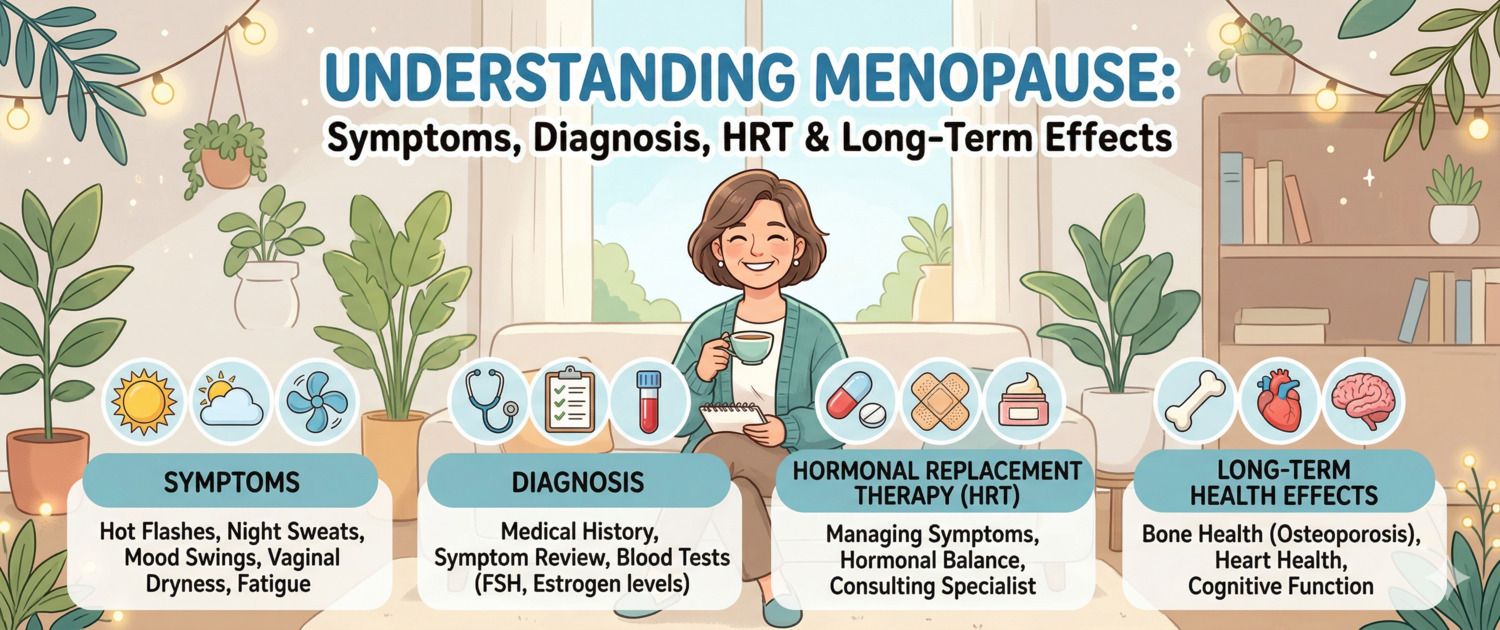
The average age of menopause is 51. This means a third of most women's lives is spent in postmenopause — not in disease, but in a physiological transition that nonetheless reshapes metabolism, bones, the cardiovascular system and the brain. How well a woman navigates those years depends largely on how early she understands what is happening and how effectively medical support is structured. Here is a thorough account — from the first signs of perimenopause to long-term health protection strategies.
What Is Menopause: Three Stages
Menopause is not a single day or moment. It is a process spanning years, conventionally divided into three stages.
Perimenopause — the transition period beginning 2–10 years before the final menstrual period. The ovaries gradually exhaust their follicular reserve, cycles become irregular, and oestradiol begins to fluctuate and progressively fall. Fertility declines but does not vanish at once — if a woman is trying to conceive during this stage and cannot, a doctor orders female infertility tests. The first symptoms appear here — hot flushes, sleep disturbances, mood changes — while menstruation still continues. Diagnostically, this is the most challenging stage: hormone levels can be within "normal" ranges while symptoms are already significant.
Menopause — officially defined retrospectively: 12 consecutive months without a menstrual period. The average age in Western countries is 50–52. Before age 45 — early menopause; before 40 — premature ovarian insufficiency (POI), which requires a distinct clinical approach.
Postmenopause — the entire period after the last menstrual period. Acute symptoms (hot flushes) gradually subside in most women over 3–7 years, but long-term metabolic changes — falling bone density, shifting lipid profile, mucosal atrophy — continue to progress. It is postmenopause that defines long-term health risks.
The core biological mechanism throughout this transition is the decline and eventual exhaustion of ovarian oestrogen production. Oestrogen is not simply a "female hormone" — it is a universal regulator: it protects bone from resorption, maintains vascular elasticity, modulates the lipid profile, and influences sleep and mood through serotonin and other neurotransmitters.
Symptoms of Menopause: Three Clusters
Menopausal symptoms fall into three groups, each requiring its own management approach. For a detailed walk-through of the transition, see the separate article on menopause symptoms and hot flushes.
Vasomotor symptoms — the most widely recognised:
- Hot flushes — a sudden wave of heat spreading from the chest to the neck and face; lasting from 30 seconds to several minutes; accompanied by flushing and sweating
- Night sweats — hot flushes during sleep, disrupting rest
- Palpitations accompanying a flush
Around 75–80% of women experience vasomotor symptoms during perimenopause and postmenopause. For some they are mild and barely intrusive; for others — severe, occurring hourly, and profoundly affecting quality of life. Without treatment, hot flushes can persist for more than 7 years, and in some women indefinitely.
Urogenital symptoms — progressively worsening in postmenopause as mucosal atrophy advances:
- Vaginal dryness, itching, discomfort during intercourse (dyspareunia)
- Urinary urgency and frequency, recurrent urinary tract infections
- Reduced libido
Unlike hot flushes, which tend to diminish over time, urogenital symptoms worsen without treatment. Many women tolerate them for years, dismissing them as an inevitable consequence of ageing.
Psychological and cognitive symptoms:
- Sleep disturbances — independent of night sweating
- Anxiety, irritability, mood swings
- Reduced concentration and memory ("brain fog")
- Depressive episodes — the risk of depression in perimenopause is 2–4 times higher than during the reproductive years
Diagnosis: Which Tests Are Needed in Menopause
Menopause is a clinical diagnosis. A 51-year-old woman with 12 months of amenorrhoea does not need a blood test for confirmation. Tests are needed in specific circumstances.
FSH — when the clinical picture is unclear; in younger women (under 45) to confirm premature menopause or POI; when irregular cycles need differentiating from other causes. FSH > 40 IU/L combined with amenorrhoea is the laboratory criterion for postmenopause.
LH — always together with FSH. A FSH:LH ratio > 1 in postmenopause is physiological. If LH is disproportionately high — other causes should be excluded.
Oestradiol — predictably low in postmenopause (< 30–40 pmol/L). Useful for gauging the degree of oestrogen deficiency, establishing a baseline before starting HRT, and monitoring on therapy.
Lipid panel — mandatory. After menopause, total cholesterol and LDL rise, while HDL falls. This is a direct consequence of losing oestrogen's vascular protection and one of the drivers of the sharp rise in cardiovascular risk after menopause.
Additionally — TSH (hypothyroidism mimics menopausal symptoms and commonly debuts at this age), full blood count, glucose, mammography and cervical cytology before starting HRT.
Densitometry (DXA) — for all postmenopausal women to assess bone density and osteoporosis risk. The first scan should be performed immediately after confirmed postmenopause, or earlier in the presence of risk factors.
Hormone Replacement Therapy: Who Benefits and Who Should Avoid It
HRT is the most effective treatment for menopausal symptoms and simultaneously the most myth-laden. Here is what the evidence says, without distortion in either direction.
HRT effectively resolves:
- Hot flushes and night sweats — frequency reduction of 75–90%
- Urogenital symptoms — local preparations (vaginal creams, rings) work even better than systemic therapy for isolated genitourinary atrophy
- Sleep disturbances and psychological symptoms
- Reduces bone loss and osteoporotic fracture risk
Who should consider HRT:
- Women with moderate to severe vasomotor symptoms reducing quality of life
- Women with premature menopause or POI — HRT is indicated regardless of symptoms, at minimum until the average age of natural menopause (51): early oestrogen deficiency dramatically raises the risk of osteoporosis and cardiovascular disease
- Women at high osteoporosis risk when antiresorptive agents are not tolerated
Contraindications to systemic HRT:
- Breast cancer (personal or family history requires careful individual assessment)
- History of endometrial cancer
- Active thrombosis or thromboembolism (transdermal formulations are significantly safer than oral)
- Active liver disease
- Uncontrolled hypertension
Principles of modern HRT:
- "Window of opportunity" — maximum benefit with minimum risk when HRT is started within 10 years of menopause or before age 60
- Women with an intact uterus must have oestrogen combined with a progestogen (to protect the endometrium)
- Lowest effective dose
- Transdermal formulations (gels, patches) preferred over oral — bypass hepatic first-pass metabolism, lower thrombosis risk
The decision on HRT is made individually by the gynaecologist, taking into account symptoms, medical history, investigation results and patient preferences.
Non-Hormonal and Alternative Approaches
When HRT is not possible or not desired:
- Cognitive behavioural therapy (CBT) — a proven method for reducing hot flush frequency and intensity, working through modification of the response to triggers
- Physical activity — moderate aerobic exercise improves sleep, reduces anxiety, slows bone and muscle loss
- SSRIs and SNRIs — reduce hot flush frequency by 50–60%; particularly indicated when depressive symptoms coexist
- Gabapentin — effective for night sweats
- Phytoestrogens (soy isoflavones, red clover) — moderate evidence base; more effective than placebo in some women, but substantially inferior to HRT
Menopause and Long-Term Health Consequences
This is what is most often left unspoken in discussions of menopause: it changes not only how a woman feels today, but her long-term risk profile for the rest of her life.
Osteoporosis. In the first 5–7 years of postmenopause, a woman can lose 20–30% of bone mass — the highest rate of bone loss in a lifetime. Oestrogen normally suppresses osteoclasts; without it, resorption accelerates sharply. One in three women over 50 will sustain an osteoporotic fracture. Densitometry, vitamin D, calcium and antiresorptive agents when indicated are mandatory components of postmenopause management. Details in the osteoporosis article.
Cardiovascular disease. Before menopause, women are substantially better protected from CVD than men — oestrogen maintains endothelial elasticity, a favourable lipid profile, and reduces platelet aggregation. After menopause this gap closes within 5–10 years. Monitoring the lipid profile, blood pressure and glucose becomes as important as it is for men of the same age.
Cognitive changes. Oestrogen has neuroprotective effects — it supports synaptic plasticity, cerebral blood flow and acetylcholine synthesis. "Brain fog" in perimenopause is not imagined: it reflects genuine neurochemical changes. Long-term, early menopause (especially before 45) is associated with elevated dementia risk — another argument for HRT when oestrogen deficiency begins early.
PCOS and menopause. Women with PCOS have a distinctive menopausal transition: their ovaries are depleted later (by 2–4 years), since follicular reserve is initially greater. However, they carry higher metabolic risks in postmenopause — insulin resistance, dyslipidaemia, obesity. Individualised postmenopause management is essential for this group.
When to See a Doctor
Menopause calls for planned, proactive medical care — not waiting for things to "resolve on their own." See a gynaecologist or reproductive endocrinologist when:
- Cycle irregularities begin after age 40 — the start of perimenopause; time to assess baseline hormone levels and plan ahead
- Severe hot flushes (more than 7–8 per day, significant night sweating, disrupted sleep) — markedly reduce quality of life; HRT or alternatives are effective
- Urogenital symptoms — dryness, painful intercourse, recurrent infections; local preparations are safe and highly effective
- Menopause before age 45 — mandatory consultation; early oestrogen deficiency requires active management
- Any vaginal bleeding in postmenopause (after 12 months of amenorrhoea) — endometrial cancer must be excluded; this is not "the cycle returning"
Menopause is not an ending but a transition. Women who actively manage their health during this period live longer and with better quality of life than those who tolerate symptoms or ignore long-term risks. Medicine today has all the tools needed.
For a practical guide on which hormone tests women should order after 40 and how to build a hormonal check-up plan, see the article which hormone tests women should get after 40.
This article is for informational purposes only. Diagnosis and treatment are the responsibility of a qualified gynaecologist.
For informational purposes only
This article is for informational purposes only and does not constitute medical advice, diagnosis, or treatment. Please consult a healthcare professional for medical guidance.