Estradiol: Normal Levels, Causes and Blood Test Interpretation
Reviewed by the LabReadAI medical team
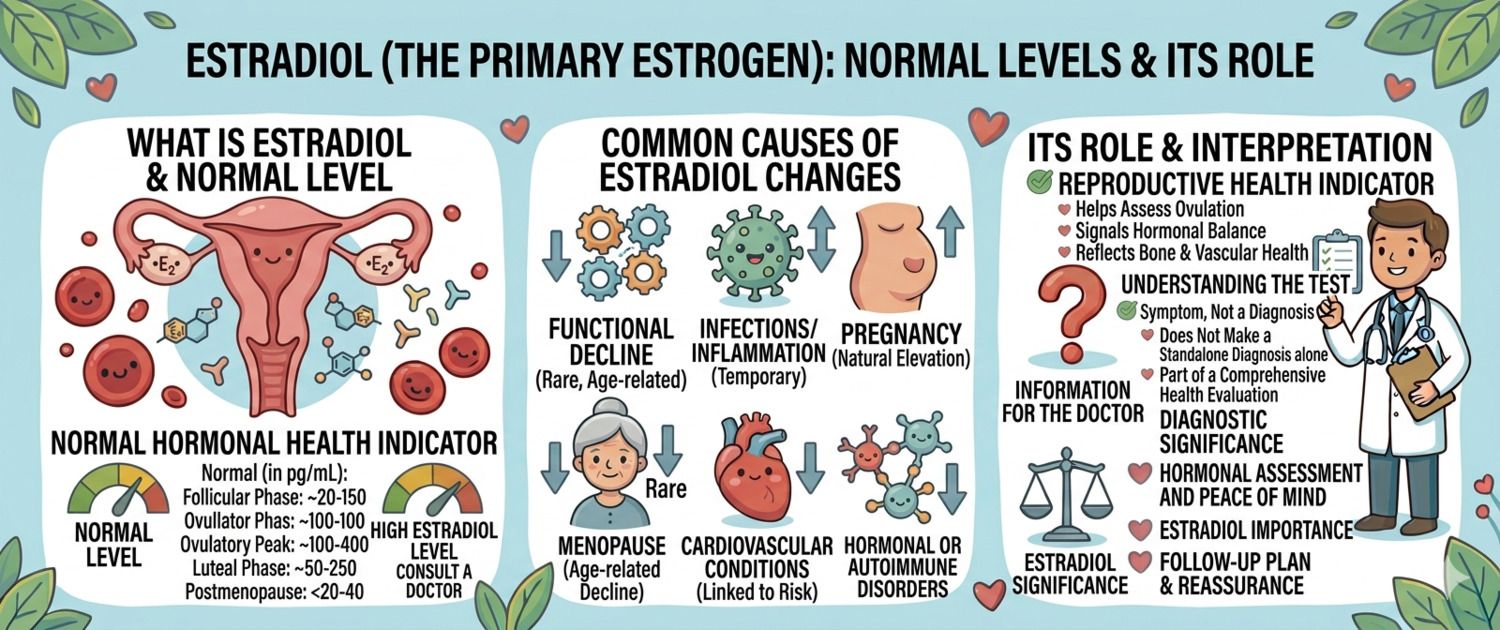
Estradiol — the most biologically active of the three estrogens — governs female reproductive function, bone density, vascular health, and neurological wellbeing, while in men it supports bone integrity and normal lipid metabolism. Its concentration varies 10 to 20-fold across the menstrual cycle, pregnancy, and menopause — which is precisely why "normal estradiol" without context is meaningless. Let's break down what it does, why it deviates from normal, and how to correctly read results.
What Estradiol Is and What It Does
Estradiol (E2) is a steroid hormone synthesized from cholesterol via testosterone through the action of the aromatase enzyme. In women of reproductive age, the primary source is granulosa cells of ovarian follicles. In men and postmenopausal women, the source is peripheral aromatization of testosterone in adipose tissue, liver, and adrenal glands.
Functions of estradiol in women:
- Reproductive system — development of secondary sex characteristics, regulation of the menstrual cycle, preparation of the endometrium for implantation, follicle growth stimulation
- Bone tissue — suppression of osteoclast-mediated resorption; estradiol deficiency in menopause is the primary driver of postmenopausal osteoporosis
- Cardiovascular system — estradiol lowers LDL, raises HDL, and exerts vasodilatory effects; this is why premenopausal women have lower cardiovascular risk than age-matched men
- Nervous system — neuroprotective effects; influence on mood, memory, and cognitive function; estradiol fluctuations are linked to premenstrual syndrome
- Skin and mucous membranes — maintains moisture and elasticity
In men, estradiol is required for normal spermatogenesis, bone density maintenance, and cognitive function — but at substantially lower concentrations.
The full breakdown of physiology and clinical effects is in the article estradiol: what this hormone is and why it matters.
Normal Estradiol Levels
Estradiol reference values are the most variable of all sex hormones — fluctuating 10–20-fold within a single menstrual cycle.
In women of reproductive age — by cycle phase:
| Cycle phase | E2 normal range (pg/mL / pmol/L) |
|---|---|
| Early follicular (days 1–5) | 20–150 pg/mL / 73–550 pmol/L |
| Late follicular (days 6–13) | 60–400 pg/mL / 220–1468 pmol/L |
| Pre-ovulatory peak (days 12–14) | 150–700 pg/mL / 551–2569 pmol/L |
| Luteal phase (days 15–28) | 30–250 pg/mL / 110–918 pmol/L |
Special physiological states:
| State | E2 normal range |
|---|---|
| Pregnancy — 1st trimester | 200–3500 pg/mL |
| Pregnancy — 2nd trimester | 1000–12,000 pg/mL |
| Pregnancy — 3rd trimester | 5000–25,000 pg/mL |
| Perimenopause | 10–150 pg/mL (highly variable) |
| Postmenopause | < 10–20 pg/mL |
| Men 18–50 years | 10–40 pg/mL / 37–147 pmol/L |
| Men over 50 years | 10–50 pg/mL |
Unit conversion: pg/mL × 3.671 = pmol/L.
Critical point: when interpreting a result, the cycle day and phase must always be documented — without this information, comparing to reference ranges is meaningless. A value that appears "elevated" in early follicular phase may be entirely physiological at mid-cycle.
How to Prepare for an Estradiol Blood Test
Preparation for estradiol testing is more demanding than most hormones — because of pronounced intra-cycle variability.
- Cycle day is decisive. The standard for baseline assessment is days 2–5 of the menstrual cycle (early follicular phase, when levels are at their lowest and most stable). For ovulation monitoring — follow the clinical protocol
- Morning draw, fasting or 3–4 hours after a light meal
- Avoid intense physical exercise for 24 hours beforehand
- No alcohol for 48 hours
- For IVF or ovarian stimulation monitoring — strictly follow the protocol; timing of the draw is critical
- Disclose hormonal contraceptives, HRT, clomiphene, or GnRH antagonists — all directly affect E2 levels
- Acute illness and stress cause transient fluctuations — repeat under baseline conditions if needed
Estradiol is always interpreted alongside FSH, LH, prolactin, and the clinical picture. An isolated result without hormonal context rarely enables a diagnosis.
Causes of High Estradiol (Hyperestrogenism)
Estradiol elevation is a relatively common finding with fundamentally different causes in women and men.
In women:
| Cause | Mechanism | Characteristic features |
|---|---|---|
| Polycystic ovary syndrome (PCOS) | Chronic anovulation; no progesterone counterbalance | Irregular cycle; hyperandrogenism |
| Ovarian follicular cysts | Autonomous E2 production by unreleased mature follicle | Pelvic pain; missed period |
| Endometriosis | Local aromatization within endometriotic lesions | Pelvic pain; dysmenorrhea |
| Obesity | Peripheral androgen aromatization in adipose tissue | High BMI; insulin resistance |
| Hormone-producing ovarian tumors (granulosa cell) | Autonomous E2 hypersecretion | Often — postmenopausal uterine bleeding |
| Liver cirrhosis | Impaired estrogen metabolism | Gynecomastia in men; spider angiomas |
| Exogenous estrogens (HRT, COC) | Direct hormone administration | Clear temporal link to drug use |
| Hypothyroidism | Elevated SHBG → relative hyperestrogenism | Elevated TSH |
In men: Estradiol excess in men manifests as gynecomastia, reduced libido, erectile dysfunction, and suppressed spermatogenesis. Main causes: obesity (testosterone aromatization in adipose tissue), liver cirrhosis, anabolic steroid use, and feminizing testicular tumors.
Chronically elevated cortisol from stress suppresses sex hormone synthesis but can produce relative hyperestrogenism through a feedback mechanism with simultaneous progesterone deficiency — particularly during perimenopause.
Causes of Low Estradiol (Hypoestrogenism)
Low estradiol in women of reproductive age is a serious signal of hypothalamic-pituitary-ovarian axis disruption.
| Cause | Mechanism | Characteristic features |
|---|---|---|
| Natural menopause | Depletion of ovarian follicular reserve | Age > 45–50; elevated FSH |
| Premature ovarian insufficiency (POI) | Follicular reserve depletion before age 40 | Amenorrhea; elevated FSH before age 40 |
| Hypothalamic amenorrhea | Reduced pulsatile GnRH secretion | Stress; low body weight; excessive training |
| Hyperprolactinemia | Prolactin suppresses GnRH → ↓ LH/FSH → ↓ E2 | Galactorrhea; cycle disruption |
| Turner syndrome | Congenital absence of functional ovaries | Primary amenorrhea; karyotype 45,X |
| Anorexia and cachexia | Nutritional deficit → hypothalamic suppression | BMI < 18.5 |
| Sheehan's syndrome | Pituitary necrosis after postpartum hemorrhage | Agalactia; secondary amenorrhea |
| Surgical menopause | Bilateral oophorectomy | Acute E2 drop after surgery |
Hypoestrogenism in women of any age carries significant long-term risks: osteoporosis (up to 3–5% annual bone density loss in early menopause), cardiovascular disease, urogenital atrophy, and cognitive decline.
Estradiol in the Context of the Sex Hormone System
Estradiol cannot be interpreted in isolation — it must be analyzed alongside FSH, LH, progesterone, and testosterone.
Estradiol and FSH: the key diagnostic pair. When estradiol falls, the pituitary compensates by raising FSH — the classic pattern of declining ovarian reserve and menopause. A combination of low E2 + elevated FSH (> 25–40 IU/L) in the early follicular phase is the diagnostic criterion for reduced ovarian reserve or menopause. Isolated high E2 with suppressed FSH — possible hormone-producing tumor.
Estradiol and LH: the pre-ovulatory surge. The sharp rise in estradiol just before ovulation triggers the LH surge, which initiates egg release. Monitoring both hormones is used in natural conception planning and IVF protocols.
Estradiol and testosterone in men. A fraction of testosterone is normally aromatized to estradiol — this is physiologically necessary. The optimal T/E2 ratio supports fertility, bone density, and cognitive function. In obesity, this balance is disrupted: excessive aromatization lowers testosterone and raises estradiol — the classic pattern in men with metabolic syndrome.
Estradiol and the thyroid. Hypothyroidism raises SHBG (sex hormone-binding globulin), altering the ratio of free to total estradiol. Normalizing TSH frequently improves sex hormone balance in parallel.
When Estradiol Abnormalities Require Medical Attention
Scheduled visit to a gynecologist or endocrinologist when:
- Any menstrual cycle disturbance (irregularity, amenorrhea, menorrhagia) — mandatory E2 + FSH + LH panel
- Infertility — ovarian reserve assessment; E2 > 60–80 pg/mL in the early follicular phase indicates reduced reserve
- Climacteric symptoms before age 40 — rule out premature ovarian insufficiency
- Gynecomastia in a man of any age — assess testosterone/estradiol ratio
- Persistent hyperestrogenism without obesity or medication use — rule out hormone-producing tumor
Seek urgent care when:
- Amenorrhea for more than 3 months in a woman of reproductive age
- Severe hot flashes, sleep disruption, and mucosal dryness in a woman under 40 — possible POI
- Marked hyperestrogenism with postmenopausal uterine bleeding — rule out malignancy
For the full women's hormone panel after 40 — oestradiol, FSH, progesterone, TSH — see the article which hormone tests women should get after 40.
This article is for informational purposes only and does not replace professional medical advice. Consult a reproductive endocrinologist or endocrinologist if your estradiol level is abnormal.
For informational purposes only
This article is for informational purposes only and does not constitute medical advice, diagnosis, or treatment. Please consult a healthcare professional for medical guidance.