First Signs of Pregnancy: Symptoms, Test and What to Check
Reviewed by the LabReadAI medical team
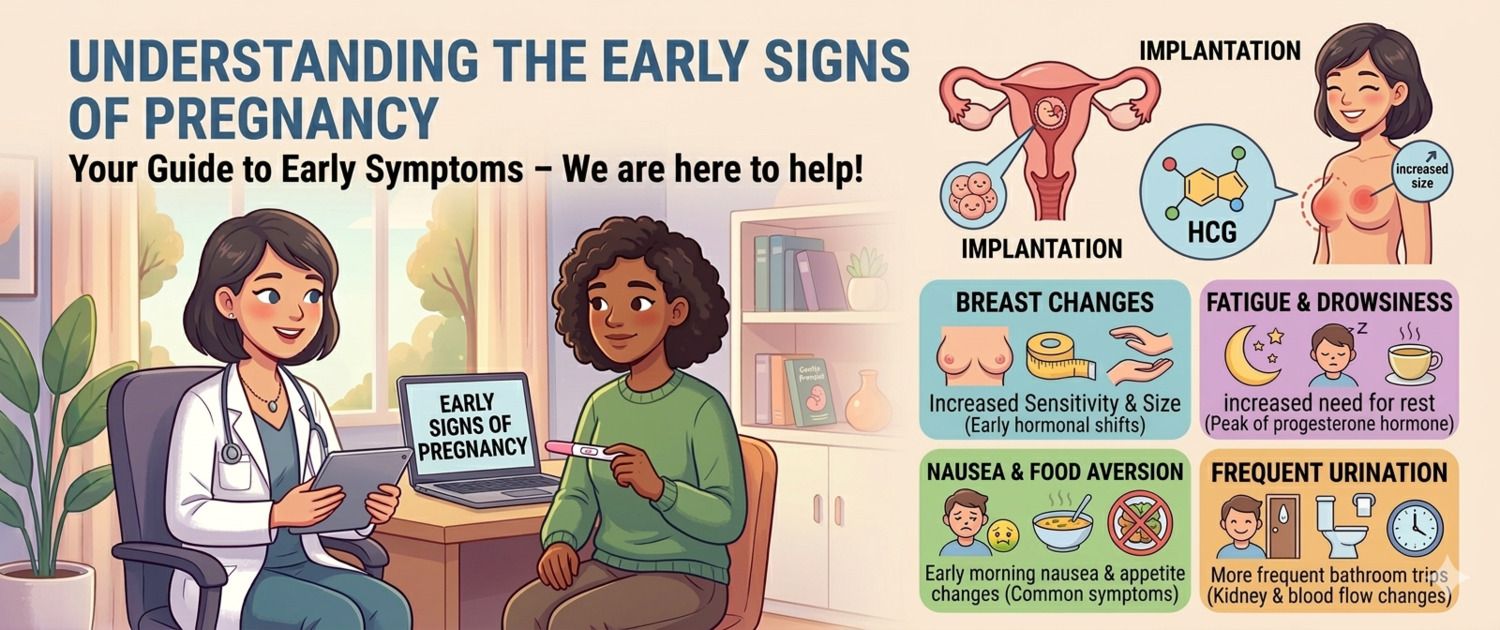
Many women notice changes in how they feel before a home test shows two lines. This is not a coincidence: hormonal changes begin immediately after fertilisation, and hCG — the hormone pregnancy tests detect — starts rising before a missed period. Let's look at which symptoms appear first, how to correctly interpret a test, and what to do immediately after confirming pregnancy.
What Happens in the First Days After Fertilisation
After fertilisation, the egg travels through the fallopian tube for 6–12 days before implanting in the endometrium. From the moment of implantation, trophoblast cells (the future placenta) begin producing human chorionic gonadotropin (hCG). This hormone maintains the corpus luteum, which continues producing progesterone and estradiol — preventing the endometrium from shedding.
hCG is detectable in blood as early as 8–10 days after ovulation — roughly 4–5 days before the expected period. Urinary hCG concentration rises slightly more slowly. This is why a home test may be negative 2–3 days before a missed period — and positive on the day of the missed period or shortly after.
First Pregnancy Symptoms: When They Appear
Pregnancy symptoms are highly individual: some women notice changes as early as 1–2 weeks after conception; others only after a missed period. Most early signs are non-specific and overlap with premenstrual syndrome — which makes them difficult to distinguish before a test.
1–2 weeks after conception (weeks 3–4 gestational age)
Implantation bleeding — light spotting, pink or brownish, appearing 6–12 days after fertilisation. Lasts 1–2 days, much lighter than a period. Many women mistake it for the start of their period and are surprised when their period "doesn't come." Key difference from threatened miscarriage: implantation bleeding occurs before the missed period, is scant, and is painless with no progression.
Breast tenderness — one of the earliest changes. The breasts become sensitive and heavy, nipples painful. Caused by rapid rises in progesterone and estradiol. Similar to PMS but more pronounced and does not resolve with the start of a period.
Mild fatigue — increasing tiredness, drowsiness even after a full night's sleep. Progesterone has a sedative effect on the central nervous system.
Basal body temperature stays elevated — for women charting BBT: temperature remains above 37°C after ovulation and does not fall before the expected period.
3–4 weeks after conception (weeks 5–6 gestational age)
Nausea — occurs in 70–80% of pregnant women, typically from weeks 4–6. Despite the name "morning sickness," it can strike at any time of day. The mechanism involves rapidly rising hCG and estrogens acting on chemoreceptors in the vomiting centre. It peaks around weeks 8–10 and resolves for most women by the end of the first trimester.
Changes in smell and taste — heightened sensitivity to odours, aversion to previously liked foods or smells (often coffee, meat, cigarette smoke), unusual food cravings. Caused by rising estrogen levels.
Frequent urination — increasing blood volume and rising hCG stimulate the kidneys to work harder. The growing uterus also presses on the bladder — more relevant at later stages, but begins early in some women.
Bloating and constipation — progesterone relaxes smooth muscle throughout the gut, slowing peristalsis.
Mood swings — rapid hormonal fluctuations affect serotonin and dopamine synthesis.
How a Pregnancy Test Works
Home pregnancy tests detect hCG in urine. Most tests have a sensitivity of 20–25 mIU/mL. Urinary hCG reaches this threshold roughly on the day of the missed period or 1–2 days later.
When to test:
- The most reliable time is the first day of a missed period or later
- Morning urine is preferred — hCG concentration is at its peak
- "Early" tests with 10 mIU/mL sensitivity can be used 4–5 days before the expected period, but the false-negative rate is higher
- A negative test with a 1–2-day delay — repeat in 2–3 days
Why a test can be wrong:
- Testing too early (hCG has not yet reached the threshold)
- Diluted urine (heavy fluid intake beforehand)
- Rarely: biochemical pregnancy (fertilisation occurred but implantation did not complete — hCG briefly rises then falls)
Blood hCG: Quantitative Testing
A laboratory blood test for β-hCG is more sensitive than a home test — it detects hCG from 2–5 mIU/mL. This allows pregnancy confirmation 7–10 days after conception — earlier than any home test.
Normal hCG dynamics in pregnancy:
| Gestational age | hCG (mIU/mL) |
|---|---|
| Weeks 3–4 | 16–156 |
| Weeks 4–5 | 101–4870 |
| Weeks 5–6 | 1110–31500 |
| Weeks 6–7 | 11500–289000 |
| Peak (weeks 8–12) | 25700–288000 |
The doubling rule: in a normal pregnancy, hCG doubles every 48–72 hours in the first 8–10 weeks. The trend matters far more than the absolute value: hCG 500 mIU/mL alone tells you nothing — what matters is whether it doubled 48 hours later. Failure to double may indicate a missed miscarriage or ectopic pregnancy.
Ectopic pregnancy: hCG rises but more slowly than normal, often combined with abdominal pain and spotting. Requires urgent evaluation.
Blood Tests to Take After Confirming Pregnancy
First visit to an obstetrician-gynaecologist — ideally before weeks 8–10. For the full list, see what tests are done in pregnancy. Standard first-trimester screening includes:
Complete blood count — assessing haemoglobin and ruling out anaemia. For pregnancy-specific norms, see the CBC in pregnancy article.
Ferritin — iron store assessment. Ferritin falls before haemoglobin — early correction is critical, especially if breastfeeding is planned.
TSH — thyroid function. Untreated hypothyroidism during pregnancy poses serious risks to fetal brain development. First-trimester target: below 2.5 mIU/L.
Fasting glucose — screening for pre-existing diabetes. Gestational diabetes is diagnosed later (weeks 24–28), but the baseline glucose level is important for risk stratification.
Vitamin D — deficiency is common and affects fetal bone formation, immunity, and preeclampsia risk.
Folic acid — ideally started before conception; essential throughout the first trimester. Reduces neural tube defect risk. Standard dose: 400–800 µg/day; high-risk patients: 4 mg/day as prescribed.
When to Seek Urgent Medical Attention
Immediately: heavy bleeding (heavier than a period) at any stage; sudden severe abdominal or shoulder pain — possible ectopic pregnancy; hCG rising but not doubling on repeat testing with pain or spotting.
Within a few days: positive test with more than 5–7 days of missed period — register with an obstetric provider; positive test with unusually severe symptoms (inability to eat or drink from vomiting — hyperemesis gravidarum).
Summary
The first signs of pregnancy — fatigue, breast tenderness, nausea, and implantation bleeding — can appear before a missed period. A home test is most reliable on the first day of a missed period or later. Laboratory β-hCG is more sensitive and earlier: what matters is not the absolute value but the doubling trend. After confirming pregnancy, the key tests — ferritin, TSH, glucose, and vitamin D — allow deficiencies to be corrected at the most critical time.
This article is for informational purposes only. If pregnancy is suspected or any concerning symptoms arise, consultation with an obstetrician-gynaecologist is essential.
For informational purposes only
This article is for informational purposes only and does not constitute medical advice, diagnosis, or treatment. Please consult a healthcare professional for medical guidance.