hCG Blood Test: Normal Levels in Pregnancy by Week
Reviewed by the LabReadAI medical team
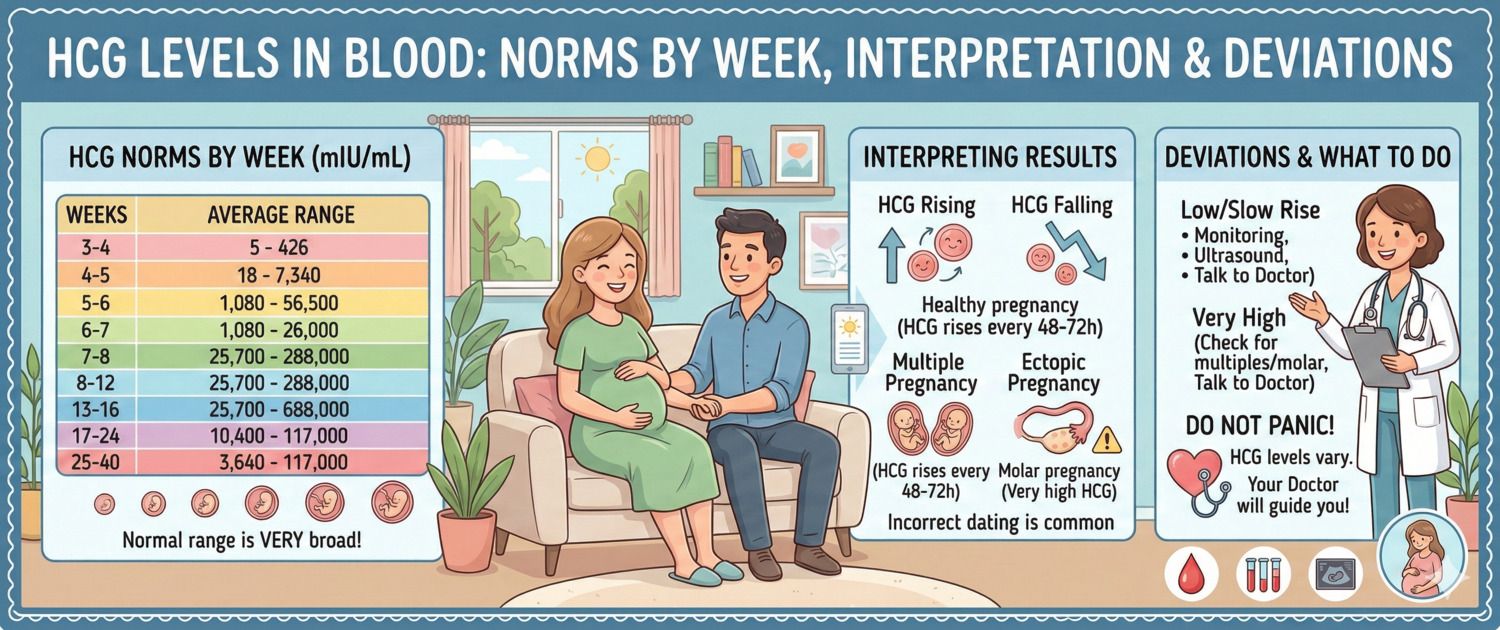
Two lines on a pregnancy test are caused by hCG — the hormone that strip tests detect in urine and that blood tests measure earlier, more precisely and more reliably than any home test. But hCG is not exclusively a pregnancy marker: in non-pregnant women and men, a detectable level can signal a malignant process. This article covers normal hCG ranges by week of pregnancy, what high and low results mean, and when a result requires urgent evaluation.
What Is hCG and Why Is It Measured?
hCG stands for human chorionic gonadotropin. It is a glycoprotein hormone produced by trophoblast cells — the outer layer of the fertilised egg — from the moment it implants in the uterine wall. hCG signals the corpus luteum to continue producing progesterone, sustaining the pregnancy until the placenta is fully formed.
The hCG molecule has two subunits — α and β. The alpha subunit is structurally identical to that of TSH, FSH and LH, which is why clinical testing specifically measures β-hCG: it is unique to chorionic gonadotropin and produces no cross-reactions with other hormones.
hCG is measured to confirm pregnancy and monitor its progression; diagnose ectopic pregnancy; verify complete resolution after miscarriage or termination; screen for fetal chromosomal abnormalities in the first trimester; and detect certain tumours in non-pregnant individuals.
hCG Normal Ranges in Pregnancy by Week
hCG levels rise rapidly from the first days after conception, doubling every 48–72 hours throughout the first trimester — the fastest hormone surge in the human body.
| Gestational age | Normal β-hCG (mIU/mL) |
|---|---|
| 1–2 weeks (from conception) | 25–300 |
| 3–4 weeks | 1,500–5,000 |
| 5–6 weeks | 10,000–50,000 |
| 7–8 weeks | 50,000–200,000 |
| 9–12 weeks | 20,000–100,000 |
| 13–16 weeks | 6,000–30,000 |
| 17–24 weeks | 4,000–10,000 |
| 25–40 weeks | 3,000–15,000 |
After peaking at weeks 7–11, hCG levels naturally fall — this is physiological, not a warning sign. Reference ranges are deliberately wide: a ten-fold difference between the lower and upper limits at the same gestational age is entirely normal. This is why a single hCG value is far less informative than the trend across two or three serial measurements.
The doubling rule: in a healthy pregnancy, β-hCG doubles every 48–72 hours until week 10. A rise of less than 66% over 48 hours is a warning sign requiring obstetric review.
hCG in Non-Pregnant Women and Men: Reference Values
Outside of pregnancy, hCG should be undetectable or at the very lowest end of the assay's sensitivity.
| Group | Normal (mIU/mL) |
|---|---|
| Non-pregnant women | < 5 |
| Postmenopausal women | < 10 |
| Men | < 2.5 |
A mild transient rise in non-pregnant women is expected in the days immediately following pregnancy loss — hCG clears gradually and fully normalises within four to six weeks. Any persistent elevation in men or non-pregnant women requires oncological investigation without delay.
How to Prepare for an hCG Blood Test
Blood for β-hCG is drawn from a vein, ideally fasting or four hours after a light meal. The test is informative as early as 8–10 days after conception — three to five days before a urine home test can turn positive.
For serial monitoring, it is essential to use the same laboratory each time: different assay methods produce different absolute values, and comparing results across laboratories can be misleading. If you are receiving hCG injections as part of an IVF protocol, inform your doctor — these will artificially elevate the result.
A full overview of recommended blood tests during pregnancy, including hCG, is available in the pregnancy panel section.
Causes of High hCG
A physiological rise in pregnant women needs no explanation. Pathological elevation in other contexts is a different matter.
Multiple pregnancy. In a twin pregnancy, hCG is approximately twice the singleton norm for the same gestational age — proportional to the number of embryos.
Chromosomal abnormalities. Trisomy 21 (Down syndrome) is associated with hCG levels 1.5 to 2 times the normal range in the first trimester. This is why β-hCG is a core component of first-trimester combined screening alongside PAPP-A.
Hydatidiform mole. Abnormal trophoblast proliferation without a viable embryo produces hCG three to ten times higher than the expected range for the assumed gestational age.
Malignancy. In non-pregnant women and men, elevated hCG may indicate germ cell tumours of the testis or ovary, choriocarcinoma or other malignancies. In oncology, hCG serves as one of several tumour markers — its role in cancer diagnostics is described in detail in the tumour markers panel section.
Causes of Low hCG in Pregnancy
hCG below the lower limit for gestational age, or insufficient rise on serial testing, is a clinically significant finding.
Threatened or missed miscarriage. When the embryo stops developing, hCG stops rising and begins to fall. This is often the first laboratory signal of a missed miscarriage, appearing before any changes become visible on ultrasound.
Ectopic pregnancy. When implantation occurs outside the uterus, the trophoblast develops abnormally and hCG rises more slowly than expected. The combination of rising-but-not-doubling hCG plus an empty uterine cavity on ultrasound at 5–6 weeks constitutes a presumptive ectopic pregnancy until proven otherwise.
Early pregnancy complications. When early signs of pregnancy coincide with cramping or spotting, the trajectory of serial hCG measurements becomes the primary prognostic tool alongside ultrasound.
hCG as a Tumour Marker: When Men Are Tested
In men, hCG is normally undetectable. Its presence is an absolute indication for oncological workup, primarily for germ cell tumours of the testis — the most common malignancy in men aged 15–35. hCG together with AFP (alpha-fetoprotein) is used for diagnosis, staging and treatment monitoring of testicular cancer.
In postmenopausal women, hCG above 10 mIU/mL without an obvious cause also requires oncological exclusion — principally choriocarcinoma and ovarian tumours.
When an hCG Result Requires Urgent Attention
Situations that cannot wait for a scheduled appointment:
- hCG is not doubling within 48–72 hours in the first trimester, especially with pelvic pain or bleeding;
- hCG is falling in a confirmed ongoing pregnancy;
- hCG is positive but no gestational sac is visible on ultrasound at 5–6 weeks;
- hCG is detectable in a man or non-pregnant woman — even at a low level;
- hCG has not normalised within 6–8 weeks after miscarriage or delivery.
Alongside hCG, pregnancy monitoring routinely includes TSH assessment and, when gestational diabetes risk is present, a glycated haemoglobin test.
For informational purposes only
This article is for informational purposes only and does not constitute medical advice, diagnosis, or treatment. Please consult a healthcare professional for medical guidance.