Folate (Folic Acid): Normal Levels, Deficiency and Test Interpretation
Reviewed by the LabReadAI medical team
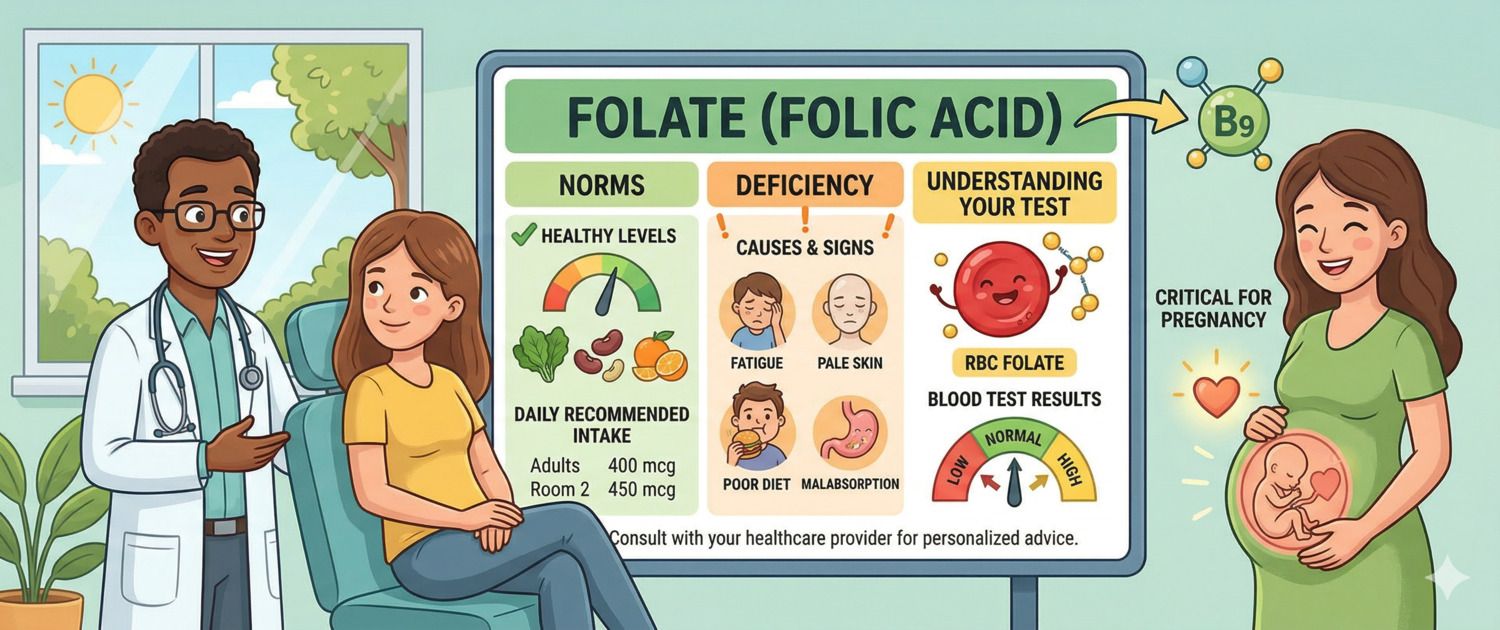
Folic acid is strongly associated with pregnancy — and rightly so, but that association captures only part of the picture. Folate is needed by every dividing cell: bone marrow, mucosal lining, immune cells. Its deficiency produces the same blood count picture as vitamin B12 deficiency — enlarged immature red cells and falling haemoglobin. This is precisely why these two markers are always measured together: an identical haematological pattern, but fundamentally different mechanisms and consequences. Here is what folate does, when it becomes deficient and how to identify it.
What Is Folate and Why Is It Needed
Folate is the collective name for a group of water-soluble B9 vitamins. In food it exists as folates (polyglutamate forms); in supplements and fortified foods as folic acid (a synthetic monoglutamate form with higher bioavailability). The body cannot synthesise folate — it comes exclusively from diet or supplementation.
Inside the cell, folate performs two key biochemical roles.
The first is nucleotide and DNA synthesis. Active folate (tetrahydrofolate) participates in producing purines and thymidine — the building blocks of DNA. Without adequate folate, cells cannot divide normally: DNA is synthesised with errors, cells grow large but cannot complete mitosis. This is what produces megaloblastic anaemia with enlarged immature red cells — an elevated MCV on the complete blood count.
The second is homocysteine metabolism. Folate (together with vitamins B12 and B6) participates in remethylating homocysteine to methionine. Homocysteine is a toxic intermediate of amino acid metabolism. Its excess damages the vascular endothelium, raises the risk of thrombosis and atherosclerosis, and during pregnancy increases the risk of neural tube defects. Folate deficiency → rising homocysteine → vascular and neurological consequences.
The critical distinction from vitamin B12: folate does not participate in myelin synthesis. Therefore, folate deficiency causes anaemia but does not cause neuropathy or spinal cord damage — that is the exclusive domain of B12 deficiency.
Normal Folate Levels in Blood
Folate can be measured in two ways, each carrying distinct information.
Serum folate reflects current dietary intake over the preceding few days. It responds quickly to dietary changes: a week without green vegetables and serum folate falls, even if cellular stores are still adequate.
Red cell folate reflects intracellular stores accumulated over the past 2–3 months (the lifespan of a red blood cell). It is a far more stable and clinically meaningful marker: it does not respond to short-term dietary variation and reflects true tissue folate status.
| Measure | Normal range |
|---|---|
| Serum folate | 7–45 nmol/L (3.1–20 ng/mL) |
| Red cell folate | 370–1470 nmol/L (163–649 ng/mL) |
| Deficiency (serum) | < 7 nmol/L |
| Borderline (serum) | 7–10 nmol/L |
Reference ranges at your specific laboratory may differ. Always use the values printed on your own lab report.
Two practical conclusions from this distinction:
When the goal is to assess actual folate status — red cell folate is preferred, or both measures together. A normal serum folate with low red cell folate indicates that dietary intake has recently improved, but cellular stores have not yet recovered.
For standard biochemical screening — serum folate is sufficient. Frank deficiency (< 7 nmol/L) is captured well by both methods.
How to Prepare for a Folate Blood Test
Fasting. Blood should be drawn fasting — 8–12 hours. This is especially important for serum folate: eating foods rich in green vegetables or fortified products transiently raises the serum level.
Folic acid supplements. If the patient is taking folate or multivitamin supplements, the serum folate result will reflect their intake rather than true tissue status. Ideally, stop supplements 2 weeks before the test for diagnostic (not monitoring) purposes. If the goal is to monitor therapy response, continue as usual.
Alcohol. Avoid for 24–48 hours. Alcohol impairs folate absorption in the small intestine and accelerates its urinary excretion.
Test with B12 simultaneously. Both markers are drawn in a single blood sample. Differential diagnosis of megaloblastic anaemia is impossible without knowing both values.
Light and temperature. Folate is light-sensitive — samples must be protected from direct sunlight during transport. Quality laboratories observe this protocol as standard.
Folate Deficiency: Causes
Folate deficiency develops faster than B12 deficiency: body stores are relatively small (5–20 mg, mainly in the liver) and are depleted within 3–4 months of zero intake.
| Cause | Mechanism | Who is at risk |
|---|---|---|
| Inadequate dietary intake | Primary cause; folate is found in dark leafy vegetables, legumes, liver, eggs. When the diet is completely devoid of fresh vegetables and fruit, vitamin C is simultaneously depleted — in such cases scurvy may develop as a co-occurring feature of combined nutritional deficiency | Unbalanced diet, elderly, socioeconomically deprived |
| Pregnancy and lactation | Demand rises sharply (to 600 µg/day vs 400 µg for non-pregnant) | All pregnant women without supplements |
| Alcohol use disorder | Impaired absorption + poor diet + accelerated urinary loss | Chronic alcohol overuse |
| Coeliac disease and Crohn's disease | Small intestinal mucosal atrophy → impaired absorption | IBD and coeliac disease |
| Methotrexate use | Direct dihydrofolate reductase antagonist — blocks folate activation | Oncology patients, rheumatoid arthritis |
| Sulfasalazine, trimethoprim | Partial inhibition of folate metabolism | Patients on these drugs |
| Haemodialysis | Folate lost across the dialysis membrane | End-stage renal failure |
| Haemolytic anaemia | Accelerated red cell turnover requires more folate | Sickle cell disease, thalassaemia |
Symptoms of folate deficiency. Unlike B12 deficiency, the clinical picture of folate deficiency is almost entirely haematological. There are no neurological deficits — this is the defining differential feature.
- Weakness, rapid fatigue, dyspnoea on exertion — from anaemia
- Pallor, sometimes with a faint yellow tinge — from destruction of defective red cells
- Inflamed tongue (glossitis) — present but less common than in B12 deficiency
- Gastrointestinal symptoms: diarrhoea, reduced appetite
- In pregnancy: neural tube defects (anencephaly, spina bifida) when deficiency occurs in the periconceptional period — which is why supplements are prescribed 1–3 months before planned conception
High Folate: When It Is Elevated
Folate above the reference range is far less clinically significant than deficiency. However, a few situations deserve attention.
Supplement use and fortified foods — the most common cause of high serum folate. Not pathological as such, but very high folate (> 45 nmol/L) with simultaneously low or normal B12 creates a diagnostic problem: excess folate can "mask" the haematological signs of B12 deficiency, allowing anaemia to remain absent while neurological damage from B12 deficiency progresses. This is not theoretical — cases of severe neuropathy have been described in patients with normal blood counts who were taking high-dose folic acid.
Pernicious anaemia. Paradoxically, in severe B12 deficiency (especially pernicious anaemia) serum folate can be elevated: impaired cellular folate uptake due to dysfunction of the "methyl trap" mechanism causes folate to accumulate in the blood rather than entering cells.
Vegetarian and vegan diets — abundant green vegetables, legumes and fortified foods physiologically raise folate; not pathological.
Folate and Vitamin B12: Distinguishing the Two Deficiencies
This is a practically critical question, since both deficiencies produce an identical haematological picture — megaloblastic anaemia with elevated MCV. The distinction is vital because treatment is fundamentally different.
| Feature | Folate deficiency | Vitamin B12 deficiency |
|---|---|---|
| Macrocytosis (↑ MCV) | Yes | Yes |
| Low haemoglobin | Yes | Yes |
| Neuropathy, ataxia | No | Yes — the distinguishing feature |
| Serum folate | ↓ | Normal or mildly reduced |
| Serum B12 | Normal or secondarily reduced | ↓ |
| Red cell folate | ↓ | ↓ (secondary — methyl trap) |
| Homocysteine | ↑ | ↑ |
| Methylmalonic acid | Normal | ↑ (specific for B12) |
The key differentiating tests are methylmalonic acid (elevated only in B12 deficiency) and the patient's neurological status. Red cell folate in B12 deficiency is often secondarily reduced — this does not indicate a primary folate deficiency.
The critical clinical rule: treating an unrecognised B12 deficiency with folic acid alone is dangerous. The anaemia will improve, but neurological damage will continue to progress. Full detail in the B12-deficiency anaemia article.
Full anaemia work-up is performed with a complete blood count that includes haemoglobin and MCV.
When to See a Doctor
- Pregnancy planning — begin folic acid supplementation 1–3 months before conception, without waiting to confirm pregnancy. Neural tube defects form at weeks 3–4 after fertilisation — when most women are not yet aware they are pregnant
- Megaloblastic anaemia (MCV > 100 fL, reduced haemoglobin) — mandatory simultaneous measurement of folate and B12 to select the correct treatment
- Methotrexate or sulfasalazine use — routine folate monitoring; prophylactic supplementation is typically co-prescribed with these drugs
- Chronic inflammatory bowel disease — malabsorption risk; regular folate and B12 monitoring is mandatory
- Alcohol use disorder — routine nutritional status screening
- Elderly patients with anaemia and neurological symptoms — simultaneous assessment of folate, B12 and homocysteine
Folate is one of the few nutrients whose deficiency is preventable by straightforward measures: a varied diet rich in green vegetables and legumes meets the daily requirement of most adults without supplements. The exception is pregnancy and lactation, where demand rises sharply enough that targeted supplementation cannot be avoided.
This article is for informational purposes only. Interpretation of test results and diagnosis are the responsibility of a qualified physician.
For informational purposes only
This article is for informational purposes only and does not constitute medical advice, diagnosis, or treatment. Please consult a healthcare professional for medical guidance.