Scurvy: Vitamin C Deficiency Symptoms, Diagnosis and Treatment
Reviewed by the LabReadAI medical team
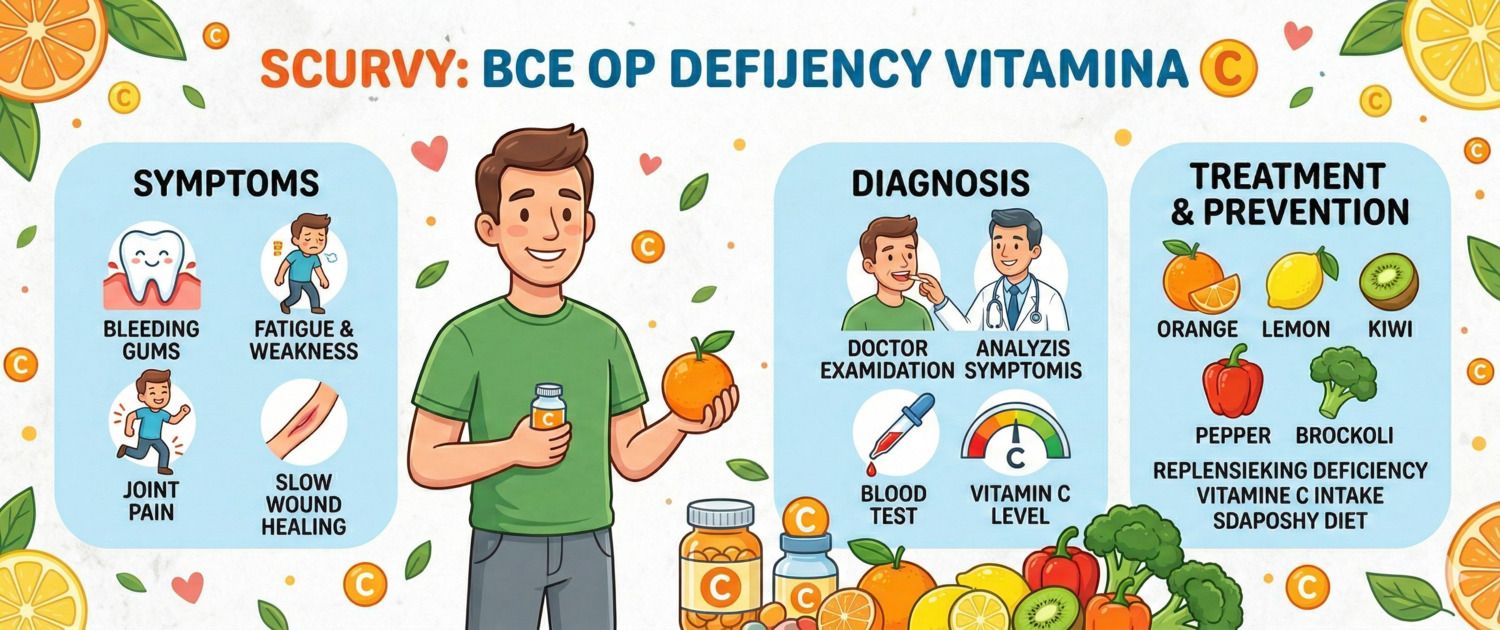
Bleeding gums, bruises from the lightest touch and fatigue that does not lift for weeks — in the twenty-first century this does not look like the disease described in sixteenth-century maritime logs. Yet scurvy has not disappeared: it is identified in care homes, in people with eating disorders, in patients on highly restrictive diets and in anyone who goes months without fresh fruit or vegetables.
What Scurvy Is and How Vitamin C Deficiency Causes It
Scurvy is the clinical manifestation of severe vitamin C (ascorbic acid) depletion. It develops when ascorbic acid reserves are so exhausted that collagen synthesis is impaired — collagen being the structural protein that maintains the integrity of blood vessels, skin, gums and bone.
The mechanism is straightforward: vitamin C is an indispensable cofactor for prolyl and lysyl hydroxylase enzymes, which hydroxylate proline and lysine residues during collagen assembly. Without hydroxylation, the collagen triple helix cannot stabilise — defective molecules form instead of strong fibres. Collagen-dependent structures throughout the body begin to break down faster than they can be rebuilt.
The human body cannot synthesise vitamin C: the GULO gene encoding the final enzyme of ascorbate synthesis from glucose is non-functional. Food is therefore the only source. When dietary supply stops entirely, clinical symptoms appear within 4–6 weeks; a full clinical picture develops within 1–3 months.
Historically, scurvy devastated armies and naval expeditions. James Lind's 1747 observation that citrus fruit prevents the disease was one of the first controlled clinical trials in the history of medicine. Today scurvy persists — its portrait has simply changed.
Causes of Scurvy in Adults and Risk Groups
In the modern world, scurvy is a disease of specific social and medical vulnerabilities. Recognising risk groups enables diagnosis where it is least expected.
Older adults — the most important risk group in high-income countries. Narrowing dietary variety (subsistence on tinned food and convenience meals), reduced cooking activity, social isolation and impaired intestinal absorption gradually deplete vitamin C stores. Studies in residential care homes find suboptimal levels in 10–30% of residents.
People with eating disorders: anorexia nervosa, avoidant/restrictive food intake disorder (ARFID), severe orthorexia. Strict self-imposed food restriction in these conditions frequently excludes fresh fruit and vegetables.
Alcohol use disorder: ethanol impairs vitamin C intestinal absorption, accelerates metabolic degradation and displaces adequate nutrition. Chronic alcoholism is one of the leading causes of scurvy in middle-aged men.
Smoking: nicotine and tobacco smoke oxidants sharply accelerate ascorbic acid turnover — plasma vitamin C in smokers is on average 30–40% lower than in non-smokers at equivalent dietary intake. The recommended daily allowance for smokers is 35 mg/day higher, a requirement that is frequently unmet.
Haemodialysis: ascorbic acid is water-soluble and is actively removed during each dialysis session — patients require regular supplementation.
Highly restrictive elimination diets: elimination of all fresh plant foods (carnivore-only diets without supplementation), monotonous diets excluding fruit and vegetables for more than 4–6 weeks.
Inflammatory bowel disease: impaired micronutrient absorption from inflamed mucosa — coeliac disease, Crohn's disease.
Infants on inadequate feeds: historically important, now rare — prolonged exclusive feeding with boiled milk without fresh food introduction.
Symptoms of Scurvy by Stage
Scurvy develops in stages. Understanding this progression allows the diagnosis to be suspected long before the classic clinical picture is established.
Early stage (4–8 weeks of deficiency, plasma vitamin C < 11 µmol/L):
- Non-specific fatigue and irritability — the first symptoms, typically attributed to overwork or stress by the patient themselves
- Reduced appetite
- Joint and muscle pain — particularly in the lower limbs, worsening with physical activity
- Early hyperkeratosis — hair follicles become more prominent; skin coarsens
Established stage (8–12 weeks, plasma vitamin C < 6 µmol/L):
- Perifollicular haemorrhages — pin-point bleeds around hair roots, most prominent on the shins, thighs and buttocks. One of the most specific early signs: ascorbic acid is required to maintain capillary wall integrity
- Corkscrew hairs — a keratinisation defect causes new hairs to grow coiled, breaking at the base
- Gum bleeding and hyperplasia — swollen, spongy, easily bleeding gums. The interdental papillae are classically affected first. Teeth begin to loosen
- Large skin bruises — at points of minor trauma and spontaneously: defective collagen fails to support vessel walls
- Delayed wound healing and breakdown of previously healed scars
- Progressive weakness — the patient struggles to rise from bed
Severe stage (> 3 months without vitamin C):
- Tooth loss — progressive destruction of the periodontal ligament
- Widespread haemorrhage — haemarthroses, intramuscular haematomas, haematuria, gastrointestinal bleeding
- Generalised oedema — from increased vascular permeability
- Seizures, loss of consciousness — from massive blood loss
- Death — from cardiac failure caused by pericardial haemorrhage or direct cardiac vascular involvement. This is the stage that killed sailors on long voyages
A diagnostic pitfall: in older or edentulous patients, the classic gum changes may be absent — substantially complicating recognition of the disease.
Diagnosis: Blood Tests and Clinical Features
Scurvy is diagnosed on clinical and laboratory grounds. A typical presentation combined with a characteristic dietary history (fruit- and vegetable-poor diet, membership of a risk group) supports diagnosis and treatment initiation even before blood results return.
Plasma vitamin C — the primary laboratory test. A level below 11 µmol/L confirms deficiency; below 6 µmol/L places the patient in the scurvy risk zone. Preanalytical handling is critical: ascorbic acid is light-sensitive and the tube must be shielded from ultraviolet exposure immediately after collection.
Complete blood count — normochromic or hypochromic anaemia: scurvy impairs both iron absorption (vitamin C is required for Fe³⁺ → Fe²⁺ reduction) and causes ongoing blood loss that depletes stores.
Blood biochemistry — elevated LDH with extensive muscle haemorrhage and tissue breakdown. Plasma calcium and phosphorus remain normal in isolated scurvy — distinguishing it from rickets, with which it can occasionally be confused in children.
Radiography in children with scurvy shows characteristic changes: the Trümmerfeld zone (dense metaphyseal line), Pelkan's spurs and periosteal haematomas. Bony radiological changes are not typical in adults.
Differential diagnosis: thrombocytopaenic purpura (platelets are normal in scurvy), vasculitis (CRP and ESR elevated; autoantibodies present), haemophilia (coagulation cascade is abnormal; coagulation screen is normal in scurvy), megaloblastic anaemia (when vitamin B12 or folate deficiency coexists).
Treatment of Scurvy
Treatment is simple, available and rapidly effective — when the diagnosis is made in time.
Ascorbic acid replacement:
- Standard adult regimen: 500–1000 mg ascorbic acid per day in 2–3 divided doses for 1–2 weeks, followed by a maintenance dose of 100–200 mg/day
- Joint and muscle pain begins to improve within 24–48 hours of starting treatment
- Gum bleeding is substantially reduced within 1–2 weeks
- Full recovery takes 2–4 weeks; petechiae, bruises and skin changes resolve progressively
- Teeth already lost do not regenerate — but those that remain and have loosened are re-secured
Dietary correction alongside supplementation:
- Immediate introduction of vitamin C-rich foods: red bell pepper (150–200 mg per 100 g), kiwi fruit (80–90 mg), citrus fruits, broccoli, strawberries
- Fresh food is preferred over cooked: heat processing destroys 40–60% of ascorbic acid
- Maintain adequate daily intake (≥ 75–90 mg) after completing the treatment course
Correction of co-existing deficiencies: scurvy frequently coexists with deficiency of vitamin D, iron, vitamin B12 and folate — particularly in older patients. After restoring vitamin C, a comprehensive nutritional assessment is appropriate.
Supportive care in severe cases: haemostatic support for significant active bleeding; joint protection and analgesia for haemarthroses until haematomas resolve; iron supplementation for severe anaemia.
Prognosis with timely treatment is excellent: the overwhelming majority of symptoms are fully reversible. Exceptions are irreversible tooth loss, vision loss from orbital haemorrhage and neurological sequelae from large compressive haematomas — all consequences of delayed diagnosis.
When to See a Doctor
Scurvy should be suspected when characteristic symptoms coincide with dietary risk factors — there is no need to wait for the full clinical picture.
See a doctor (GP, gastroenterologist or haematologist) when:
- progressive gum bleeding occurs alongside joint pain and fatigue;
- unexplained petechiae appear on the skin — particularly around hair follicles on the shins;
- wound healing is markedly delayed or a previously healed scar breaks down;
- you belong to a risk group (older age, alcohol use disorder, highly restrictive diet, haemodialysis) and have any of the above symptoms.
Do not attempt to self-treat suspected scurvy without laboratory confirmation: similar symptoms (petechiae, mucosal bleeding) are produced by thrombocytopaenia and vasculitis, which require fundamentally different management. Diagnosis must be made by a clinician.
This content is for informational purposes only and does not replace professional medical advice.
For informational purposes only
This article is for informational purposes only and does not constitute medical advice, diagnosis, or treatment. Please consult a healthcare professional for medical guidance.