LDH Blood Test: Normal Levels, High Results and Causes
Reviewed by the LabReadAI medical team
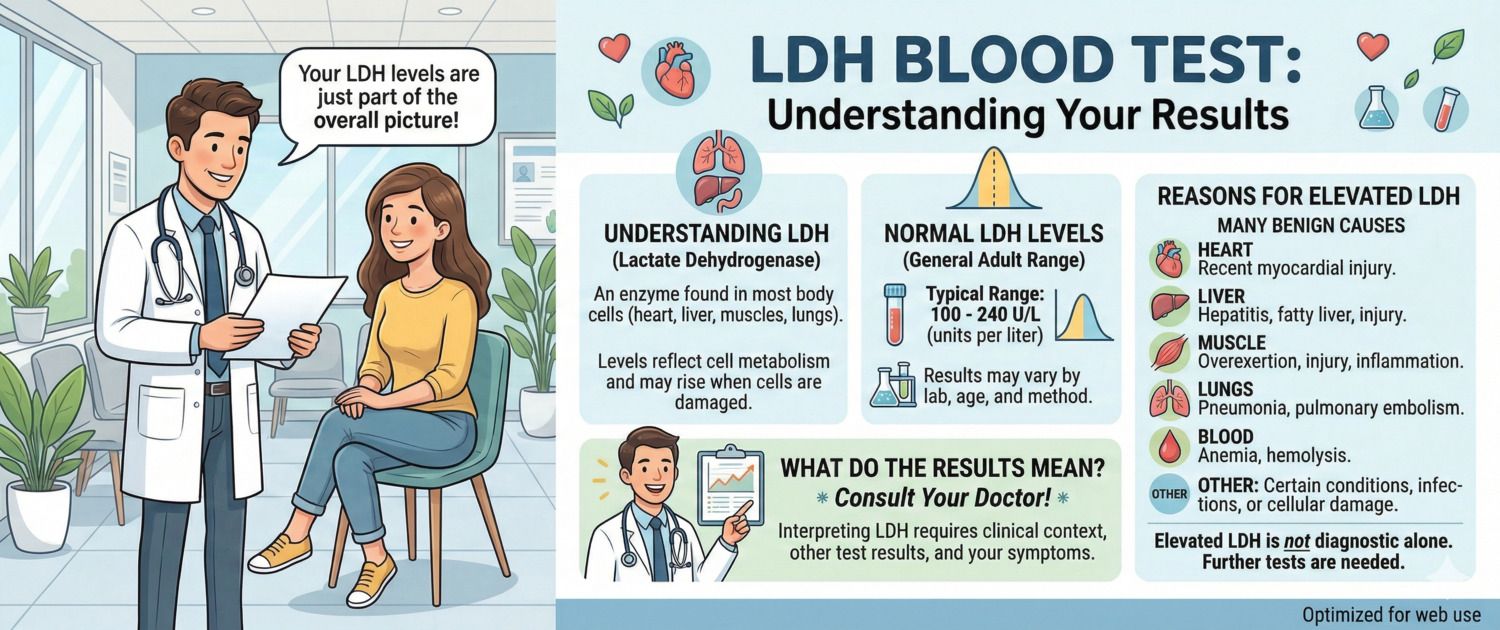
You receive your blood test results and notice that LDH is flagged above the reference range. Before worrying, it helps to understand what this enzyme actually measures — and which conditions cause it to rise. Lactate dehydrogenase (LDH) is one of the most sensitive markers of cell damage in medicine, reacting to dozens of conditions, from a bruised muscle to an acute heart attack. This guide covers normal LDH levels, what elevated results mean, and when they require urgent attention.
What Is LDH and Why Is This Cell Damage Marker Measured?
Lactate dehydrogenase is an enzyme found in virtually every cell of the body — heart, liver, skeletal muscles, kidneys, lungs and red blood cells. Its biological role is to catalyse the reversible conversion between lactate and pyruvate, helping cells produce energy when oxygen is scarce.
Think of a cell as a sealed container: while the walls are intact, LDH stays inside. The moment cells break down — through inflammation, necrosis or haemolysis — the enzyme spills into the bloodstream and blood levels rise sharply. This is why LDH is called a cell damage marker: it is not organ-specific, but it is extremely sensitive to the fact that cells are being destroyed somewhere in the body.
In clinical practice, LDH is used to assess the severity of haemolysis, monitor cancer activity, help differentiate causes of jaundice, and track treatment response in liver and muscle disease.
Normal LDH Levels in Adults, Children and Pregnancy
Reference values depend on age, sex and the assay method used. Most laboratories use a kinetic method at 37 °C.
| Group | LDH Normal Range (U/L) |
|---|---|
| Adults 18–60 years | 125–220 |
| Men over 60 years | 130–230 |
| Women over 60 years | 120–215 |
| Infants under 1 year | 170–580 |
| Children 1–14 years | 150–500 |
| Adolescents 14–18 years | 130–280 |
| Pregnant women (all trimesters) | up to 250 |
In children, LDH levels are physiologically higher than in adults because rapid tissue growth involves intense cellular turnover. In pregnancy, a moderate rise in the third trimester is expected due to placental expansion. Always compare your result with the reference range printed on your laboratory report, as intervals vary between labs.
LDH Isoenzymes: What They Reveal About Specific Organs
LDH exists in five molecular forms called isoenzymes (LDH-1 through LDH-5). Each predominates in different tissues, and their ratio helps pinpoint the source of damage.
| Isoenzyme | Main Source | Clinical significance of elevation |
|---|---|---|
| LDH-1 | Heart, red blood cells | Haemolysis, acute myocardial infarction |
| LDH-2 | Heart, red blood cells | Normally the highest fraction in serum |
| LDH-3 | Lungs, lymphocytes | Lung disease, lymphomas |
| LDH-4 | Kidneys, placenta | Kidney damage |
| LDH-5 | Liver, skeletal muscle | Hepatitis, rhabdomyolysis |
In healthy serum, LDH-2 > LDH-1. In acute myocardial infarction this ratio flips — LDH-1 rises above LDH-2. Before cardiac troponin was available, this "flip pattern" was the primary laboratory criterion for heart attack. Isoenzyme analysis is ordered less frequently today, but remains useful in complex diagnostic situations.
Causes of High LDH in the Blood
Elevated LDH always signals cell destruction — the question is which cells.
Haematological causes
The most frequent cause of a dramatic LDH spike is red blood cell destruction. In haemolytic anaemia, LDH pours from millions of lysed erythrocytes, often reaching 5–10 times the upper limit of normal. In megaloblastic anaemia, immature precursor cells are destroyed in the bone marrow before they reach the bloodstream — a process called ineffective erythropoiesis — which also drives LDH sharply upward.
In multiple myeloma, LDH level reflects tumour burden and serves as a prognostic marker: the higher the LDH, the more aggressive the disease.
Cardiac causes
Historically, LDH was a cornerstone marker of myocardial infarction. It rises 12–24 hours after the onset of chest pain, peaks on days 2–4 and normalises only after 8–14 days. Today troponin is used for early diagnosis, but LDH retains value in delayed presentations — when troponin has already returned to normal.
Hepatic causes
Liver cells (hepatocytes) are rich in LDH-5. In liver cirrhosis, acute viral hepatitis and toxic liver injury, this isoenzyme rises sharply. ALT, AST and bilirubin typically rise alongside LDH, and the combination helps gauge the true extent of damage.
Other causes
Intense physical exercise causes a moderate, transient rise in muscle LDH-5 — a physiological response that resolves within 24–48 hours. Pulmonary embolism elevates the lung-derived LDH-3. Certain medications — statins, chemotherapy agents, anaesthetics — can also alter enzyme levels.
Causes of Low LDH
Genuinely low LDH is clinically significant only in rare cases. The most common explanation is analytical interference: high-dose vitamin C in the blood sample suppresses enzyme activity in the test tube, producing a falsely low result. True hereditary LDH isoenzyme deficiency is an extremely rare genetic condition. Isolated low LDH with no other abnormalities generally requires no further investigation.
How to Prepare for an LDH Blood Test
Several factors can cause falsely elevated LDH results. To ensure an accurate reading:
Fast for at least 8 hours before the test. Avoid intense exercise for 24–48 hours: muscle LDH-5 remains elevated for up to two days after strenuous training. Handle the sample gently — mechanical haemolysis from a shaken tube can multiply the LDH result two to three times; the laboratory should flag this. Tell your doctor about all medications, especially statins and cytostatic agents that alter enzyme activity.
When High LDH Requires Urgent Medical Attention
A mild LDH elevation — 1.5 to 2 times the upper limit — is often found incidentally and warrants elective follow-up. However, the following situations call for same-day evaluation:
- LDH is more than 3 times the upper limit of normal, especially combined with chest pain, jaundice or dark urine;
- LDH is rising on serial measurements (a second result 24–48 hours later is higher than the first);
- High LDH is paired with a sharp drop in haemoglobin on the complete blood count;
- LDH is climbing in a patient with a known cancer diagnosis — this may signal disease progression.
In any of these scenarios, do not wait for a scheduled appointment — seek medical evaluation the same day.
LDH Test Interpretation: Key Takeaways
LDH is not a diagnosis — it is an alarm signal. An elevated level tells you that cells are breaking down somewhere in the body, but not which organ or why. It is always interpreted in context: alongside symptoms, the clinical picture, and other laboratory results. Do not try to read LDH in isolation — show the result to your doctor, who will correlate all available data and arrange appropriate investigations. All treatment decisions must be made by a qualified medical professional.
For informational purposes only
This article is for informational purposes only and does not constitute medical advice, diagnosis, or treatment. Please consult a healthcare professional for medical guidance.