Haemolytic Anaemia: Causes, Symptoms and Treatment
Reviewed by the LabReadAI medical team
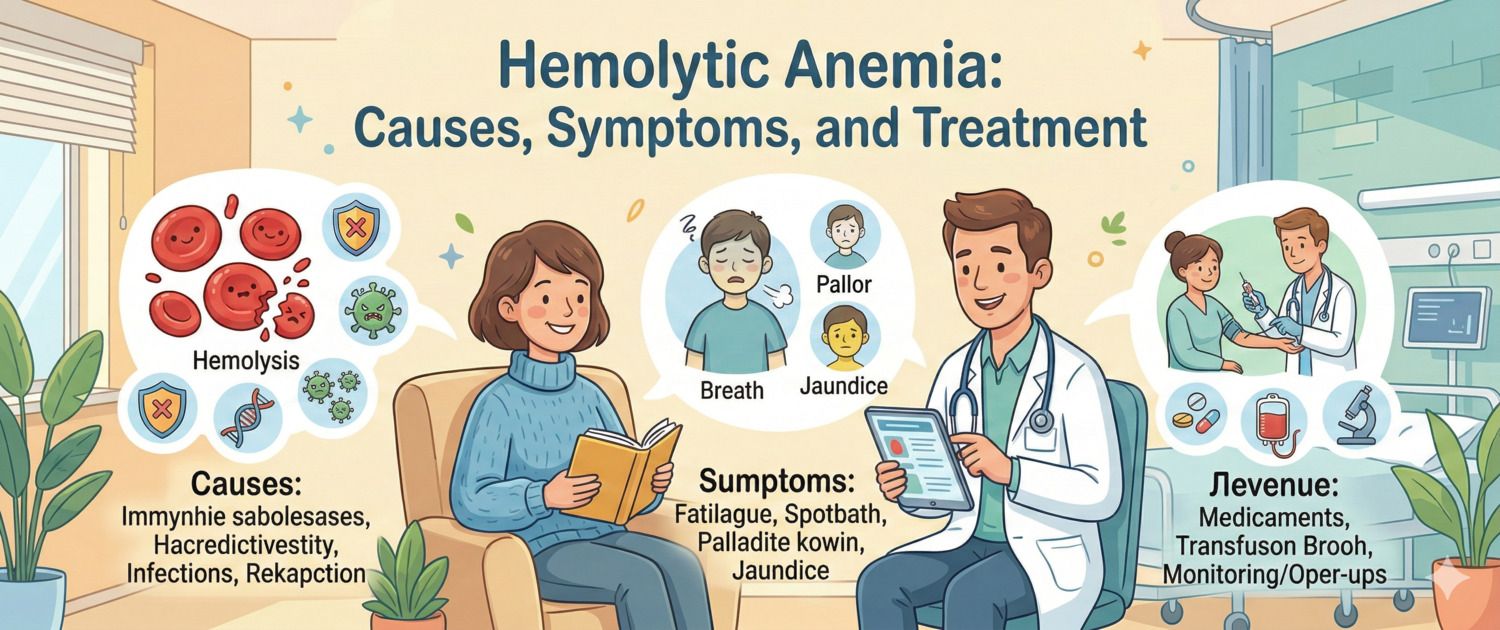
Anaemia always comes down to one of three mechanisms: too little production, too much loss, or destruction that outpaces the bone marrow. Haemolytic anaemia is the third: red blood cells are destroyed faster than the marrow can replace them. What makes this type particularly deceptive is how it can masquerade as jaundice, mimic an acute abdomen, or emerge as a complication of an entirely different disease.
What Haemolytic Anaemia Is
Haemolytic anaemia is a group of conditions united by one mechanism: the lifespan of red blood cells is significantly shortened. Normally a red cell lives 90–120 days. In haemolysis — from a few days to a few weeks. The bone marrow attempts to compensate by ramping up production — hence reticulocytosis. But when the rate of destruction exceeds the maximum capacity of erythropoiesis, anaemia results.
Haemolysis occurs in two fundamentally different settings:
- Intravascular — red cells are destroyed within the bloodstream, releasing haemoglobin into the plasma. Manifests as haemoglobinuria (dark urine) and haemoglobinaemia. Seen in severe immune conflicts, incompatible blood transfusions, and paroxysmal nocturnal haemoglobinuria.
- Extravascular — red cells are captured and destroyed in the spleen and liver. Characteristic of most autoimmune and hereditary forms. Manifests as splenomegaly and jaundice without haemoglobinuria.
Causes of Haemolytic Anaemia
Causes divide into two broad groups — inherited (a defect in the red cell itself) and acquired (an external force acting on normal red cells).
Inherited (corpuscular) haemolytic anaemias
Membrane defects:
- Hereditary spherocytosis (Minkowski-Chauffard disease) — the most common hereditary haemolytic anaemia in Europe. A defect in membrane proteins (spectrin, ankyrin) makes red cells spherical and rigid — they become trapped in the spleen and are destroyed. Autosomal dominant inheritance.
- Hereditary elliptocytosis
Enzyme defects:
- G6PD (glucose-6-phosphate dehydrogenase) deficiency — the world's most common enzyme disorder (> 400 million carriers). Silent until provoked: oxidative stress (infection, fava beans, certain drugs — primaquine, dapsone) triggers acute haemolysis.
- Pyruvate kinase deficiency
Haemoglobin defects:
- Sickle cell anaemia — a single amino acid substitution in the β-chain of haemoglobin. Upon deoxygenation, haemoglobin polymerises → red cells become sickle-shaped → vascular occlusion (pain crises, organ infarcts) + haemolysis. Prevalent in sub-Saharan Africa and the Mediterranean.
- Thalassaemias — impaired synthesis of α- or β-haemoglobin chains; severe forms require regular transfusions.
Acquired (extracorpuscular) haemolytic anaemias
Immune:
- Autoimmune haemolytic anaemia (AIHA) — autoantibodies attack the patient's own red cells. Types: warm-antibody (IgG, react at 37°C — the most common form) and cold-antibody (IgM, agglutination at low temperatures — cold agglutinin disease). Primary or secondary (lymphoma, SLE, chronic lymphocytic leukaemia).
- Haemolytic disease of the newborn — Rh conflict or ABO incompatibility
- Post-transfusion haemolysis
Microangiopathic:
- TTP (thrombotic thrombocytopenic purpura) and HUS (haemolytic uraemic syndrome) — mechanical fragmentation of red cells in thrombosed microvasculature
Infectious:
- Malaria — plasmodium replicates inside red cells and destroys them
- Babesiosis, clostridial sepsis
Drug- and toxin-induced:
- Drugs (quinine, methyldopa, high-dose penicillin)
- Toxins (snake and spider venoms, lead)
Mechanical:
- March haemoglobinuria — red cell destruction in foot capillaries during prolonged running on hard surfaces
- Damage in cardiopulmonary bypass circuits or from prosthetic heart valves
Symptoms of Haemolytic Anaemia
The clinical picture depends on the rate and severity of haemolysis.
With chronic compensated haemolysis (mild form):
- Moderate fatigue and pallor
- Scleral icterus (mild jaundice)
- Splenomegaly — the spleen enlarges as the "filter" removing destroyed cells
- Gallstone disease — pigment stones from bilirubin
During an acute haemolytic crisis:
- Sudden severe weakness and dizziness
- Marked pallor and jaundice
- Dark urine ("black water" in intravascular haemolysis)
- Abdominal and back pain — from vascular spasm and renal tubular obstruction
- Fever, tachycardia
- Potentially: acute kidney injury, shock
In sickle cell anaemia — vaso-occlusive crises: intense bone pain, chest crisis, strokes, acute chest syndrome.
Diagnosis: Blood Tests, Reticulocytes and Bilirubin in Haemolysis
The three pillars of haemolysis:
1. Reduced haemoglobin — severity ranges from mild to severe anaemia. In chronic compensated haemolysis, haemoglobin may be normal.
2. Reticulocytosis — reticulocytes elevated (> 2%), reflecting compensatory increased erythropoiesis. Reticulocytosis is the key feature distinguishing haemolytic from hypoplastic anaemia.
3. Markers of red cell destruction:
- Indirect bilirubin — elevated (haemoglobin breakdown product)
- LDH — markedly elevated (intracellular enzyme released on cell death)
- Haptoglobin — reduced or undetectable (binds free haemoglobin; depleted by massive haemolysis)
- Free plasma haemoglobin — in intravascular haemolysis
Confirmatory tests:
- Direct Coombs test (direct antiglobulin test, DAT) — detects antibodies on the red cell surface. Positive in AIHA.
- Blood film: spherocytes (hereditary spherocytosis), sickle cells, schistocytes (red cell fragments in microangiopathy)
- Osmotic fragility — reduced in spherocytosis
- G6PD assay
- Haemoglobin electrophoresis — for suspected sickle cell anaemia or thalassaemia
- Complete blood count with differential — essential in the workup
Treatment of Haemolytic Anaemia: Autoimmune, Hereditary and Beyond
Approach depends on cause and severity.
Autoimmune haemolytic anaemia:
- Glucocorticoids (prednisolone 1 mg/kg/day) — first line; effective in 70–80% of warm-antibody AIHA
- For resistance or relapse: rituximab (anti-CD20), splenectomy
- Red cell transfusion — for life-threatening severe anaemia, with awareness of cross-match difficulties
Hereditary spherocytosis:
- Mild forms: monitoring, folic acid supplementation
- Severe forms: splenectomy — eliminates haemolysis radically (though the membrane defect persists)
- Pre-splenectomy vaccination: pneumococcal, meningococcal, Haemophilus influenzae
G6PD deficiency:
- No specific treatment — avoid oxidative triggers (fava beans, implicated drugs)
- During acute crisis: fluid therapy, transfusions for severe anaemia
Sickle cell anaemia:
- Hydroxycarbamide (hydroxyurea) — reduces frequency of pain crises
- Bone marrow transplantation — the only curative option
- Gene therapy — in clinical trials with promising early results
For all forms: folic acid 1 mg/day (accelerated erythropoiesis depletes folate); caution with iron supplementation — haemolysis can cause iron accumulation, and supplementing without confirmed deficiency may worsen iron overload.
When to Seek Urgent Medical Attention
- Sudden severe weakness, pallor, dark urine — acute haemolytic crisis; call emergency services immediately
- Jaundice + reduced urine output — risk of acute kidney injury
- Chest pain or dyspnoea in sickle cell anaemia — acute chest syndrome; emergency hospitalisation
- Newly discovered anaemia with reticulocytosis and jaundice — haematology referral within days
This article is for informational purposes only and does not replace consultation with a qualified haematologist.
For informational purposes only
This article is for informational purposes only and does not constitute medical advice, diagnosis, or treatment. Please consult a healthcare professional for medical guidance.