Bilirubin in Blood: Normal Levels, Causes and Interpretation
Reviewed by the LabReadAI medical team
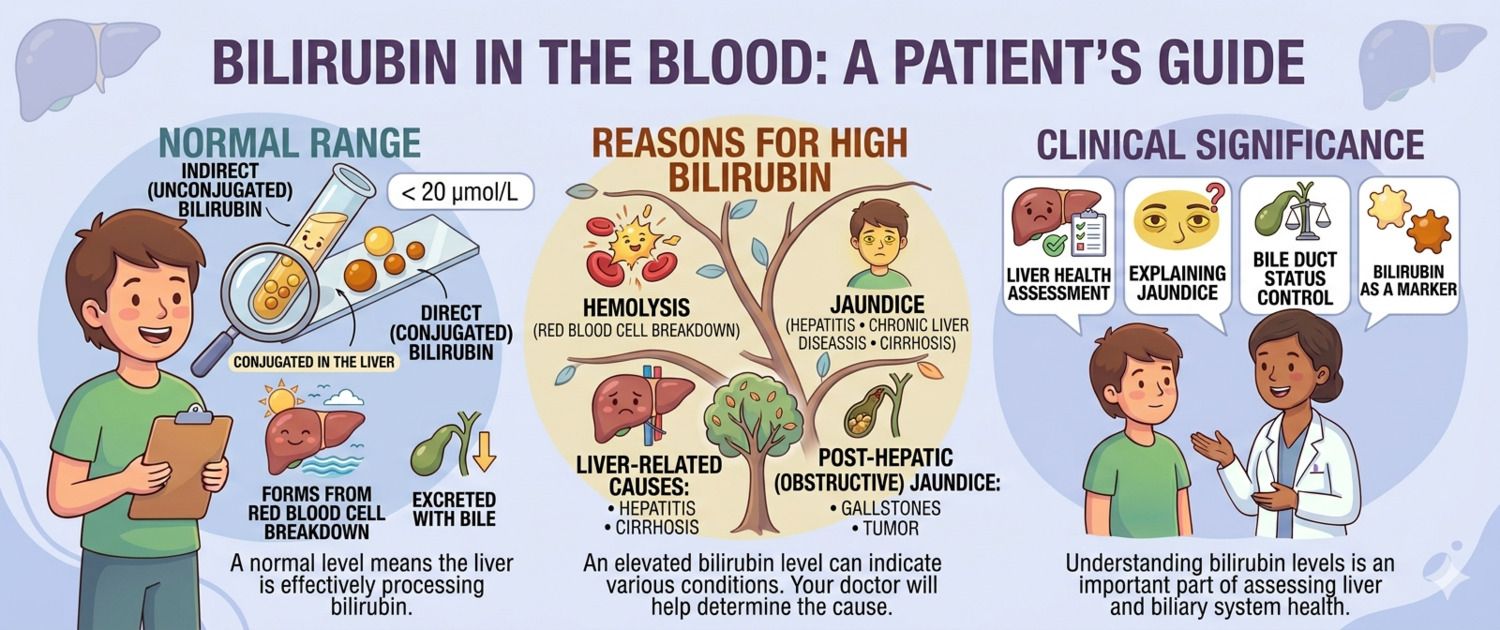
A yellowish tint to the skin or whites of the eyes is the visible expression of what is happening with bilirubin in the blood. But jaundice is just the tip of the iceberg: bilirubin abnormalities are frequently discovered well before jaundice becomes apparent — on a routine panel. Knowing which fraction is elevated — direct or indirect — and in what context immediately narrows the diagnostic search from "something is wrong with the liver" to a specific mechanism of disruption.
What Bilirubin Is and How It Forms
Bilirubin is a yellow-orange pigment, the final breakdown product of heme. Approximately 80% derives from the destruction of aging red blood cells in the reticuloendothelial system (spleen, liver, bone marrow). The remaining 20% comes from other heme-containing proteins: myoglobin, cytochromes, and catalase.
The bilirubin pathway involves several steps:
- Indirect (unconjugated) bilirubin forms from heme breakdown and enters the blood, where it binds to albumin. It is fat-soluble and toxic to nervous tissue. In this form it is transported to the liver
- Hepatic conjugation: hepatocytes take up indirect bilirubin and attach glucuronic acid using the enzyme UGT1A1. This produces direct (conjugated) bilirubin — water-soluble and non-toxic
- Biliary excretion: direct bilirubin is excreted into bile and passes into the intestine, where gut bacteria convert it to urobilinogen and stercobilin. Urobilinogen is partially reabsorbed into the blood and excreted in urine; stercobilin colors the stool
Total bilirubin = direct + indirect. The ratio of these fractions identifies the stage at which the process broke down.
Understanding this pathway explains why jaundice looks different in different diseases: in hemolysis, urine is dark but stool is normally colored; in bile duct obstruction, stool becomes pale and urine turns dark. A liver function test is always a composite view of this entire metabolic pathway.
Normal Bilirubin Levels
Reference values are largely sex-independent in adults. In newborns, thresholds are fundamentally different and reflect fetal hemoglobin physiology.
| Marker | Normal in adults | Units |
|---|---|---|
| Total bilirubin | 3.4–20.5 | µmol/L |
| Direct (conjugated) | 0–5.1 | µmol/L |
| Indirect (unconjugated) | up to 16.5 | µmol/L |
Clinically relevant thresholds for total bilirubin:
| Level (µmol/L) | Interpretation |
|---|---|
| < 20.5 | Normal |
| 20.5–34.2 | Subclinical hyperbilirubinemia — no visible jaundice |
| > 34.2 | Jaundice becomes visible (scleral icterus) |
| > 85–100 | Marked jaundice requiring active investigation |
| > 200–300 | Severe hyperbilirubinemia — high risk of complications |
In newborns, jaundice in the first days of life is physiological: neonatal bilirubin peaks on days 3–5. Norms and treatment thresholds depend on gestational age and hours of life — interpretation is strictly pediatric.
Unit conversion: mg/dL × 17.1 = µmol/L.
How to Prepare for a Bilirubin Test
Bilirubin is measured in serum and is sensitive to several pre-analytical factors.
- Strictly fasting: minimum 8–12 hours. Fatty meals activate bile flow and transiently reduce direct bilirubin
- Light protection: bilirubin is photosensitive — shield the sample from direct light immediately after collection
- Rapid delivery to the lab: at room temperature under light, bilirubin degrades by 30–50% within a few hours
- No alcohol for 24–48 hours before testing
- Disclose all medications: rifampicin, certain antibiotics, and contrast agents can produce false elevation
Bilirubin is a standard component of the liver function panel alongside ALT, AST, ALP, GGT, and albumin. Isolated interpretation without these companion markers frequently leads to incorrect conclusions.
Causes of Elevated Direct (Conjugated) Bilirubin
Direct bilirubin rises when the liver conjugates bilirubin normally but its excretion is impaired — either from the hepatocyte into bile or along the biliary tract.
| Cause | Mechanism | Characteristic features |
|---|---|---|
| Viral hepatitis (A, B, C, E) | Hepatocyte injury — impaired excretion | Elevated ALT/AST; viral markers positive |
| Alcoholic hepatitis | Toxic liver injury | AST/ALT > 2; markedly elevated GGT |
| Gallstone disease with choledocholithiasis | Mechanical bile duct obstruction | Colicky pain; elevated ALP and GGT |
| Pancreatic cancer / cholangiocarcinoma | Common bile duct compression | Painless progressive jaundice |
| Primary biliary cholangitis (PBC) | Autoimmune destruction of small bile ducts | AMA antibodies; itch; ALP predominates |
| Primary sclerosing cholangitis (PSC) | Biliary fibrosis | Association with ulcerative colitis |
| Dubin–Johnson / Rotor syndrome | Genetic defect in direct bilirubin transport | Benign; family history |
| Drug-induced hepatitis | Toxic or immune liver injury | Clear temporal link to drug initiation |
| Intrahepatic cholestasis of pregnancy | Impaired bile flow in late pregnancy | Third trimester; intense itch |
When direct bilirubin is elevated, C-reactive protein helps quantify the inflammatory component and distinguish infectious hepatitis from mechanical obstruction — in the latter, CRP is often normal or only modestly elevated.
Causes of Elevated Indirect (Unconjugated) Bilirubin
Indirect bilirubin rises when it is produced faster than the liver can process it, or when the hepatocytes' capacity for conjugation is itself reduced.
| Cause | Mechanism | Characteristic features |
|---|---|---|
| Hemolytic anemia | Accelerated red cell destruction — substrate overload | Hemoglobin low; reticulocytes ↑; haptoglobin ↓ |
| Gilbert's syndrome | Genetic reduction in UGT1A1 activity | Benign; triggered by fasting and stress |
| Crigler–Najjar disease | Complete or near-complete UGT1A1 absence | Severe neonatal jaundice |
| Neonatal jaundice (physiological) | Immature neonatal enzyme systems | Peaks days 3–5 of life |
| Massive hematoma or hemorrhage | Extravascular blood breakdown | Mild elevation; link to trauma |
| Infectious mononucleosis, malaria | Hemolytic component | Splenomegaly; characteristic systemic signs |
| Right heart failure | Hepatic venous congestion → hepatocyte hypoxia | Hepatomegaly; edema |
Gilbert's syndrome is the most common cause of chronically elevated indirect bilirubin in young adults: present in 5–8% of the population, entirely benign, requires no treatment. Diagnostic pattern: total bilirubin 20–50 µmol/L with normal direct bilirubin, ALT, AST, and albumin; levels rise with fasting or physical stress.
Differential Diagnosis of Jaundice by Bilirubin Fraction
The first and most critical step in any jaundice workup is determining which fraction is elevated. This immediately separates three fundamentally different pathogenic mechanisms.
| Type of jaundice | Direct Br | Indirect Br | ALT/AST | ALP/GGT | Stool color | Urine color |
|---|---|---|---|---|---|---|
| Prehepatic (hemolysis) | Normal | ↑↑ | Normal | Normal | Normal | Dark |
| Hepatic (hepatitis, cirrhosis) | ↑↑ | ↑ | ↑↑↑ | ↑ | Mildly pale | Dark |
| Posthepatic (cholestasis, obstruction) | ↑↑↑ | Normal/↑ | Mildly ↑ | ↑↑↑ | Completely pale | Dark ("beer-colored") |
Pale or clay-colored stool (acholic stool) is one of the most specific signs of mechanical biliary obstruction. Abdominal ultrasound of the liver and biliary tract is the mandatory next step after any marked direct bilirubin elevation: dilated bile ducts confirm obstruction.
When Bilirubin Abnormalities Require Medical Attention
A mild isolated indirect bilirubin elevation in a young asymptomatic person with normal liver enzymes is most likely Gilbert's syndrome: observation, not treatment.
Scheduled visit to a GP or gastroenterologist when:
- Total bilirubin > 34 µmol/L with any deviation in ALT, AST, ALP, or GGT
- Moderate isolated elevation of direct bilirubin — even without visible jaundice
- Repeatedly elevated total bilirubin without an obvious cause
- Skin itch combined with any bilirubin elevation — a sign of cholestasis
Seek urgent care when:
- Total bilirubin > 85–100 µmol/L with worsening jaundice
- Pale stools combined with dark urine and jaundice
- Fever with right upper quadrant pain and jaundice — cholangitis (Charcot's triad), a medical emergency
- Rapid deterioration in a patient with known liver disease: worsening jaundice, confusion, or bleeding — signs of decompensated cirrhosis
Confusion in the setting of marked jaundice is a sign of hepatic encephalopathy and requires immediate hospitalization.
This article is for informational purposes only and does not replace professional medical advice. Consult a GP or gastroenterologist if your bilirubin is elevated.
For informational purposes only
This article is for informational purposes only and does not constitute medical advice, diagnosis, or treatment. Please consult a healthcare professional for medical guidance.